India–UK Trade and Investment Relations
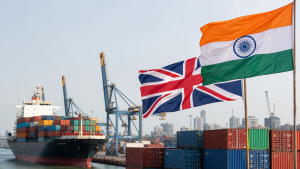
India and the United Kingdom share a wide economic partnership covering goods trade, services, investment and movement of skilled professionals. The relationship is supported by formal trade and social security arrangements aimed at reducing barriers and improving market access.
The CETA Framework and Tariff Structure
The bilateral trade architecture is anchored by the Comprehensive Economic and Trade Agreement (CETA). Signed on July 24, 2025, and agreed in principle on May 6, 2025, the agreement entered into force on July 15, 2026. It creates a reciprocal tariff-liberalisation framework between India and the UK.
- Wide tariff coverage: Under CETA, 99% of Indian goods entering the UK and 90% of UK goods entering India are either duty-free or subject to reduced tariffs.
- Immediate access for Indian exports: India secured immediate duty-free access for textiles, garments, leather, footwear, chemicals, pharmaceuticals, processed food and marine products.
- Steel exports: The agreement grants duty-free access for 85% of Indian steel exports.
- UK export interests: The UK obtained improved market access in India for whisky, automotive products, cosmetics and medical devices.
- Protected Indian sectors: India kept tariff protection for sensitive agricultural and dairy sectors. Dairy products, cereals, millets, edible oils, oilseeds and apples were excluded from tariff concessions.
Double Contributions Convention and Services Mobility
The Double Contributions Convention (DCC) accompanies CETA and also entered into force on July 15, 2026. It is a reciprocal social security agreement designed to reduce compliance costs for cross-border professionals and firms.
- Dual contribution relief: Cross-border workers and employers are exempted from paying social security contributions in both countries for up to five years.
- Services coverage: CETA’s services package covers 137 sub-sectors of Indian export interest, including information technology, financial, professional and healthcare services.
- Mobility pathways: The agreement provides predictable entry rules for business visitors, investors and contractual professionals.
- Special professional quota: A quota of up to 1,800 Indian chefs, yoga instructors and classical musicians is available for entry into the UK under simplified criteria.
Projected Economic Outcomes
The agreement is expected to expand bilateral trade and add to the long-term economic output of both countries. The key projections are as follows:
| Economic indicator | Value/target |
| Annual bilateral trade growth | £25.5 billion |
| UK GDP expansion | £4.8 billion |
| Indian GDP expansion | £5.1 billion |
| Total bilateral trade target | USD 100 billion by 2030 |
Institutional Leadership and Implementation
Implementation of the trade and investment framework involves political leadership and institutional mechanisms in both countries. These mechanisms are meant to monitor compliance, handle technical barriers to trade and manage sanitary and phytosanitary (SPS) measures.
- UK leadership: Prime Minister Andy Burnham assumed office on July 20, 2026, after the resignation of Keir Starmer.
- UK trade ministry: Jonathan Reynolds MP serves as UK Secretary of State for Business, Innovation, Science and Trade.
- Indian leadership: Piyush Goyal, Union Minister of Commerce and Industry, and Rajesh Agrawal, Commerce Secretary, lead the Indian side.
- Bilateral machinery: Joint institutions under CETA oversee implementation and address trade frictions.
Key Prelims Takeaways
- Official name: The India-UK Free Trade Agreement is officially titled the Comprehensive Economic and Trade Agreement (CETA).
- Entry into force: CETA and the Double Contributions Convention (DCC) came into force on July 15, 2026.
- Tariff coverage: CETA eliminates or reduces tariffs on 99% of Indian goods entering the UK and 90% of UK goods entering India.
- Steel access: India got immediate duty-free access for 85% of its steel exports to the UK.
- Protected items: Indian tariff concessions do not cover dairy products, cereals, millets, oilseeds, edible oils and apples.
- Social security relief: The DCC provides a five-year exemption from dual social security contributions for cross-border workers.
- Special quota: Up to 1,800 Indian chefs, yoga instructors and classical musicians can enter the UK under a special quota.
| Related | |
|---|---|