National Health and Emergency Trauma-Care Programmes
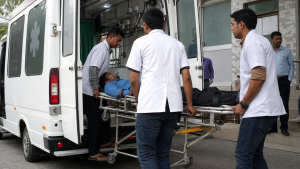
India’s emergency trauma-care framework is designed to reduce preventable deaths during the Golden Hour after an accident or acute injury. It combines constitutional safeguards, court directions, national schemes, highway-based trauma facilities and statutory protection for those who help accident victims.
Constitutional and Judicial Mandate for Trauma Care
The Supreme Court, in SaveLIFE Foundation & Anr. vs Union of India & Ors. (May 26, 2026), declared timely access to trauma care a fundamental right under Article 21 of the Constitution. The Court held that the State has a positive obligation to maintain an integrated trauma-care chain from the site of injury to final hospital treatment.
- Integrated emergency response: States and Union Territories were directed to merge existing helpline numbers such as 100, 101, 102, 108, 1033 and 1091 into the single emergency number 112.
- Ambulance standards: All registered ambulances were required to comply with the National Ambulance Code (AIS-125) and carry GPS or vehicle-location tracking devices.
- System integration: Ambulances are to be linked with the 112 response system for faster dispatch and coordination.
- Trauma registry: The Union Ministry of Health and Family Welfare (MoHFW) was asked to issue guidelines for a national trauma registry format.
- State readiness: States were directed to establish functional State Trauma Registries within four months.
National Trauma Infrastructure and NPPMT&BI
The National Programme for Prevention and Management of Trauma and Burn Injuries (NPPMT&BI) is a Centrally Sponsored Scheme under the MoHFW. It supports the development of trauma-care facilities along major transport routes and aims to strengthen emergency response where accident risk is high.
- Trauma care facilities: The programme has supported the creation of 196 designated Trauma Care Facilities.
- Facility levels: These are classified as Level I, Level II and Level III centres.
- Highway focus: The framework prioritises trauma-care centres every 100 kilometres along National Highways.
- Golden Hour objective: The planning is meant to improve treatment within the first 60 minutes after injury, when rapid care is most likely to save lives.
The “Golden Hour” refers to the first 60 minutes after a traumatic injury, when prompt medical intervention can significantly reduce mortality.
Emergency Care Upgrades and Budgetary Outlays
Under Para 88 of the Union Budget 2026–27, the government proposed Emergency & Trauma Care Centres to expand emergency and trauma capacity in district hospitals by 50%. A gap analysis against the Indian Public Health Standards (IPHS) identified district hospitals for phased strengthening.
- Hospitals identified: 613 district hospitals were selected for phased upgrades across the country.
- Phase I: 160 hospitals are targeted for completion by March 2027.
- Phase II: 203 hospitals are covered under the next phase.
- Phase III: The remaining 250 hospitals will be taken up in the final phase.
- Specialised committees: Three committees were set up to handle infrastructure, drugs, diagnostics and quality; human resources, academic expansion and skilling; and digital systems with pre-hospital care.
- Workforce expansion: The five-year health roadmap includes training 1.5 lakh multi-skilled caregivers and adding 1 lakh allied health professionals across 10 disciplines.
Legislative Framework and Victim Protection
The legal framework also protects people who help road accident victims. Section 134A of the Motor Vehicles Act, 1988, inserted through the 2019 amendment, provides statutory protection to Good Samaritans.
- Good Samaritan protection: A bystander or helper is not liable for civil or criminal action for injury or death caused due to negligence while providing emergency assistance.
- Hit-and-run compensation: Under the Motor Vehicles (Amendment) Act, 2019, the Solatium Scheme provides compensation of ₹2,00,000 for death and ₹50,000 for severe bodily injury.
Key Prelims Takeaways
- Article 21: Timely access to emergency trauma care is treated as a fundamental right.
- Single helpline: The national emergency number 112 integrates multiple emergency and ambulance numbers.
- Ambulance code: The National Ambulance Code is AIS-125.
- NPPMT&BI: A Centrally Sponsored Scheme under the MoHFW for trauma and burn care.
- Trauma corridor planning: Trauma centres are to be developed at 100-km intervals on National Highways.
- Good Samaritan law: Section 134A protects helpers from liability while assisting accident victims.
- Hit-and-run relief: The Solatium Scheme provides ₹2,00,000 for death and ₹50,000 for severe injury.
| Related | |
|---|---|