India’s Biofuel Policy and Ethanol Blending Programme
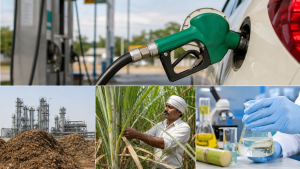
India’s biofuel policy provides the framework for shifting transport energy away from fossil fuels toward cleaner domestic alternatives. The Ethanol Blended Petrol Programme remains the centrepiece of this transition, with wider goals of reducing crude oil imports, cutting emissions, and supporting farm-based feedstocks.
Policy Framework and Ethanol Targets
- biofuels/">National Policy on Biofuels, 2018: The policy, amended in June 2022, is administered by the Ministry of Petroleum and Natural Gas.
- Inter-ministerial coordination: The National Biofuel Coordination Committee (NBCC) handles overall coordination, implementation, and allocation of domestic feedstock for biofuel production.
- E20 target: The June 2022 amendment advanced the target of 20% ethanol blending in petrol from 2030 to the Ethanol Supply Year (ESY) 2025–26.
- National rollout: India met the 20% blending target ahead of schedule, making E20 petrol the nationwide pump standard between November 2025 and June 2026.
Economic and Environmental Gains
- Foreign exchange savings: From the launch of the Ethanol Blended Petrol (EBP) Programme in 2014–15 to mid-2026, India saved over ₹1.97 lakh crore in foreign exchange through lower crude oil imports.
- Crude substitution: The programme replaced about 316 lakh tonnes of crude oil during this period.
- Emission reduction: It also reduced carbon dioxide emissions by an estimated 952 lakh tonnes.
- Farmer payments: Direct payments to agricultural communities and sugarcane farmers crossed ₹1.66 lakh crore, creating an additional income stream for rural producers.
- Production capacity: Domestic ethanol production capacity expanded from 421 crore litres in 2014 to about 2,000 crore litres in 2026.
Feedstock Management and Biodiesel Constraints
- FCI rice allocation: The government approved 52 lakh metric tonnes (LMT) of surplus Food Corporation of India rice for ethanol production across ESY 2024–25 and ESY 2025–26, with validity up to June 30, 2026.
- E30 standard: In May 2026, the Bureau of Indian Standards notified the fuel-quality standard for E30 under IS 19850:2026.
- Transition window: The E30 standard has been introduced to prepare the refining sector for a transition expected between 2028 and 2030.
- Biodiesel target: The National Policy on Biofuels sets a 5% biodiesel blending target in diesel by 2030.
- Current bottleneck: Actual biodiesel blending remains around 0.6% in 2025–26 because of feedstock shortages and logistical difficulties in securing non-edible oilseeds.
Sustainable Aviation Fuel and Compressed Bio-Gas
- ATF regulation: On April 17, 2026, the government amended the Aviation Turbine Fuel (Regulation of Marketing) Order, 2001 to bring ATF blended with Sustainable Aviation Fuel (SAF) under direct regulation.
- SAF policy: The Ministry of Civil Aviation is finalising a draft SAF policy to support domestic production facilities, feedstock supply chains, and a national SAF Registry.
- CORSIA alignment: India has set an indicative SAF blending target for international flights at 1% from January 2027, rising to 2% in 2028 and 5% by 2030.
- SATAT initiative: Under the Sustainable Alternative Towards Affordable Transportation (SATAT) initiative, India has 210 operational Compressed Bio-Gas (CBG) plants and 334 more under construction.
- CBG blending mandate: Commercial use of CBG is supported by a phased blending obligation that is expected to reach 5% by FY 2028–29.
Key Prelims Takeaways
- Policy authority: The Ministry of Petroleum and Natural Gas implements the biofuel policy, while the NBCC oversees feedstock distribution and coordination.
- E20 milestone: India achieved the 20% ethanol blending target ahead of the original 2030 schedule.
- E30 preparedness: IS 19850:2026 is the key BIS standard for the upcoming E30 fuel transition.
- Economic impact: The EBP Programme has delivered large foreign exchange savings and substantial gains for farmers.
- Biodiesel gap: Despite a 5% target by 2030, biodiesel blending remains far below target because of feedstock constraints.
- SAF regulation: The amended ATF Order, 2001 provides the regulatory basis for SAF blending in aviation fuel.
- CBG expansion: SATAT is the main framework for scaling up CBG production and blending in transport fuel.
Current General Studies comprises current-affairs-based, General Studies-rich study material on policies, laws, institutions, economy, science, environment, governance, international relations, and other varied but important topics for UPSC and State PSC Prelims examinations.
Fortnightly PDF compilations: Available here
Originally written on
February 14, 2026
and last modified on
September 4, 2026.
| Related | |
|---|---|