Indigenisation and Make-in-India Initiatives in Defence
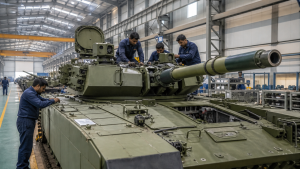
India’s defence indigenisation drive aims to reduce import dependence and build a strong domestic industrial base for military modernisation. The push combines procurement reform, import restrictions on selected items, and greater participation by public and private manufacturers.
Policy Framework for Defence Indigenisation
- Defence Acquisition Procedure (DAP) 2020: It governs capital procurement for the Indian Armed Forces and gives preference to categories such as Buy (Indian-IDDM) and Buy (Indian).
- Buy (Indian-IDDM): This category supports indigenously designed, developed and manufactured equipment, giving priority to domestic design capability.
- Positive Indigenisation Lists (PILs): These lists prohibit the import of identified systems, subsystems, assemblies and raw materials after specified timelines.
- Domestic manufacturing rights: PILs provide assured opportunities for Indian firms, including private companies and Public Sector Undertakings, to develop key military equipment.
- Offset reforms: The revised offset guidelines under DAP encourage foreign Original Equipment Manufacturers to set up manufacturing facilities in India instead of supplying low-value components.
Budgetary Allocations and Domestic Priorities
- Total defence allocation: The Union Budget FY 2026–27 provided ₹7.85 lakh crore to the Ministry of Defence, a 15.19% increase over the previous year’s budget estimates.
- Share in Central Government expenditure: Defence accounts for 14.67% of the total expenditure of the Central Government, underlining its priority in public spending.
- Capital expenditure: ₹2.19 lakh crore has been earmarked for capital outlay, which is 27.95% of the total defence budget.
- Domestic procurement reserve: ₹1.39 lakh crore has been set aside specifically for procurement from domestic defence industries.
- Policy significance: This earmarking creates assured demand for Indian manufacturers and supports long-term industrial capacity building.
Industrial Output and Digital Interventions
- SRIJAN Defence Portal: Launched in August 2020, it works as a digital repository where Defence Public Sector Undertakings upload imported items for local development.
- Item catalogue: By June 2026, the portal had catalogued more than 33,000 defence items for indigenisation.
- Import substitution: Over the five-year period ending in August 2026, domestic efforts replaced imports for more than 15,700 items, generating an import substitution value of about ₹9,000 crore.
- Production growth: Domestic defence production reached ₹1.78 lakh crore in FY 2025–26, showing steady expansion in the manufacturing base.
- Sectoral share: Public sector units accounted for 76% of domestic production, while private companies contributed 24%.
- Export performance: Defence exports rose to ₹38,424 crore in FY 2025–26, with exports reaching over 80 countries.
- Export composition: DPSUs accounted for 54.84% of export value, while the private sector, MSMEs and startups together contributed 45.16%.
Procurement Approvals and Recent Examples
- DAC clearance of July 3, 2026: The Defence Acquisition Council cleared Acceptance of Necessity proposals worth ₹52,000 crore.
- Systems covered: The approvals included systems such as Akash Tarang and jet-based Kamikaze drones.
- February 12, 2026 approval: The DAC cleared the procurement of 114 Rafale multi-role fighter jets.
- Domestic manufacturing angle: A majority of these advanced platforms were planned for domestic assembly and manufacture, reflecting the localisation push.
- Strategic relevance: Such approvals show that procurement is being aligned with industrial development, not just operational needs.
| Defence Parameter (FY 2025–26) | Value / Metric | Key Structural Details |
| Annual Domestic Production | ₹1.78 lakh crore | 15.6% annual growth; DPSUs/PSUs (76%), private sector (24%) |
| Annual Defence Exports | ₹38,424 crore | 62.66% annual increase; reaching over 80 countries |
| Export Sector Participation | Shares | DPSUs (54.84%), private sector/MSMEs/startups (45.16%) |
Key Prelims Takeaways
- DAP 2020: The core procurement framework for capital acquisitions in the defence sector.
- Buy (Indian-IDDM): The most preferred category for indigenous design and manufacture.
- Positive Indigenisation Lists: Used to phase out imports of selected defence items.
- FY 2026–27 defence budget: ₹7.85 lakh crore, with ₹2.19 lakh crore for capital expenditure.
- Domestic procurement reserve: ₹1.39 lakh crore earmarked for purchases from Indian industry.
- SRIJAN Portal: More than 33,000 items catalogued for local development of import alternatives.
- Production and exports: Domestic production reached ₹1.78 lakh crore, while exports touched ₹38,424 crore in FY 2025–26.
Current General Studies comprises current-affairs-based, General Studies-rich study material on policies, laws, institutions, economy, science, environment, governance, international relations, and other varied but important topics for UPSC and State PSC Prelims examinations.
Fortnightly PDF compilations: Available here
Originally written on
March 18, 2026
and last modified on
September 5, 2026.
| Related | |
|---|---|