India’s Uranium Resources and Nuclear Fuel Policy
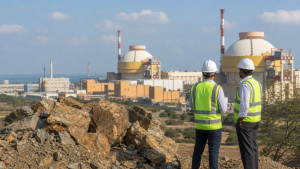
India’s nuclear fuel policy rests on a mix of domestic uranium exploration, long-term import contracts, and strict safety regulation. The aim is to secure fuel for civilian reactors while preserving the country’s closed nuclear fuel cycle and proliferation safeguards.
Legislative Framework
- SHANTI Act, 2025: The Sustainable Harnessing and Advancement of Nuclear Energy for Transforming India (SHANTI) Act, 2025, came into effect on December 21, 2025, replacing the Atomic Energy Act, 1962, and the Civil Liability for Nuclear Damage Act, 2010.
- Private participation: The Act permits private enterprises and public-private joint ventures to construct, own and operate nuclear reactors, and to engage in fuel fabrication.
- State control over sensitive activities: Uranium enrichment and reprocessing of spent fuel remain under exclusive state control because of proliferation risks.
- Draft rules: The Department of Atomic Energy (DAE) framed draft Rules and Regulations under the new law, with public consultation concluding on September 4, 2026.
Institutional Oversight
- Department of Atomic Energy and Atomic Energy Commission: Dr. Ajit Kumar Mohanty heads the DAE as Secretary and serves as ex-officio Chairman of the Atomic Energy Commission (AEC) under a one-year extension from April 11, 2026.
- Atomic Energy Regulatory Board (AERB): The AERB regulates nuclear safety, security and compliance across facilities. Shri A. K. Balasubrahmanian took over as Chairman on January 1, 2026.
- Uranium Corporation of India Limited (UCIL): UCIL is the public sector enterprise responsible for domestic uranium mining and processing. Dr. Kacham Anand Rao became Chairman and Managing Director on September 1, 2025.
- Technical leadership: Shri Anuttam Mishra holds additional charge as Director (Technical) at UCIL, along with his role as Director (Technical) of IREL (India) Limited, from March 27, 2026.
Domestic Uranium Resources and Exploration
- Nodal agency: The Atomic Minerals Directorate for Exploration and Research (AMDER) identifies and evaluates domestic uranium and thorium deposits.
- Important resource areas: Major uranium-bearing regions include Jaduguda in Jharkhand and Tummalapalle in Andhra Pradesh.
- Budget concern: A parliamentary standing committee in 2026 flagged a capital shortfall of ₹118.18 crore for AMDER and recommended restoring the amount at the revised estimate stage for 2026–27.
- Overseas assets: State-run NTPC is pursuing a draft memorandum of understanding with UCIL for joint due diligence to acquire overseas uranium mining assets.
Fuel Imports, Safeguards and Global Agreements
- Imported uranium: Between 2008–09 and 2024–25, India imported 18,842.60 metric tonnes of uranium under International Atomic Energy Agency (IAEA) safeguards for its civilian reactor fleet.
- Safeguarded reactors: As of April 2026, 16 civilian reactors with a combined capacity of 6,380 MW were under IAEA safeguards and ran entirely on imported uranium.
- Unsafeguarded reactors: Reactors outside safeguards depend mainly on domestic uranium supplies.
- Australia arrangement: In July 2026, India and Australia signed an Administrative Arrangement to operationalise their 2014 civil nuclear cooperation agreement and pave the way for commercial uranium supplies.
- Uzbekistan supply deal: In late August 2026, India and Uzbekistan advanced negotiations to extend their 2019 supply contract, under which Navoi Mining and Metallurgical Company was contracted to supply 1,100 metric tonnes of uranium through 2026.
Reactor Capacity and Three-Stage Programme
- Current capacity: India operates 24 nuclear power reactors with an installed capacity of 8.78 GW.
- Under construction: Nine additional units with 7.5 GW capacity are under construction.
- Long-term target: The Nuclear Energy Mission for Viksit Bharat sets an administrative target of 100 GW of nuclear power capacity by 2047.
- Prototype Fast Breeder Reactor: The indigenously designed 500 MWe Prototype Fast Breeder Reactor (PFBR) at Kalpakkam achieved first criticality on April 6, 2026.
- Three-stage programme: The PFBR marks the launch of the second stage of India’s three-stage nuclear power programme.
- Fuel cycle logic: This stage uses plutonium-239 and depleted uranium to breed more fissile material.
Important exam fact: India’s nuclear policy combines domestic mining, imported fuel under safeguards, and a closed fuel cycle with restricted control over enrichment and reprocessing.
Key Prelims Takeaways
- SHANTI Act, 2025: Replaced the Atomic Energy Act, 1962, and the Civil Liability for Nuclear Damage Act, 2010.
- Private participation: Allows private entities and public-private joint ventures to build, own and operate reactors and fabricate fuel.
- State monopoly retained: Enrichment and spent-fuel reprocessing remain under exclusive state control.
- Domestic uranium: AMDER is the nodal agency for uranium and thorium exploration; Jaduguda and Tummalapalle are key deposits.
- Imported fuel: India imported 18,842.60 metric tonnes of uranium between 2008–09 and 2024–25 under IAEA safeguards.
- Reactor profile: India has 24 operating reactors with 8.78 GW capacity, and 16 safeguarded reactors with 6,380 MW capacity.
- PFBR milestone: The 500 MWe PFBR at Kalpakkam achieved first criticality on April 6, 2026, advancing the second stage of the nuclear programme.
Current General Studies comprises current-affairs-based, General Studies-rich study material on policies, laws, institutions, economy, science, environment, governance, international relations, and other varied but important topics for UPSC and State PSC Prelims examinations.
Fortnightly PDF compilations: Available here
Originally written on
March 17, 2026
and last modified on
September 5, 2026.
| Related | |
|---|---|