Major National Skill Development Schemes and Missions
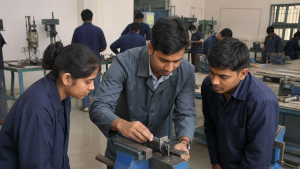
India’s skill development system is built to improve employability through training, apprenticeships, institutional upgradation and digital access. It is mainly driven by the Ministry of Skill Development and Entrepreneurship (MSDE) through flagship schemes for youth, artisans, industrial training institutes and apprentices.
Administrative and Budgetary Framework
The skill development portfolio is headed by Jayant Chaudhary, Minister of State (Independent Charge) for MSDE, with Debashree Mukherjee as Secretary. For FY 2026–27, the MSDE received a Budget Estimate of ₹9,540.50 crore, up from ₹5,749.90 crore in FY 2025–26. The increase is linked mainly to the funding needs of the new PM-SETU initiative.
PM-SETU Scheme: Modernizing ITIs
- Full form and approval: Pradhan Mantri Skilling and Employability Transformation through Upgraded ITIs (PM-SETU) was approved in May 2025, launched on October 4, 2025, and rolled out nationwide on July 7, 2026.
- Objective: The scheme aims to modernize 1,000 government ITIs through a hub-and-spoke model.
- Financial outlay: It is a Centrally Sponsored Scheme with a total outlay of ₹60,000 crore over five years.
- Cost sharing: The outlay includes ₹30,000 crore from the Centre, ₹20,000 crore from States and ₹10,000 crore from industry.
- Governance model: Upgraded ITIs are to be managed by industry-led Special Purpose Vehicles (SPVs) in Section 8 companies, with private industry partners holding a 51% stake.
- CSR angle: The scheme allows the private industry’s 17% financial share to be counted under Corporate Social Responsibility (CSR) obligations.
Pradhan Mantri Kaushal Vikas Yojana (PMKVY)
- Launch: PMKVY was launched in 2015.
- Coverage: The scheme has trained over 1.64 crore candidates.
- Placement record: The official dashboard in late August 2026 recorded a cumulative placement rate of 7%, with 200,224 placements out of 2.85 million registered trained candidates.
- PMKVY 4.0 outlay: The fourth phase has an allocation of ₹6,000 crore for FY 2022–23 to FY 2025–26.
- Skill focus: PMKVY 4.0 emphasises future-ready skills such as artificial intelligence (AI), cybersecurity, semiconductors and green energy.
PM Vishwakarma and SANKALP
- PM Vishwakarma launch: The scheme was launched on September 17, 2023.
- Outlay: It has a financial outlay of ₹13,000 crore for FY 2023–24 to FY 2027–28.
- Target group: The scheme supports traditional craftspeople across 18 specialized trades.
- Benefits: Beneficiaries receive formal skill certification, a ₹15,000 toolkit e-voucher and collateral-free business loans up to ₹3 lakh at a concessional interest rate of 5%.
- SANKALP full form: Skill Acquisition and Knowledge Awareness for Livelihood Promotion.
- SANKALP nature: It was a World Bank-supported decentralization scheme launched in 2018.
- Closure: The implementation phase of SANKALP concluded in March 2025.
- Audit finding: A Parliamentary Public Accounts Committee report in early 2026 noted that the scheme utilised only 44% of its allocated funds, citing slow field implementation and weak administrative monitoring.
Apprenticeship and Digital Public Infrastructure
- NAPS: The National Apprenticeship Promotion Scheme was initiated in 2016 and has engaged more than 56.08 lakh apprentices so far.
- NAPS-2 target: The second phase aims to register 46 lakh apprentices during FY 2022–23 to FY 2025–26.
- Stipend support: Under NAPS-2, the Central Government provides 100% funding for a partial stipend support of 25% of the minimum prescribed stipend, capped at ₹1,500 per month per apprentice.
- Purpose: The model is designed to reduce the wage burden on employers, especially smaller enterprises, while expanding apprenticeship uptake.
- Skill India Digital Hub (SIDH): SIDH serves as the main digital public infrastructure for skill development and has registered over 1.5 crore users.
Scheme Snapshot
| Scheme | Funding / Outlay | Target / Scale | Key Features |
| PM-SETU | ₹60,000 crore | 1,000 government ITIs | Hub-and-spoke model; industry-led SPVs in Section 8 companies |
| PMKVY 4.0 | ₹6,000 crore | National youth | Focus on AI, cybersecurity, semiconductors and green energy |
| PM Vishwakarma | ₹13,000 crore | 18 traditional trades | ₹15,000 toolkit e-voucher; loans up to ₹3 lakh |
| NAPS-2 | Central stipend support capped at ₹1,500/month | 46 lakh apprentices | 25% of minimum stipend covered through Central funds |
Key Prelims Takeaways
- PM-SETU: A Centrally Sponsored Scheme for upgrading 1,000 government ITIs with a total outlay of ₹60,000 crore.
- Cost-sharing: PM-SETU has a Centre-State-Industry funding structure, unlike fully central schemes.
- Industry role: PM-SETU uses industry-led SPVs in Section 8 companies with a 51% private stake.
- PMKVY 4.0: The scheme focuses on emerging technologies such as AI, cybersecurity, semiconductors and green energy.
- PM Vishwakarma: Supports traditional artisans through certification, a toolkit e-voucher and collateral-free loans.
- NAPS-2: Central support is limited to ₹1,500 per month per apprentice, covering 25% of the minimum stipend.
- SIDH: The Skill India Digital Hub is the main digital platform for skill development and has crossed 1.5 crore users.
Current General Studies comprises current-affairs-based, General Studies-rich study material on policies, laws, institutions, economy, science, environment, governance, international relations, and other varied but important topics for UPSC and State PSC Prelims examinations.
Fortnightly PDF compilations: Available here
Originally written on
March 17, 2026
and last modified on
September 5, 2026.
| Related | |
|---|---|