Major Railway Modernisation Schemes and Policies
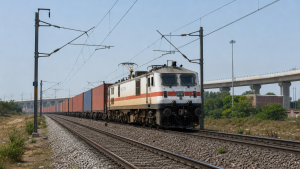
Indian Railways is moving through a major modernisation phase focused on faster freight movement, safer operations, cleaner traction and better passenger infrastructure. The reform push combines large-scale corridor projects, indigenous safety technology, electrification, station upgrades and policy changes aimed at improving efficiency across the network.
Dedicated Freight Corridors
- Eastern Dedicated Freight Corridor (EDFC): It spans 1,337 km from Ludhiana in Punjab to Sonnagar in Bihar and is fully operational. It is designed to move coal, steel and agricultural products faster and with lower interference from passenger traffic.
- Western Dedicated Freight Corridor (WDFC): It covers 1,506 km from Dadri in Uttar Pradesh to Jawaharlal Nehru Port Trust (JNPT) in Mumbai, Maharashtra. It was fully completed on March 31, 2026 after the trial run of freight trains on the final 102-km JNPT–New Saphale (Vaitarna) section.
- Operational impact: The Dedicated Freight Corridor network registered a peak of 903 daily train interchanges with the Indian Railways main network on August 30, 2026.
- Traffic distribution: Of these, 484 interchanges were on the EDFC and 419 on the WDFC.
Kavach Automatic Train Protection
- Kavach: This is an indigenously developed Automatic Train Protection system meant to prevent collisions, enforce speed limits and apply brakes automatically if the loco pilot does not respond to signals.
- Version 4.0: The updated version was commissioned on 2,633 route kilometres of the Indian Railways network as of July 2026.
- Working system: It uses stationary optical fibres, radio towers and GPS coordinates for real-time communication between locomotives, stations and trackside equipment.
- Exam relevance: Kavach is important as one of the key indigenous safety solutions being expanded across major rail routes.
Rolling Stock and Green Initiatives
- Electrification: Indian Railways achieved a broad-gauge electrification rate of 99.6% across its national network as of July 2026.
- Hydrogen Fuel Cell Trainset: In July 2026, India’s first indigenously developed hydrogen fuel cell trainset was launched on the Jind–Sonipat section in Haryana.
- Train composition: The trainset is a 10-coach passenger train designed to carry up to 2,600 passengers.
- Vande Bharat services: The active passenger fleet included 162 standard Vande Bharat trains and 2 Vande Bharat Sleeper services as of July 2026.
- Amrit Bharat trains: Indian Railways also had 72 Amrit Bharat passenger services for high-density routes.
- Significance: These rolling-stock additions reflect the push toward modern, energy-efficient and higher-capacity train services.
Station Redevelopment and High-Speed Rail
- Amrit Bharat Station Scheme: Redevelopment works were completed for 261 stations out of 1,340 identified railway stations as of July 18, 2026.
- Core focus: The scheme emphasizes master planning, improved circulation and better passenger amenities.
- Mumbai–Ahmedabad High-Speed Rail Corridor: As of May 2026, the project recorded 450 km of pier work and 354 km of viaduct construction.
- Other progress: The corridor also reported work on 17 river bridges and 4 mountain tunnels.
- Congestion relief: Indian Railways sanctioned a ₹272-crore project on September 1, 2026 to construct an 11-km dedicated freight bypass line between Adra and Joychandipahar in West Bengal.
Policy Reforms and the Reform Express
- Reform Express: The Ministry of Railways launched this initiative to implement 52 key structural and operational reforms in 52 weeks.
- Reform count: In July 2026, 8 new structural reforms were announced, taking the total implemented reforms to 17.
- Fly ash transport: Under the policy guidelines, transport of fly ash was shifted from open wagons to closed, ISO-standard containerized systems.
- Environmental aim: The new arrangement is intended to reduce dust pollution during transit.
Key Prelims Takeaways
- EDFC: 1,337 km; fully operational from Ludhiana to Sonnagar.
- WDFC: 1,506 km; fully completed on March 31, 2026 from Dadri to JNPT.
- Peak corridor movement: 903 daily train interchanges were recorded across both DFCs on August 30, 2026.
- Kavach 4.0: Commissioned on 2,633 route km as an indigenous ATP system.
- Electrification: Broad-gauge electrification reached 99.6% across the network as of July 2026.
- Hydrogen trainset: India’s first indigenous hydrogen fuel cell trainset was launched on the Jind–Sonipat section.
- Station scheme and MAHSR: 261 stations completed under the Amrit Bharat Station Scheme; MAHSR reported 450 km of pier work and 354 km of viaduct work.
Current General Studies comprises current-affairs-based, General Studies-rich study material on policies, laws, institutions, economy, science, environment, governance, international relations, and other varied but important topics for UPSC and State PSC Prelims examinations.
Fortnightly PDF compilations: Available here
Originally written on
March 1, 2026
and last modified on
September 5, 2026.
| Related | |
|---|---|