Major Tribal Development Schemes in India
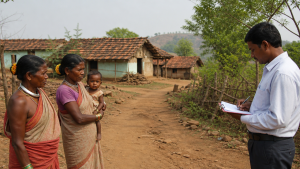
The Ministry of Tribal Affairs implements several major schemes to improve living standards in tribal areas, with a focus on roads, housing, education, livelihoods and basic services. These initiatives are especially important for Scheduled Tribes, Particularly Vulnerable Tribal Groups (PVTGs), De-notified Tribes and other marginalised tribal communities.
For Prelims, the most useful schemes to remember are DAJGUA, PM-JANMAN, EMRS, PMJVM and SEED. Each has a distinct target group and delivery mechanism, but all aim at reducing long-standing development gaps in tribal regions.
Dharti Aaba Janjatiya Gram Utkarsh Abhiyan (DAJGUA)
- Launch and duration: Launched on October 2, 2024, and implemented over five years from FY 2024–25 to 2028–29.
- Budget: Total outlay of ₹79,156 crore, with ₹56,333 crore from the Centre and ₹22,823 crore from States.
- Coverage: Aims to saturate infrastructure and welfare gaps in 63,843 tribal-majority villages across 549 districts and 2,911 blocks in 30 States and Union Territories.
- Beneficiary reach: Directly targets more than 5 crore tribal citizens.
- Implementation model: The scheme has 25 targeted interventions coordinated by 17 line ministries.
Pradhan Mantri Janjati Adivasi Nyaya Maha Abhiyan (PM-JANMAN)
- Target group: Focuses on 75 identified PVTG communities.
- Time period: Runs from FY 2023–24 to 2025–26.
- Objective: Ensures saturation of basic services such as housing, clean water, road connectivity and electricity.
- Budget: Total outlay of ₹24,104 crore, including ₹15,336 crore from the Centre and ₹8,768 crore from States.
- Housing progress: 4,73,939 pucca houses sanctioned and 2,50,374 completed out of a target of 4.90 lakh houses.
- Road connectivity: 7,316.62 km of roads sanctioned; 1,196 km completed against an 8,000 km target.
Eklavya Model Residential Schools (EMRS)
- Purpose: A central sector scheme for quality residential secondary education for Scheduled Tribe students, especially in remote tribal areas.
- Operational network: As of March 6, 2026, there were 499 operational EMRS campuses across the country.
- Student strength: These schools were enrolling 1,56,564 Scheduled Tribe students.
- Administrative change: The guidelines were revised on April 29, 2022, to merge Eklavya Model Day Boarding Schools (EMDBS) into the EMRS framework.
- Funding: The scheme receives a dedicated annual budgetary allocation.
Pradhan Mantri Janjatiya Vikas Mission (PMJVM)
- Objective: Promotes tribal livelihoods through value addition, enterprise creation and better market access.
- Period: Operates from FY 2021–22 to 2025–26.
- Scheme structure: Consolidates and merges earlier tribal livelihood schemes.
- Nodal agency: TRIFED functions as the nodal implementing agency.
- Key platform: Supports Van Dhan Vikas Kendras (VDVKs) for processing and marketing minor forest produce.
- Coverage: As of August 2026, 4,172 VDVKs had been sanctioned, supporting about 12.48 lakh tribal individuals.
Scheme for Economic Empowerment of DNTs (SEED)
- Target group: De-notified, Nomadic and Semi-Nomadic Tribes.
- Focus areas: Education, health and livelihood support for historically marginalised communities.
- Education support: During FY 2025–26, ₹26.75 crore was disbursed for the education of 4,485 DNT students.
- Health coverage: 73,569 Ayushman Bharat health insurance cards were issued to eligible DNT families.
Important Institutional and Constitutional Points
- TRIFED: Established in 1987 and placed under the Ministry of Tribal Affairs to organise retail marketing of tribal products.
- Article 275(1): Provides financial support from the Consolidated Fund of India for tribal welfare and related state plans.
- Fifth Schedule: Applies to tribal areas in states other than Assam, Meghalaya, Tripura and Mizoram.
- Sixth Schedule: Applies specifically to tribal areas in Assam, Meghalaya, Tripura and Mizoram.
- National Commission for Scheduled Tribes: Created by the 89th Constitutional Amendment Act, 2003, under Article 338A.
Key Prelims Takeaways
- DAJGUA village norm: A selected village must have at least 500 people and a minimum 50% Scheduled Tribe population.
- PVTG criteria: Based on Dhebar Commission-era indicators such as pre-agricultural technology, low literacy, stagnant or declining population and subsistence economy.
- DAJGUA coverage: 63,843 tribal-majority villages across 30 States and Union Territories.
- PM-JANMAN target: 75 PVTG communities with a focus on basic services saturation.
- EMRS role: Provides residential schooling for ST students in remote areas.
- PMJVM nodal agency: TRIFED supports tribal livelihoods through VDVKs and minor forest produce processing.
- SEED beneficiaries: Focuses on DNT, Nomadic and Semi-Nomadic communities through education, health and livelihood support.
Current General Studies comprises current-affairs-based, General Studies-rich study material on policies, laws, institutions, economy, science, environment, governance, international relations, and other varied but important topics for UPSC and State PSC Prelims examinations.
Fortnightly PDF compilations: Available here
Originally written on
January 14, 2026
and last modified on
September 4, 2026.
| Related | |
|---|---|