Major Indian Cultural Capitals and Learning Centres
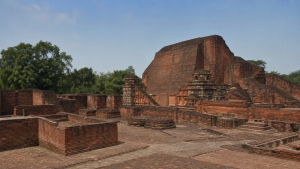
India’s intellectual history was shaped by ancient universities, temple academies, and cities that nurtured philosophy, music, literature, and scholarship. These centres became lasting symbols of India’s role in the development of education and culture across Asia.
Historical Seats of Learning and Ancient Universities
The Indian subcontinent hosted some of the earliest residential universities and monastic academies in history. They combined teaching, debate, and research with religious and philosophical study.
- Ancient Nalanda University: Founded in 427 CE by Gupta Emperor Kumaragupta, Nalanda was among the world’s earliest residential universities. It attracted scholars from across Asia before its destruction in 1193 CE.
- Vikramshila University: Established by Pala King Dharmapala in ancient Bihar, it became a major centre of Vajrayana Buddhist scholarship and monastic training, with close links to Tibet.
- Sharda Peeth: Located historically in Kashmir near the Kishenganga River, this ancient temple university was a major centre of Sanskrit learning and the developmental birthplace of the Sharda script.
- Santiniketan: Founded by Rabindranath Tagore in West Bengal as a residential school and centre of learning, it later evolved into Visva-Bharati University. It was inscribed as a UNESCO World Heritage Site in 2023.
- Modern Nalanda University: Established in Rajgir, Bihar, under the Nalanda University Act, 2010, this international institution operates with participation from India and 17 East Asia Summit (EAS) countries. Its 455-acre campus, inaugurated in June 2024, is designed as a net-zero green campus with solar energy, water treatment, and recycling systems.
Major Indian Cultural and Intellectual Capitals
Several cities became enduring centres of literary, artistic, spiritual, and scholarly traditions. Their influence extended far beyond their regions and helped shape modern Indian cultural identity.
- Kolkata: Known as the “Cultural Capital of India,” it was the centre of the 19th-century Bengal Renaissance and remains closely associated with literature, cinema, theatre, and art.
- Varanasi: A major spiritual centre in Uttar Pradesh, it has long been associated with Vedic learning, Sanskrit scholarship, and classical Hindustani music, especially the Benares Gharana.
- Pune: Often regarded as the cultural and academic capital of Maharashtra, Pune is important for Marathi heritage, theatre, and higher education.
- Gwalior: Located in Madhya Pradesh, it is a UNESCO City of Music and is renowned for the Gwalior Gharana and its classical music traditions.
Institutional Safeguards and Cultural Framework
To preserve and document India’s material and intangible heritage, the Ministry of Culture supports institutions and networks that map monuments, antiquities, and regional traditions.
- National Mission on Monuments and Antiquities (NMMA): Under the Ministry of Culture, it has documented 1.84 lakh monuments and heritage sites and catalogued 17.20 lakh antiquities across India as of March 2026.
- Zonal Cultural Centres (ZCCs): The Ministry of Culture runs seven ZCCs to preserve and cross-promote regional heritage.
- ZCC Headquarters: Patiala, Prayagraj, Kolkata, Chümoukedima (Nagaland), Thanjavur, Nagpur, and Udaipur.
- Purpose: These centres support cultural exchange, documentation, and the promotion of traditional arts, crafts, music, dance, and folklore.
Key Sites for Prelims Revision
- Nalanda: Founded by Gupta Emperor Kumaragupta in 427 CE; known as a major residential university.
- Vikramshila: Established by Pala King Dharmapala in Bihar; linked to Vajrayana Buddhist scholarship.
- Sharda Peeth: Ancient temple university in Kashmir; associated with Sanskrit learning and the Sharda script.
- Santiniketan: Founded by Rabindranath Tagore; later became Visva-Bharati University and a UNESCO World Heritage Site in 2023.
- Modern Nalanda University: Established under the Nalanda University Act, 2010; located in Rajgir with participation from 17 EAS countries.
- Gwalior: UNESCO City of Music; known for the Gwalior Gharana.
- Varanasi and Kolkata: Important cultural capitals associated with learning, literature, spirituality, and the arts.
Key Prelims Takeaways
- Ancient university tradition: Nalanda and Vikramshila represent India’s early residential and monastic learning systems.
- Temple academy: Sharda Peeth was an important centre of Sanskrit learning in Kashmir.
- Modern revival: Nalanda University in Rajgir was created under the Nalanda University Act, 2010.
- International structure: Modern Nalanda involves India and 17 East Asia Summit countries.
- Cultural capitals: Kolkata, Varanasi, Pune, and Gwalior are major centres of art, scholarship, and music.
- Heritage documentation: NMMA has documented 1.84 lakh monuments and 17.20 lakh antiquities as of March 2026.
- Zonal network: Seven ZCCs function from Patiala, Prayagraj, Kolkata, Chümoukedima, Thanjavur, Nagpur, and Udaipur.
| Related | |
|---|---|