India’s Child Protection Schemes and Laws
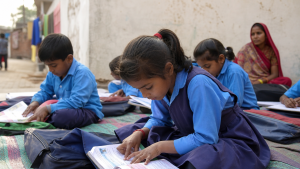
India’s child protection framework rests on constitutional safeguards, special laws, and targeted welfare schemes aimed at children in need of care, protection, or rescue. The Ministry of Women and Child Development (WCD) is the nodal ministry for coordinating these measures across the country.
Constitutional and Statutory Framework
- Article 15(3): Empowers the State to make special provisions for children.
- Article 21A: Guarantees free and compulsory education for children aged 6 to 14 years.
- Article 24: Prohibits the employment of children in hazardous occupations.
- Article 39(e) and (f): Direct the State to protect children from abuse, exploitation, and moral and material abandonment.
- National Commission for Protection of Child Rights (NCPCR): A statutory body established under the Commissions for Protection of Child Rights Act, 2005.
- NCPCR composition: The Commission consists of a Chairperson and six members, of whom at least two must be women.
- Juvenile Justice (Care and Protection of Children) Act, 2015: Provides the framework for children in conflict with law and children in need of care and protection.
- Juvenile Justice Boards (JJBs): Handle cases involving children in conflict with law.
- Child Welfare Committees (CWCs): Function in every district for children in need of care and protection.
Exam fact: The child protection framework is anchored in the Constitution, the Juvenile Justice law, and specialized bodies such as NCPCR, JJBs, and CWCs.
Mission Vatsalya: Flagship Child Welfare Scheme
- Mission Vatsalya: A centrally sponsored umbrella scheme for child protection and welfare, replacing the Integrated Child Protection Scheme (ICPS).
- Objective: Strengthen the child protection system, support vulnerable children, and improve rescue, rehabilitation, and reintegration services.
- Funding pattern: Shared in a 60:40 ratio between the Centre and States/UTs with legislatures; 90:10 for North-Eastern and Himalayan States; and 100% central funding for Union Territories without legislatures.
- Child sponsorship: Provides financial support of ₹4,000 per month for vulnerable children living in families with annual income below ₹1.5 lakh.
- After-care support: Offers ₹2,000 per month to youth aged 18 to 21 years transitioning out of Child Care Institutions.
- Mission Vatsalya Portal: Integrates the TrackChild Portal, Khoya-Paya Application, and GHAR (Go Home and Re-Unite) Portal for tracking and rehabilitation of missing or vulnerable children.
- Use in administration: Helps states and districts monitor case status, rescue efforts, and reunification outcomes.
CARA and Legal Adoption Regulations
- Legal framework: Adoption in India is governed by the Juvenile Justice (Care and Protection of Children) Act, 2015, as amended in 2021, and the Adoption Regulations, 2022.
- CARA: The Central Adoption Resource Authority is the statutory body regulating in-country and inter-country adoptions.
- International basis: CARA functions in line with the Hague Convention on Intercountry Adoption, 1993.
- Adoption orders: The 2021 amendment authorizes District Magistrates and Additional District Magistrates to issue adoption orders, reducing dependence on civil courts.
- CARINGS portal: Adoption procedures are managed through the Child Adoption Resource Information and Guidance System.
- Home Study Report: The process includes a 60-day window for completion of the Home Study Report.
- Referral period: Prospective parents get a 48–96-hour referral window.
- Post-adoption follow-up: A mandatory 2-year follow-up period is part of the procedure.
The POCSO Act and Child Protection Measures
- POCSO Act, 2012: The Protection of Children from Sexual Offences Act defines a child as any person below 18 years of age.
- Gender-neutral law: It provides a gender-neutral framework to deal with sexual offences against children.
- POCSO amendment, 2019: Introduced death penalty provisions for aggravated penetrative sexual assault.
- Special Courts: The Act mandates Special Courts for speedy trial of offences.
- Child-friendly procedure: Recording of statements must be done in a child-sensitive manner; police officers are not required to wear uniforms while recording such statements.
- Mandatory reporting: Failure to report child sexual abuse or child pornography is a punishable offence.
- Intermediary responsibility: Social media intermediaries are also covered under mandatory reporting obligations.
Key Prelims Takeaways
- Ministry of Women and Child Development: Smt. Annpurna Devi is the Union Cabinet Minister, Smt. Savitri Thakur is Minister of State, and Shri Anil Malik is the Secretary.
- NCPCR: A statutory body under the Commissions for Protection of Child Rights Act, 2005.
- Mission Vatsalya: The umbrella child protection scheme replacing ICPS.
- Adoption authority: CARA regulates both in-country and inter-country adoptions through the CARINGS portal.
- Adoption orders: Issued by District Magistrates and Additional District Magistrates after the 2021 amendment.
- POCSO: Covers all children below 18 years and requires mandatory reporting of offences.
- District institutions: JJBs and CWCs are central to juvenile justice and child care mechanisms.
Current General Studies comprises current-affairs-based, General Studies-rich study material on policies, laws, institutions, economy, science, environment, governance, international relations, and other varied but important topics for UPSC and State PSC Prelims examinations.
Fortnightly PDF compilations: Available here
Originally written on
March 7, 2026
and last modified on
September 5, 2026.
| Related | |
|---|---|