National Supercomputing Mission: Objectives, Milestones and Participating Institutes
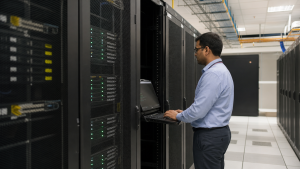
The National Supercomputing Mission (NSM) is India’s flagship programme to create a nationwide high-performance computing ecosystem. It supports advanced research, scientific simulations, academic work, startups and industry by connecting supercomputing facilities across the country.
Core mandate and governance
The National Supercomputing Mission was launched in April 2015 as a central sector scheme with an approved outlay of Rs 4,500 crore. It is jointly led by the Department of Science and Technology (DST) and the Ministry of Electronics and Information Technology (MeitY). The core implementing agencies are the Centre for Development of Advanced Computing (C-DAC), Pune, and the Indian Institute of Science (IISc), Bengaluru.
The mission’s main objective is to build a reliable, nationwide high-performance computing (HPC) grid. These supercomputers are networked through the National Knowledge Network (NKN) to provide access to academia, researchers, startups and MSMEs.
Three-phase strategy and indigenization
The NSM follows a phased roadmap to strengthen India’s self-reliance in supercomputing.
- Phase 1: Focused on domestic assembly of systems.
- Phase 2: Moved towards hardware manufacturing with 40% domestic value addition.
- Phase 3: Targets complete domestic design of supercomputing systems.
- Indigenization goal: India aims for near-complete indigenization of HPC systems by 2030, with local component content expected to exceed 70% by the end of the decade.
- Indian technologies: C-DAC has developed the Rudra server and the Trinetra high-speed interconnect system.
Capacity, utilisation and user impact
As of July 2026, the mission has deployed 39 systems with a cumulative capacity of more than 67 Petaflops (PF). Nine additional systems, adding over 55 PF, are under implementation to take the total to about 120 PF. A successor framework, NSM 2.0, is planned to move towards exascale computing for strategic autonomy.
The commissioned systems report an average utilisation rate of over 81%, with several running above 95%. The mission has supported more than 13,000 researchers, including around 1,700 PhD scholars, and has completed over one crore compute jobs.
Exam fact: NSM is a central sector scheme launched in April 2015 with an outlay of Rs 4,500 crore.
Exam fact: Supercomputers under the mission are linked through the National Knowledge Network (NKN).
Major supercomputing systems
The mission has established important systems across leading Indian institutions. A few major examples are given below.
| System | Location | Capacity | Key fact |
| PARAM Shivay | IIT (BHU) | 833 TF | First indigenously assembled system (2019) |
| PARAM Pravega | IISc Bengaluru | 3.3 PF | Large academic supercomputer (2022) |
| PARAM Siddhi-AI | C-DAC Pune | 6.5 PF | Premier AI supercomputer |
| PARAM Rudra | IUAC, GMRT, SNBNCBS | Custom | Built on C-DAC’s Rudra servers (2024) |
Human resource development
Along with infrastructure, the mission focuses on building a skilled workforce in high-performance computing and artificial intelligence. Dedicated training centres operate in Pune, Kharagpur, Chennai, Palakkad and Goa to train students and professionals.
- Skill building: Trains students and professionals in HPC and AI.
- Training centres: Located in Pune, Kharagpur, Chennai, Palakkad and Goa.
- Institutional support: Helps create a pool of experts to manage and use supercomputing systems effectively.
Key Prelims Takeaways
- Launch: April 2015 as a central sector scheme.
- Budget: Approved outlay of Rs 4,500 crore.
- Lead ministries: DST and MeitY.
- Implementing agencies: C-DAC, Pune, and IISc, Bengaluru.
- Network backbone: National Knowledge Network (NKN).
- Capacity status: 39 systems with more than 67 PF deployed by July 2026.
- Future plan: Nine more systems under implementation to take capacity to about 120 PF; NSM 2.0 is planned for exascale computing.
- Indigenous systems: PARAM Shivay, PARAM Pravega, PARAM Siddhi-AI and PARAM Rudra are key mission systems.
- Indigenization: Targets near-complete domestic design by 2030 and over 70% local content by the end of the decade.
- Indian technologies: Rudra server and Trinetra interconnect system.
- User reach: Supported over 13,000 researchers and completed more than one crore compute jobs.
| Related | |
|---|---|