India’s Disaster Management Architecture: Laws, Authorities and Agencies
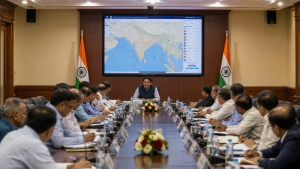
India’s disaster management system is built on a statutory and administrative framework that has evolved from relief-centric response to a more proactive model focused on mitigation, preparedness, response and recovery. The Disaster Management Act, 2005 provides the core legal foundation, while later amendments have refined institutional roles and planning responsibilities.
Legal Framework and the 2005 Act
- Disaster Management Act, 2005: It is the principal law governing disaster management in India and marked the shift from post-disaster relief to a structured approach centred on prevention, mitigation and preparedness.
- Legal basis of institutions: The Act provides for disaster management authorities at the national, state and district levels, along with response and training institutions.
- Disaster definition: The statutory definition covers natural and man-made events, but excludes matters related to law and order from “man-made causes”.
- Disaster database: The amendment framework legally defines a disaster database to include national and state-level data on risk assessments, fund allocations, expenditures and mitigation plans.
National Level Institutional Structure
- National Disaster Management Authority (NDMA): It is the apex statutory body for disaster management and is chaired ex-officio by the Prime Minister of India.
- Composition: The NDMA may have up to nine members nominated by the Prime Minister.
- Planning role: Under the amended framework, preparation of the national disaster management plan now lies directly with the NDMA.
- National Executive Committee (NEC): It assists the NDMA in the performance of its functions and is chaired by the Union Home Secretary.
- National Crisis Management Committee (NCMC): It serves as the nodal body for major disasters and has been given statutory recognition under the amendment framework.
- High-Level Committee (HLC): It oversees the allocation of financial assistance and has also been given statutory status.
State, District and Urban Architecture
- State Disaster Management Authorities (SDMAs): These are chaired by the respective Chief Ministers and are the apex disaster management bodies at the state level.
- State planning role: The amended law assigns responsibility for preparing state disaster management plans directly to the SDMAs.
- District Disaster Management Authority (DDMA): It is headed by the District Collector, Deputy Commissioner or District Magistrate as Chairperson.
- Local participation: Elected local representatives function as Co-Chairpersons in the district framework.
- Urban Disaster Management Authorities (UDMAs): The amendment introduced provision 41A, allowing state governments to constitute UDMAs in state capitals and cities with Municipal Corporations.
- Exclusions: Delhi and Chandigarh are excluded from the UDMA provision.
- State response forces: State governments have been empowered to legally constitute their own State Disaster Response Forces (SDRFs) and define their functions.
Specialised Response and Capacity Building Bodies
- National Disaster Response Force (NDRF): It is the specialised national response force for disaster situations.
- Strength and structure: The NDRF has 16 operational battalions with a sanctioned strength of 18,581 personnel.
- Role: It provides specialised search, rescue and response support during disasters.
- National Institute of Disaster Management (NIDM): It functions under the statutory framework of the Act for capacity building, training and policy research.
- Training and knowledge support: NIDM supports disaster management authorities through research, training modules and institutional capacity development.
Planning, Coordination and Policy Linkages
- Central coordination: The disaster management structure aims to ensure coordination between central, state and district authorities rather than relying only on emergency relief.
- Legal convergence: The 2025 amendment was intended to bring greater clarity and convergence in governance and planning.
- Digital records: The statutory disaster database is meant to improve monitoring of risks, fund use and mitigation efforts.
- Sendai Framework: India’s National Disaster Management Plan aligns domestic mitigation efforts with the international priorities of the Sendai Framework for Disaster Risk Reduction.
- Urban preparedness: The introduction of UDMAs reflects growing attention to disaster management in urban areas with high population density and infrastructure risk.
Key Prelims Takeaways
- Core law: The Disaster Management Act, 2005 is the main legal framework for disaster governance in India.
- Apex body: The NDMA is chaired ex-officio by the Prime Minister.
- Planning authority: National and state disaster management plans are now prepared directly by the NDMA and SDMAs.
- Urban provision: Provision 41A allows state governments to create UDMAs in state capitals and Municipal Corporation cities, excluding Delhi and Chandigarh.
- Definition clause: Law-and-order matters are excluded from the category of “man-made causes” under the disaster definition.
- Statutory recognition: The NCMC and HLC have been given statutory status under the amendment framework.
- Response capability: State governments can legally constitute their own SDRFs.
Current General Studies comprises current-affairs-based, General Studies-rich study material on policies, laws, institutions, economy, science, environment, governance, international relations, and other varied but important topics for UPSC and State PSC Prelims examinations.
Fortnightly PDF compilations: Available here
Originally written on
March 20, 2026
and last modified on
September 5, 2026.
| Related | |
|---|---|