Electronics and Mobile Manufacturing Schemes in India
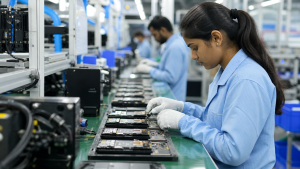
India’s electronics and mobile manufacturing push is built around incentives, clusters and semiconductor support to deepen domestic value addition. The policy focus is on phones, components, chip design and fabrication so that production can move further into the local supply chain.
From PLI-LSEM to MPMS
The Production Linked Incentive Scheme for Large Scale Electronics Manufacturing (PLI-LSEM), which helped scale up mobile phone manufacturing in India, concluded on March 31, 2026. To maintain momentum, the government introduced a new mobile manufacturing framework.
- Mobile Phone Manufacturing Scheme (MPMS): Notified by MeitY on August 21, 2026, after Union Cabinet approval on July 15, 2026.
- Outlay: ₹62,500 crore.
- Tenure: Five years, from FY 2026-27 to FY 2030-31.
- Base incentive: 2.25% to 5% on eligible incremental sales of manufactured goods.
Eligibility and Incentives under MPMS
The scheme has two target segments to support both large global manufacturers and Indian-owned brands.
- Target Segment 1: Large-scale manufacturers with minimum consolidated global turnover of ₹10,000 crore in the base year FY 2025-26.
- Target Segment 2: Indian-owned brands with minimum consolidated turnover of ₹1,000 crore in FY 2025-26.
- Design support: Under Target Segment 2, eligible firms get an additional 3% incentive on product design and R&D activities.
- Domestic sourcing support: Up to 1.5% incentive for key components to encourage localisation.
Semicon 2.0 and Semiconductor Ecosystem
To expand the semiconductor chain beyond assembly, the government notified Semicon 2.0 on August 31, 2026. The scheme builds on the India Semiconductor Mission and is intended to support design, fabrication and packaging.
- Outlay: ₹1,27,500 crore.
- Silicon wafer fabs: 40% fiscal support for projects with minimum investment of ₹20,000 crore.
- Compound and specialised fabs: 35% fiscal support for compound semiconductor fabs, display fabs, silicon photonics, sensor fabs and ATMP facilities.
- Design-led support: Financial assistance continues for domestic semiconductor chip design firms for product design and deployment.
Component Manufacturing and Infrastructure Support
India’s electronics strategy extends beyond final assembly to passive and active components, infrastructure and cluster development.
- Electronics Components Manufacturing Scheme (ECMS): The outlay was enhanced to ₹40,000 crore in Union Budget 2026-27 to support local manufacturing of components used in mobile phones and IT hardware.
- Modified Electronics Manufacturing Clusters (EMC 2.0): Supports infrastructure such as common facility centres and other plug-and-play assets.
- EMC 2.0 deadlines: Application window closed on March 31, 2024, while fund disbursements continue until March 31, 2028.
- Ranjangaon Greenfield EMC: The approved cluster near Pune, Maharashtra, had reached about 80% physical progress by March 2026.
Production, Exports and Market Shift
India’s electronics sector has seen rapid growth in output, exports and import substitution, especially in smartphones.
- Overall production: Electronic goods production reached approximately ₹13.11 lakh crore in FY 2025-26.
- Exports: Total electronic exports were about ₹4.24 lakh crore in FY 2025-26.
- Smartphones: Became India’s top exported individual commodity in FY 2025-26.
- Domestic demand: Domestically manufactured handsets accounted for about 99.2% of mobile phones used in India in 2026.
Key Prelims Takeaways
- MPMS outlay: ₹62,500 crore.
- MPMS tenure: FY 2026-27 to FY 2030-31.
- MPMS incentives: 2.25% to 5% on eligible incremental sales.
- Eligibility thresholds: ₹10,000 crore global turnover for Segment 1 and ₹1,000 crore turnover for Segment 2 in FY 2025-26.
- Extra support for Indian brands: 3% for design/R&D and up to 1.5% for domestic sourcing.
- Semicon 2.0 outlay: ₹1,27,500 crore, with 40% support for silicon wafer fabs and 35% for compound/display/packaging fabs.
- ECMS outlay: ₹40,000 crore under Union Budget 2026-27; EMC 2.0 fund disbursements continue till March 31, 2028.
| Related | |
|---|---|