Major Sericulture and Silk Industry Schemes
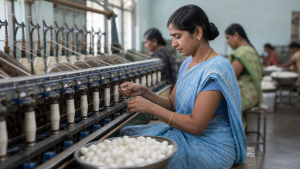
India has a strong and diversified sericulture base, supported by statutory institutions, central sector schemes and state-led livelihood initiatives. It is the second-largest producer of silk in the world and the only country that commercially produces all five major silk varieties.
The sector matters for both rural employment and textile value addition, with policy focus on improved technology, seed systems, market support and skill development. Recent schemes have also aimed at expanding direct benefits to farmers, reelers and women-led household enterprises.
Institutional Framework and Industry Profile
- Central Silk Board (CSB): A statutory body under the Ministry of Textiles, established under the Central Silk Board Act, 1948 and amended in 2006. Its headquarters is in Bengaluru, Karnataka.
- Production and employment: India’s raw silk production reached 34,042 metric tonnes (MT) as of January 2025. The sector provides employment to an estimated 80.90 lakh people.
- Commercial varieties: India produces five commercial silk varieties: Mulberry, Tropical Tasar, Oak Tasar, Eri and Muga.
- Muga silk: This silk is unique to India, with its geographical indication mainly associated with Assam.
Silk Samagra-2: Flagship Central Scheme
- Scheme and duration: Silk Samagra-2, officially the Integrated Scheme for Development of Silk Industry, is a central sector scheme approved for FY 2021-22 to FY 2025-26.
- Financial outlay: The total approved outlay is ₹4,679.85 crore.
- Fund release: From FY 2021-22 to January 2026, the central government allocated ₹4,424.90 crore and released ₹4,390.68 crore under the scheme.
- Direct state transfer: Of the released amount, ₹1,374.44 crore was distributed directly to state governments for beneficiary-oriented components.
- Beneficiaries: From FY 2021-22 to February 2026, the scheme supported 1,12,385 beneficiaries, including 65,566 sericulture farmers and 6,141 reeling and re-reeling units.
Core Components
- Research and capacity building: Research and development, training, transfer of technology and IT initiatives.
- Seed organisations: Strengthening quality seed production and related institutional support.
- Market support: Coordination and market development for silk products and value chains.
- Quality and exports: Quality certification systems, export support, brand promotion and technology upgradation.
National Technology and Skill Initiatives
- Mera Resham Mera Abhimaan 2.0 (MRMA 2.0): A 100-day National Technology Transfer Campaign formulated by the CSB.
- Campaign period: Implemented from June 22 to September 30, 2026.
- Coverage: Targeted about 218 sericulture districts across 27 practising states and union territories.
- Objective: To take improved rearing and reeling technologies directly to the field.
- Samarth scheme: The Ministry of Textiles extended the Scheme for Capacity Building in Textiles Sector through March 2026.
- Training target: With a budget of ₹495 crore, the scheme aims to train 3 lakh people, including upskilling and reskilling in traditional silk segments.
Targeted State-Level Interventions
- Uttar Pradesh’s Resham Sakhi Scheme: Jointly implemented by the State Rural Livelihood Mission and the state Silk Department.
- Women’s outreach: Targets connecting 50,000 rural women to silkworm rearing over five years.
- Initial phase: Aims to train 7,500 women across 15 districts by FY 2025-26.
- Mizoram Sericulture Mission: Focuses on promoting traditional Eri silk farming among tribal families.
- Financial support: Backed by a ₹46.79 crore allocation under central silk initiatives.
- Income expectation: Projects an annual household income of ₹20,000 to ₹40,000 per half-acre rearing unit.
Key Prelims Takeaways
- India’s position: India is the second-largest silk producer in the world.
- Unique production range: It is the only country that commercially produces all five major silk varieties.
- CSB: The Central Silk Board is a statutory body under the Ministry of Textiles, headquartered in Bengaluru.
- Major scheme: Silk Samagra-2 is the flagship central sector scheme for sericulture development.
- Scheme outlay: Silk Samagra-2 has an approved outlay of ₹4,679.85 crore for FY 2021-22 to FY 2025-26.
- Direct beneficiary support: ₹1,374.44 crore under Silk Samagra-2 was transferred to states for beneficiary-oriented components.
- Skill focus: Samarth supports capacity building in textiles, including silk-related training and reskilling.
Current General Studies comprises current-affairs-based, General Studies-rich study material on policies, laws, institutions, economy, science, environment, governance, international relations, and other varied but important topics for UPSC and State PSC Prelims examinations.
Fortnightly PDF compilations: Available here
Originally written on
March 20, 2026
and last modified on
September 5, 2026.
| Related | |
|---|---|