Important University-Industry Collaboration Models in India
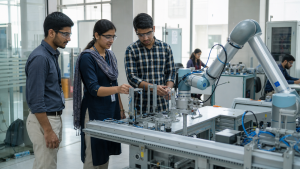
University-industry collaboration in India connects academic research with practical industrial needs through joint research, technology transfer, incubators, apprenticeships, and regional innovation networks. Policy support from NEP 2020 and UGC’s 2024 guidelines has made these partnerships more structured and outcome-oriented.
Structural Models of Collaboration
Co-location and Science Parks Model
This model places industrial research units within university campuses, enabling direct access to laboratories, faculty, and student talent.
- IIT Madras Research Park: Companies set up R&D centres on campus, encouraging regular interaction among students, researchers, and corporate engineers.
- Science and Technology Entrepreneurship Parks (STEPs): Administered by the Department of Science and Technology (DST), these parks provide land, infrastructure, and academic expertise for collaborative facilities.
Sponsored Research and Industrial Consultancy Model
In this model, industries fund specific research projects conducted by university faculty to solve immediate technical problems.
- Sponsored Research and Industrial Consultancy (SRIC) Cells: Institutions such as the IITs and IISc use dedicated cells to manage corporate-sponsored research and consultancy.
- Consortium Funding: Multiple corporations pool funds for basic research in areas such as artificial intelligence or green energy, usually in return for non-exclusive access to outcomes.
Technology Business Incubators (TBIs) and Startup Support
TBIs help university researchers and students commercialise academic ideas into market-ready products.
- Incubation Support: Universities provide space, mentorship, and legal assistance, while industries offer venture capital, market access, and commercialisation strategies.
- DST-TBI Scheme: The DST supports over 100 incubators across India, linking academic research to startup development.
Cluster-Based Regional Models
This model promotes regional economic development by bringing together educational institutions, MSMEs, and large industries.
- State-Level Clusters: The UGC encourages universities to form regional R&D clusters so that MSMEs can access university laboratories and expertise.
- SEZ Partnerships: Academic institutions establish specialised training centres near manufacturing or IT hubs to meet local employment needs.
Hub-and-Spoke Networks
This model links established research-intensive institutions with emerging universities to improve overall research capacity.
- ANRF PAIR Program: The Partnerships for Accelerated Innovation and Research (PAIR) program connects premier institutions such as IISc Bengaluru and IIT Bombay with state public universities to share resources, mentorship, and infrastructure.
Key Government Schemes and Initiatives
| Scheme Name | Nodal Agency | Primary Purpose |
| Uchchatar Avishkar Yojana (UAY) | Ministry of Education | Funds industry-sponsored research projects in IITs with joint funding from the ministry, partnering industry, and host institute. |
| Impacting Research Innovation and Technology (IMPRINT) | Ministry of Education & DST | Targets engineering and technology challenges with direct industry relevance. |
| Partnerships for Accelerated Innovation and Research (PAIR) | Anusandhan National Research Foundation (ANRF) | Uses a hub-and-spoke model to connect premier research institutions with state universities. |
| National Apprenticeship Training Scheme (NATS) | Ministry of Education | Provides on-the-job training and apprenticeships to students in collaboration with industries. |
| Patent Acquisition and Collaborative Research (PACE) | Ministry of Science and Technology | Facilitates technology transfer and collaborative development of laboratory-scale technologies into commercial products. |
UGC Guidelines on Sustainable and Vibrant University-Industry Linkage, 2024
The UGC approved new guidelines in 2024 to make university-industry relationships more sustainable and structured across higher educational institutions.
Industry Relations Cells (IRC)
- Every university must establish a dedicated Industry Relations Cell.
- The IRC acts as a single window for industries to submit research proposals, access laboratories, and hire apprentices.
- It coordinates with the University Relations Cells (URC) of corporate bodies.
Apprenticeship-Embedded Degree Programmes (AEDP)
- The UGC guidelines embed industrial competencies directly into the university curriculum.
- Up to 50% of total academic credits can be earned through skill-based, on-the-job training in a partnering industry.
- This model helps bridge the skill gap and improves employability.
Research and Development Clusters
- The guidelines mandate the creation of local and regional R&D clusters.
- These clusters pool resources between premier universities, state public universities, and MSMEs.
- They support joint patenting and shared use of expensive research infrastructure.
Noteworthy Industry-Academic Collaborations in India
IIT Madras and Ashok Leyland
- This partnership has supported the development of advanced electric vehicle (EV) technologies.
- Ashok Leyland works with the Centre for Battery Engineering and Electric Vehicles (CBEEV) at IIT Madras on battery management systems.
Galgotias University and Accenture LearnVantage
- This talent-development model was established in 2026.
- It integrates industry-led technological training into the undergraduate curriculum.
- The partnership prepares students in emerging areas such as artificial intelligence and data science.
IISc Bengaluru and Wipro
- This collaboration is centred on the Wipro IISc Research and Innovation Network (WIRIN).
- It focuses on deep-tech areas such as autonomous systems, artificial intelligence, and robotics.
- The model supports dual research projects in which Wipro engineers and IISc scientists co-create intellectual property.
Challenges and Structural Barriers
Cultural and Operational Mismatch
- Universities: Often prioritise publication and basic theoretical research.
- Industries: Focus on immediate market applications and shorter product cycles.
- This difference can slow contract negotiations and project execution.
Intellectual Property (IP) Disputes
- Ownership of patents and licensing rights remains a major friction point.
- Public universities often face rigid rules on patent sharing, which can discourage private investment.
Funding Constraints
- Private industry funding for academic research in India remains low compared to global standards.
- Most collaborative research still depends heavily on government-supported schemes.
Recent Context
India’s university-industry collaboration framework has recently gained momentum through UGC’s 2024 linkage guidelines and ANRF’s PAIR model. The focus is increasingly on research capacity, academic partnerships, and faster technology transfer.
Rare Facts for Prelims
STEPs were among the earliest institutional mechanisms in India to formally connect science parks with entrepreneurship support.
SRIC-type structures are especially important in IITs and IISc because they manage both consultancy and sponsored research under one administrative umbrella.
Under the hub-and-spoke approach, the main value is not only funding but also access to mentorship and shared research culture.
Apprenticeship-embedded degree models are designed to make industry exposure part of the credit structure, not just an optional internship.
Cluster-based collaboration is particularly useful for MSMEs, which usually cannot afford independent R&D infrastructure.
WIRIN is notable because it combines academic research with industry engineering in deep-tech fields rather than only in conventional product development.
| Related | |
|---|---|