Multilateral and Unilateral Sanctions under International Law
Economic sanctions are non-military tools used by states and international bodies to influence the conduct of target states, entities or individuals. They may take the form of trade embargoes, asset freezes, travel bans or export controls, and their legal basis differs sharply between multilateral and unilateral action.
Concept of Sanctions
In international affairs, sanctions are used to deter conflict, curb proliferation, press for human rights compliance and compel diplomatic concessions. Their legitimacy depends on who imposes them, under what authority, and whether they remain consistent with the UN Charter and general principles of international law.
- Trade embargoes: Restrict the flow of goods and services to the target.
- Financial sanctions: Freeze assets or block access to banking channels.
- Travel bans: Limit the movement of designated individuals.
- Export controls: Bar technology, dual-use items or sensitive equipment.
Multilateral Sanctions
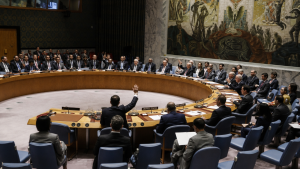
Multilateral sanctions are imposed by collective international bodies, chiefly the UN Security Council. Under Article 41 of Chapter VII of the UN Charter, the Security Council may decide measures not involving armed force to maintain or restore international peace and security. These decisions are binding on all UN member states under Article 25.
- Legal basis: Article 41, Chapter VII of the UN Charter.
- Binding effect: All UN member states are required to comply.
- Institutional legitimacy: Backed by collective security and international consensus.
- Enforcement: Implemented through domestic laws and regulations of member states.
- Veto risk: Subject to veto by any of the five permanent members of the Security Council.
Examples include UN sanctions against Southern Rhodesia in 1966, South Africa in 1977, and non-proliferation sanctions on North Korea under Resolution 1718 in 2006.
Unilateral Sanctions
Unilateral sanctions, also called autonomous sanctions, are imposed by one state or a regional bloc without explicit UN Security Council authorization. They are often used to pursue foreign policy goals, respond to national security threats, promote human rights or counter foreign aggression.
- Primary sanctions: Apply to the imposing state’s own citizens, firms and domestic transactions.
- Secondary sanctions: Extend pressure to third-country persons or entities dealing with the sanctioned target.
- Jurisdictional reach: Often enforced through domestic courts, regulators and financial penalties.
- Contested legitimacy: Frequently criticized by developing countries for lack of global consensus.
Important examples include US sanctions against Cuba under the Helms-Burton Act, 1996, the Countering America’s Adversaries Through Sanctions Act, 2017, and autonomous restrictive measures used by the European Union.
Multilateral vs Unilateral: Key Differences
| Dimension | Multilateral Sanctions | Unilateral Sanctions |
| Legal basis | Article 41, Chapter VII of the UN Charter | Domestic statutes or regional executive acts |
| Binding scope | Mandatory for all UN member states | Binding mainly within the sender state’s jurisdiction |
| Legitimacy | Higher institutional legitimacy | Often contested internationally |
| Enforcement | Through national implementation by member states | Through domestic regulatory and judicial mechanisms |
| Veto vulnerability | Yes, due to Security Council veto | No UN veto issue |
| Secondary sanctions | Rare, since all states are directly bound | Common, especially against third states or firms |
International Law Issues
Sanctions often raise legal concerns relating to sovereignty, non-intervention and extraterritorial jurisdiction. The UN Charter protects sovereign equality under Article 2(1), while the General Assembly’s Declaration on Friendly Relations (Resolution 2625) discourages coercive economic measures that undermine sovereign rights.
- Sovereignty: States cannot freely impose their foreign policy choices on others.
- Non-intervention: Economic coercion may violate the spirit of peaceful interstate relations.
- Extraterritoriality: Secondary sanctions may extend domestic law beyond territorial limits.
- Jurisdictional friction: Third states often object when their firms are targeted indirectly.
To counter extraterritorial sanctions such as the US Helms-Burton framework, the European Union adopted Blocking Regulation 2271/96, which prohibits EU entities from complying with certain non-EU secondary sanctions.
Humanitarian Concerns and Countermeasures
Comprehensive sanctions or blockades may affect civilian access to food, medicine, water and essential services. Because of such concerns, the UN General Assembly has repeatedly called for the elimination of unilateral economic measures that adversely affect civilian life and development.
UN Security Council Resolution 2664, adopted in December 2022, created a universal humanitarian carve-out across UN sanctions regimes.
- Human rights impact: Sanctions may affect the right to life, health and clean water.
- Humanitarian exemption: Resolution 2664 provides a general carve-out for humanitarian activity.
- Targeted sanctions: Magnitsky-style measures focus on officials rather than entire populations.
- Counter-terrorism: Freezing accounts and monitoring transactions can disrupt militant financing.
Under the International Law Commission Draft Articles on Responsibility of States for Internationally Wrongful Acts, 2001, injured states may take only temporary countermeasures. These must be proportionate, non-punitive and aimed at securing compliance with international obligations.
Key Prelims Takeaways
- Article 41, Chapter VII: The main UN Charter basis for non-military sanctions.
- Article 25: Makes Security Council decisions binding on all UN members.
- Multilateral sanctions: Derived from collective security and carry higher legitimacy.
- Unilateral sanctions: Imposed by one state or bloc without UN authorisation.
- Secondary sanctions: Pressure third-country firms to stop dealing with the target.
- Blocking Regulation 2271/96: EU measure against extraterritorial sanctions.
- Resolution 2664 (2022): Introduced a humanitarian exemption in UN sanctions regimes.
| Related | |
|---|---|