Digital India: Key Schemes, Objectives and Milestones
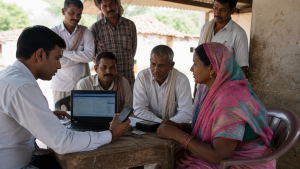
The Digital India programme is a flagship umbrella initiative that seeks to transform governance, service delivery, and public access to information through digital technologies. It was launched on July 1, 2015, by the Ministry of Electronics and Information Technology.
The initiative combines existing e-governance projects with new technology platforms to build digital public infrastructure, expand internet access, and promote digital literacy. Its aim is a digitally empowered society and a knowledge economy with fewer physical touchpoints and less paperwork.
Core Vision Areas
- Digital Infrastructure as a Core Utility to Every Citizen: High-speed internet connectivity, unique digital identity, secure cyberspace, and digital linkages for payments and public services.
- Governance and Services on Demand: Single-window portals, cloud-based records, digital payments, and online applications for faster service delivery.
- Digital Empowerment of Citizens: Digital literacy, regional-language access, open data, and secure digital storage of personal documents.
The Nine Pillars of Digital India
| Pillar | Focus Area | Key Mechanism |
| Broadband Highways | High-speed internet in rural and urban areas | BharatNet connecting Gram Panchayats through optical fiber cable |
| Universal Access to Mobile Connectivity | Network coverage in uncovered villages | Universal Service Obligation Fund supporting mobile towers |
| Public Internet Access Programme | Last-mile service access points | Common Service Centres and post offices as multi-service centres |
| e-Governance: Reforming Government | Process simplification using technology | Online tracking, form simplification, and database integration |
| e-Kranti: Electronic Delivery of Services | Sectoral service delivery portals | Technology for education, health, farmers, security, and justice |
| Information for All | Open access to government data | MyGov portal and Open Government Data Platform |
| Electronics Manufacturing | Zero net imports of electronics | Modified Special Incentive Package Scheme and Production Linked Incentive schemes |
| IT for Jobs | Skill development in smaller towns | BPO schemes and training for telecom and IT services |
| Early Harvest Programmes | Quick-impact digital tools | Biometric attendance systems, public Wi-Fi, e-Greetings, and e-Books |
Major Schemes Under Digital India
- BharatNet Project: A telecom infrastructure project to connect all 2.5 lakh Gram Panchayats through an optical fiber network. It was earlier launched as the National Optical Fibre Network in 2011 and later merged into Digital India in 2015.
- Pradhan Mantri Gramin Digital Saksharta Abhiyan (PMGDISHA): A rural digital literacy programme aiming to make six crore rural citizens digitally literate by training one eligible person per household.
- Training under PMGDISHA: Includes basic use of computers, tablets, smartphones, internet applications, and digital monetary transactions.
- Common Service Centres (CSCs): Front-end delivery outlets for e-governance, financial, educational, and public health services in rural areas.
- CSCs and local delivery: Run by local village-level entrepreneurs, with over six lakh CSCs operating across the country.
- UMANG: A unified multi-lingual mobile application launched in 2017 that aggregates over 1,200 central and state government services.
- UMANG services: Provides access to welfare schemes, land records, tax services, and utility bill payments through a single interface.
- DigiLocker: A cloud-based storage system for citizens to store and verify documents electronically, linked with Aadhaar.
- DigiLocker utility: Enables government agencies and educational boards to issue verified certificates directly to user repositories, reducing dependence on paper documents.
India Stack and Digital Public Infrastructure
- India Stack: A layered set of open Application Programming Interfaces that enables government agencies and private entities to build financial and social service platforms.
- Presenceless layer: Uses Aadhaar, a 12-digit unique identity number issued by the Unique Identification Authority of India, for instant identity verification.
- Paperless layer: Combines DigiLocker and eSign tools to allow electronic signing and submission of verified records without physical copies.
- Cashless layer: Operates through the Unified Payments Interface, Aadhaar Enabled Payment System, and Bharat Bill Payment System for real-time transfers.
- Consent layer: The Account Aggregator framework enables secure sharing of personal financial data with explicit user permission.
Key Milestones and Achievements
- UPI growth: Launched in 2016 by the National Payments Corporation of India, UPI processed over 131 billion transactions in 2023.
- Global relevance of UPI: In 2023, it handled nearly half of global real-time digital payment transactions.
- Broadband expansion: Broadband subscribers grew from fewer than 10 crore in 2014 to over 90 crore.
- Optical fibre expansion: Optical fiber cables now span over seven lakh kilometres across rural regions.
- e-Courts Mission Mode Project: Digitized court registers, enabled online case filings, and created virtual courts across high courts and district courts.
- Justice delivery: The e-Courts system has reduced physical paperwork and improved access to court processes.
Key Prelims Takeaways
- Launch date: Digital India was launched on July 1, 2015.
- Ministry: It is a flagship initiative of the Ministry of Electronics and Information Technology.
- Core goal: To create a digitally empowered society and knowledge economy.
- Three vision areas: Digital infrastructure, governance and services on demand, and digital empowerment of citizens.
- Major delivery tools: BharatNet, CSCs, UMANG, DigiLocker, UPI, and e-Courts.
- Digital public infrastructure: India Stack includes presenceless, paperless, cashless, and consent layers.
- Important numbers: BharatNet targets 2.5 lakh Gram Panchayats; PMGDISHA targets six crore rural citizens; UPI processed over 131 billion transactions in 2023.
Current General Studies comprises current-affairs-based, General Studies-rich study material on policies, laws, institutions, economy, science, environment, governance, international relations, and other varied but important topics for UPSC and State PSC Prelims examinations.
Fortnightly PDF compilations: Available here
Originally written on
April 25, 2026
and last modified on
September 5, 2026.
| Related | |
|---|---|