Types of Inland Aquaculture Systems in India
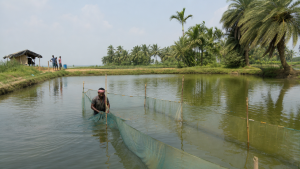
Inland aquaculture in India includes fish and shellfish farming in ponds, tanks, cages, pens, reservoirs, and saline inland waters. It is a major part of India’s fisheries growth, supported by diverse farming systems suited to different water resources and local conditions.
Overview of Inland Aquaculture in India
Inland aquaculture involves the breeding, rearing, and harvesting of aquatic organisms in controlled or semi-controlled fresh, brackish, or saline waters located inland. India ranks among the largest fish producers globally. The inland sector is the main driver of this production, recording a 38% growth from 2019-20 to 2024-25, with total production reaching 197.75 lakh tonnes. Average aquaculture productivity in the country stands at 4.7 tonnes per hectare as of early 2025.
The Gross Value Added (GVA) of the fisheries sector was reported at Rs. 3,68,124 crores in 2023-24, accounting for 7.55% of the agricultural sector GVA. The top-five states in inland fish production are Andhra Pradesh, West Bengal, Uttar Pradesh, Bihar, and Odisha. These regions use various culture systems tailored to local topographies, water availability, and economic feasibility.
Pond Aquaculture Systems
Traditional and semi-intensive ponds are the primary structures for freshwater fish farming in India. They are classified based on the number of species cultured and the input level.
Composite Fish Culture (Carp Polyculture)
Developed by the Central Inland Fisheries Research Institute (CIFRI) in 1971, this remains the most popular system. It involves farming three Indian major carps and three exotic carps together. These species occupy different ecological niches in a pond, avoiding feed competition.
- Surface Feeders: Catla (Catla catla) and Silver Carp (Hypophthalmichthys molitrix) consume plankton in the upper water column.
- Column Feeders: Rohu (Labeo rohita) feeds on plant and animal matter in the middle layer.
- Bottom Feeders: Mrigal (Cirrhinus mrigala) and Common Carp (Cyprinus carpio) consume organic detritus and benthic organisms.
- Macrophyte Feeders: Grass Carp (Ctenopharyngodon idella) feeds on aquatic weeds.
This system yields about 3 to 8 tonnes of fish per hectare per year under optimal management.
Monoculture Systems
This method involves rearing only one specific species in a pond. It is preferred for high-value species that require specialized feed or environmental controls.
- Giant Freshwater Prawn: Cultivating Macrobrachium rosenbergii yields high export returns.
- Air-Breathing Catfishes: Species like Magur (Clarias batrachus) and Singhi (Heteropneustes fossilis) are reared in shallow, low-oxygen ponds.
- Monosex Tilapia: All-male tilapia culture prevents overcrowding and ensures uniform growth.
High-Density Closed-Loop Systems
To optimize land and water usage, farmers adopt technologically advanced, intensive closed-loop aquaculture systems.
Recirculating Aquaculture Systems (RAS)
An RAS is a closed-loop fish farming system that continuously filters and reuses water.
- Mechanism: Mechanical and biological filters remove fish excreta, solid wastes, and harmful ammonia. Pure, oxygenated water is then pumped back into the tanks.
- Benefits: It enables high-density fish farming with minimal land and water requirements, reducing the risk of waterborne diseases.
- Key Species: Suitable for Pangasius, Tilapia, and Rainbow Trout in colder regions.
Biofloc Technology (BFT)
Biofloc technology is an eco-friendly farming method that converts organic waste into feed.
- Mechanism: Adding carbon sources like molasses stimulates the growth of heterotrophic bacteria. These microbes assimilate toxic nitrogenous wastes (like ammonia) and convert them into microbial protein (biofloc).
- Benefits: The biofloc acts as a direct, high-protein feed source for the fish, reducing the cost of artificial feed by up to 20-30%. It requires minimal water exchange.
- Key Species: Highly effective for shrimp (Litopenaeus vannamei), Tilapia, and Pangasius.
Open Water Enclosure Systems
These systems utilize natural water bodies such as reservoirs, lakes, and rivers without modifying their geological structures.
Cage Aquaculture
Cage culture involves raising fish in enclosed floating net structures suspended in large water bodies.
- Location: Mainly installed in deep reservoirs, irrigation canals, and natural lakes.
- Design: Standard cages are constructed using synthetic nets attached to metal or plastic frames, floated with HDPE drums.
- Advantages: This system yields high productivity, requires low initial capital setup, and simplifies harvesting. Under government schemes, thousands of cages have been installed in major reservoirs.
Pen Aquaculture
Pen culture involves blocking off a shallow area of a lake, wetland, or estuary using bamboo screens or synthetic nets.
- Location: This system is usually practiced in floodplain wetlands (locally called beels) of West Bengal and Assam.
- Application: It is primarily used to raise fish fry to fingerling size before releasing them into open waters.
Integrated Farming Systems
Integrated systems link fish culture with agriculture or animal husbandry to maximize resource efficiency.
Paddy-cum-Fish Culture
This system involves rearing fish in water-logged paddy fields concurrently or in rotation.
- Mechanism: Trenches or peripheral canals are dug inside the paddy field to serve as a refuge for fish during low-water levels.
- Synergy: Fish feed on insect pests, larvae, and weeds, reducing pesticide costs. Their waste fertilizes the soil, improving paddy yields.
- Key Species: Common Carp, Tilapia, and air-breathing catfishes are suited for this shallow environment.
Livestock-Fish Farming
This model integrates fish ponds with animal husbandry (duck, pig, or poultry farming).
- Mechanism: Animal pens are built directly over or adjacent to the pond.
- Synergy: Animal dung falls directly into the pond, acting as an organic fertilizer. This stimulates phytoplankton and zooplankton growth, which serve as natural fish feed. This eliminates the need for commercial fertilizers and supplementary feed.
Brackishwater and Inland Saline Aquaculture
India possesses diverse water resources, including vast stretches of brackish and saline waters.
Brackishwater Aquaculture
This involves farming in estuaries, backwaters, lagoons, and mangrove ecosystems where freshwater mixes with seawater.
- Key Species: Dominantly used for shrimp farming, specifically the Pacific White Shrimp (Litopenaeus vannamei) and Giant Tiger Prawn (Penaeus monodon). Finfish like Seabass and Milkfish are also cultured.
Inland Saline Aquaculture
Ground saline water is an issue in several arid and semi-arid states like Punjab, Haryana, and Rajasthan. Inland saline aquaculture utilizes these barren, salt-affected land resources.
- Mechanism: Groundwater is pumped into artificial ponds. Potassium and magnesium minerals are added to balance the ionic profile.
- Benefits: It transforms waste land into productive aquaculture hubs. Farmers successfully rear high-value shrimp (L. vannamei) and salt-tolerant fish in these areas.
Policy Interventions and Infrastructure Support
The Department of Fisheries coordinates development through the Pradhan Mantri Matsya Sampada Yojana (PMMSY).
- Infrastructure: PMMSY funding supports the establishment of freshwater hatcheries, Recirculating Aquaculture Systems (RAS), biofloc units, and feed mills.
- Resource Expansion: The scheme targets the expansion of pond aquaculture, reservoir cage installation, and the development of inland saline areas.
- Post-Harvest Support: Financial assistance is provided for constructing cold storage units, ice plants, and dedicated fish kiosks to minimize spoilage and improve market value.
Key Inland Aquaculture Terms and Trivia
- Beels: Floodplain wetlands common in Assam and West Bengal, used extensively for pen culture.
- Bheries: Large estuarine brackishwater ponds in West Bengal, traditionally used for shrimp and finfish farming.
- Kole Lands: Unique wetland ecosystems in Kerala used for integrated rice-fish farming.
- Coldwater Fisheries: High-altitude aquaculture focusing on Trout (such as Rainbow Trout) using specialized raceways in regions like Himachal Pradesh, Jammu & Kashmir, and Uttarakhand.
- Makhana-cum-Fish Integration: Rearing air-breathing fish (such as Magur or Singhi) along with fox nut (Makhana) cultivation in Bihar.
Comparison of Major Inland Aquaculture Systems in India
| System Type | Key Species | Water Source | Average Yield Potential |
| Composite Fish Culture | Catla, Rohu, Mrigal, Silver Carp, Grass Carp, Common Carp | Fresh water (Ponds/Tanks) | 3 – 8 Tonnes / Hectare / Year |
| Monoculture | Giant Freshwater Prawn, Magur, Pangasius, Tilapia | Fresh water (Ponds) | Variable (Prawn: 1 – 2 Tonnes / Hectare / Year) |
| Recirculating Aquaculture System (RAS) | Pangasius, Tilapia, Rainbow Trout | Fresh water (Tanks) | High-density (up to 30 – 40 kg / Cubic Metre) |
| Biofloc Technology (BFT) | Tilapia, Pangasius, Whiteleg Shrimp (L. vannamei) | Fresh / Brackish water (Tanks) | High-density (up to 20 – 30 kg / Cubic Metre) |
| Cage Culture | Pangasius, Tilapia, Carps | Open waters (Reservoirs/Lakes) | 3 – 5 Tonnes / Cage / Year |
| Paddy-cum-Fish Culture | Common Carp, Tilapia, Air-breathing fishes | Rainwater / Irrigation (Paddy fields) | 0.5 – 1 Tonne / Hectare / Year |
| Brackishwater Aquaculture | Whiteleg Shrimp (L. vannamei), Tiger Prawn, Seabass | Brackish water (Estuaries/Lagoons) | 4 – 10 Tonnes / Hectare / Year |
| Inland Saline Aquaculture | Whiteleg Shrimp (L. vannamei), Milkfish, Tilapia | Inland saline groundwater (Ponds) | 3 – 6 Tonnes / Hectare / Year |
Recent Context
Chhattisgarh, a landlocked state, has emerged as an inland fisheries milestone state with Tilapia product exports to the United States. The state has used PMMSY support to expand fish production and promote value-added aquaculture exports.
Rare Facts for Prelims
- CIFRI: The Central Inland Fisheries Research Institute is based at Barrackpore, West Bengal.
- GIFT Tilapia: It is a genetically improved strain developed for faster growth and better farm performance.
- HDPE: High-density polyethylene drums are commonly used for buoyancy in floating cage systems.
- Tilapia: It is one of the most adaptable fish for pond, cage, biofloc, and RAS farming.
- Biofloc: The technology is especially useful where water exchange is limited and feed cost reduction is important.
- Inland Saline Aquaculture: This system is important for converting salt-affected wastelands into productive aquaculture land.
| Related | |
|---|---|