Key Emerging Battery Technologies for Clean Energy
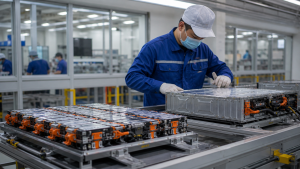
The next phase of clean energy storage is moving beyond conventional lithium-ion batteries toward chemistries that are safer, cheaper, and better suited for grid-scale and long-duration applications.
The Transition in Energy Storage
The global push for decarbonization requires battery technologies that go beyond traditional lithium-ion systems. Standard lithium-ion batteries rely on materials like cobalt and nickel, which face supply constraints, high costs, and environmental issues during mining. Additionally, current liquid-electrolyte batteries present safety risks due to flammability. Emerging battery chemistries target these vulnerabilities by utilizing abundant materials, improving safety profiles, and increasing energy capacities. These innovations support utility-scale grid storage, electric vehicles, and specialized electronics.
Solid-State Batteries (SSBs)
Solid-state technology replaces the flammable liquid or gel electrolyte of conventional batteries with a solid alternative.
Material Chemistry and Mechanics
- Anode: Typically employs pure lithium metal instead of graphite, which increases storage capacity.
- Cathode: Utilizes standard metal oxides such as nickel manganese cobalt (NMC) or lithium iron phosphate (LFP).
- Electrolyte: Composed of solid materials, including ceramics, polymers, or sulfide glass.
Key Advantages
- Superior Safety: Solid electrolytes are non-flammable and do not leak. This eliminates the risk of thermal runaway.
- Higher Energy Density: SSBs achieve energy densities between 300 Wh/kg and 500 Wh/kg, far exceeding standard lithium-ion limits.
- Extended Longevity: Solid materials suppress the formation of metallic spikes called dendrites, allowing the battery to endure over 1,000 charge-discharge cycles.
Operational Hurdles
- High Interface Resistance: Solid-to-solid contact between the electrolyte and electrodes limits ion flow.
- Manufacturing Complexity: Processing ceramic and sulfide materials requires precise, high-pressure environments, raising production costs.
Sodium-ion (Na-ion) Batteries
Sodium-ion batteries function through a process similar to lithium-ion systems but utilize sodium ions as charge carriers.
Material Chemistry and Mechanics
- Anode: Employs hard carbon instead of conventional graphite.
- Cathode: Uses transitional metal oxides, Prussian blue analogues, or polyanionic compounds.
- Electrolyte: Composed of liquid sodium salts dissolved in organic solvents.
Key Advantages
- Resource Abundance: Sodium is roughly 1,000 times more abundant in the Earth’s crust than lithium and is easily sourced from common salt.
- Low Production Cost: Raw material costs are low, with mass-produced cell prices near USD 50 per kilowatt-hour.
- Temperature Resilience: These systems operate efficiently in extreme climates, retaining up to 80% of their charge at temperatures down to -20°C.
- Safe Transport: Na-ion batteries can be fully discharged to zero volts during transport, removing fire hazards during shipping.
Operational Hurdles
- Lower Energy Density: Practical energy densities range from 150 Wh/kg to 175 Wh/kg, which limits driving range in long-distance electric vehicles.
- Larger Volumetric Footprint: Due to the larger physical size of sodium ions compared to lithium, these batteries require more space for equivalent energy storage.
Redox Flow Batteries (RFBs)
Redox flow systems store chemical energy in external liquid electrolyte tanks rather than within the cell itself.
Material Chemistry and Mechanics
- Anode and Cathode Liquids: Soluble electroactive materials dissolved in water-based solutions. Vanadium, iron, and zinc-bromine represent the primary active chemistries.
- Active Cell Stack: A central chamber divided by a membrane where reduction and oxidation reactions occur as liquids pump through.
Key Advantages
- Decoupled Capacity: Users scale power capacity by altering the cell stack size, and scale energy capacity simply by using larger storage tanks.
- Negligible Degradation: These batteries endure more than 15,000 cycles with nearly zero loss in active material.
- Inherent Safety: The use of water-based (aqueous) electrolytes eliminates flammability risks.
Operational Hurdles
- Bulk and Mass: Volumetric energy densities remain low, ranging from 15 Wh/L to 25 Wh/L.
- System Complexity: The design requires pumps, piping, and active monitoring systems, restricting use to fixed installations like power grids.
Lithium-Sulfur (Li-S) Batteries
Lithium-sulfur systems replace expensive transition metals at the cathode with elemental sulfur.
Material Chemistry and Mechanics
- Anode: Employs metallic lithium to maximize energy storage.
- Cathode: Made of low-cost, abundant elemental sulfur.
- Electrolyte: Utilizes ether-based organic liquids or solid-state conductors.
Key Advantages
- Theoretical Potential: The combination offers a theoretical energy density of approximately 2,600 Wh/kg, with practical pouch cells reaching 400 Wh/kg to 500 Wh/kg.
- Sourcing Benefits: Sulfur is a common byproduct of petroleum refining, making it highly cost-effective and globally accessible.
- Lightweight Structure: The lack of heavy metals makes Li-S cells ideal for weight-sensitive applications.
Operational Hurdles
- The Shuttle Effect: Soluble lithium polysulfides dissolve into the electrolyte and migrate back and forth between electrodes, causing rapid capacity loss.
- Low Conductivity: Sulfur acts as an electrical insulator, requiring the addition of heavy carbon matrices that reduce actual energy density.
Metal-Air Batteries
Metal-air batteries use a metal anode and draw active cathode material directly from the surrounding air.
Material Chemistry and Mechanics
- Anode: Pure metals like zinc, aluminum, iron, or lithium.
- Cathode: A porous carbon structure that breathes in ambient oxygen.
- Electrolyte: Aqueous alkaline solutions or solid-state membranes.
Key Advantages
- Ultra-Lightweight Design: Because the cell does not store the cathode reactant (oxygen) internally, overall battery weight is minimal.
- High Specific Energy: Zinc-air and aluminum-air systems offer energy densities comparable to fossil fuels, reaching over 400 Wh/kg.
- Eco-Friendly Profiles: Metals like zinc and aluminum are highly recyclable and non-toxic.
Operational Hurdles
- Slow Reaction Kinetics: The electrochemical reduction of oxygen is slow, reducing efficiency.
- Rechargeability Issues: Aluminum-air cells cannot be recharged electrically and require physical replacement of the metal anode. Zinc-air cells suffer from oxide build-up on the electrodes.
Comparative Analysis of Battery Chemistries
| Technology | Anode Material | Cathode Material | Electrolyte Type | Practical Energy Density | Key Application |
| Lithium-ion | Graphite / Silicon | Cobalt / LFP | Liquid Organic | 150 – 260 Wh/kg | Electronics, EVs |
| Solid-State | Lithium Metal | NMC / LFP | Ceramics / Polymers | 300 – 500 Wh/kg | Premium EVs, Aviation |
| Sodium-ion | Hard Carbon | Prussian Blue | Liquid Organic | 150 – 175 Wh/kg | Grid Storage, Budget EVs |
| Redox Flow | Vanadium Liquid | Vanadium Liquid | Aqueous Acid | 15 – 25 Wh/L | Long-Duration Grid |
| Lithium-Sulfur | Lithium Metal | Elemental Sulfur | Ether / Solid | 400 – 500 Wh/kg | Drones, Aerospace |
| Metal-Air (Zinc) | Zinc Metal | Ambient Oxygen | Aqueous Alkaline | 400 – 450 Wh/kg | Backup Power, Grid |
Key Trends in Clean Energy Deployment
To transition these technologies from research facilities to commercial markets, manufacturers focus on specific structural developments.
- Supply Chain De-risking: Chemistries like sodium-ion and iron-based flow batteries help reduce dependency on geographically concentrated minerals like lithium and cobalt.
- Grid Stabilization: Long-duration storage systems, such as redox flow and iron-air systems, balance intermittent solar and wind energy generation.
- Recycling Frameworks: Standardizing design structures ensures that emerging batteries undergo direct mechanical and chemical recycling at the end of their lifecycle.
Recent Context
Meine Electric, with AIC-AU, has launched an indigenous iron-air battery pilot at NTPC Simhadri for long-duration energy storage. The trial will assess technical performance and reliability under real utility conditions.
Rare Facts for Prelims
- Iron-air batteries: They store energy by reversing the rusting process of iron.
- Vanadium flow batteries: The same element can be used in both tanks, which reduces cross-contamination risk.
- Solid-state batteries: Many designs aim to use lithium metal because it can store far more charge than graphite.
- Sodium-ion batteries: Sodium ions are larger than lithium ions, which is one reason their energy density is usually lower.
- Metal-air batteries: Their cathode reactant comes from air, so the battery does not need to carry oxygen internally.
- Long-duration storage: In grid planning, storage that lasts more than four hours is often treated differently from short-duration batteries.
| Related | |
|---|---|