Major Data Centre Hubs in India
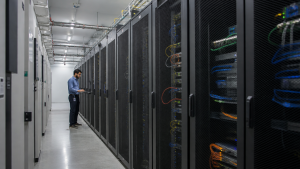
India’s data centre industry has expanded rapidly with Mumbai, Chennai, Bengaluru, Hyderabad and Delhi-NCR emerging as the main hubs. Growth is being driven by cloud adoption, data localisation rules, 5G rollout, AI workloads and rising demand for low-latency digital infrastructure.
Definition and Evolving Digital Footprint
- Data centres are physical facilities used by organisations to house critical applications and data, along with computing and storage resources.
- The total operational data centre capacity in India has expanded from 375 MW in 2020 to over 1,500 MW.
- Future forecasts project total installed capacity to reach approximately 1.8 GW to 2 GW.
- The domestic market valuation is projected to exceed USD 21 billion.
- This expansion aligns with India’s digital economy, which is targeted to reach USD 1 trillion.
Key Growth Drivers of Indian Data Centres
- Data sovereignty mandates: The Digital Personal Data Protection (DPDP) Act, 2023, requires certain categories of critical personal data to be stored within national borders.
- Financial data localisation: The Reserve Bank of India (RBI) mandates that all system providers store entire payment transaction data within systems located only in India.
- 5G network rollout: The expansion of 5G services increases mobile broadband data traffic, driving demand for edge and hyperscale data storage.
- AI and machine learning workloads: Artificial Intelligence (AI) requires high-density computing power, advanced GPUs and specialised liquid cooling infrastructure.
- Cloud adoption: Global cloud platforms are expanding local cloud regions and relying on third-party colocation facilities to meet corporate demand.
Major Data Centre Hubs in India
The majority of India’s operational capacity is concentrated in five metropolitan regions due to their connectivity, power supply and corporate demand.
| City Hub | Operational Capacity (MW) | Share of National Capacity | Key Enabling Factors |
| Mumbai / Navi Mumbai | 790 | ~52% | Extensive subsea cable landings, resilient power grid, financial capital demand |
| Chennai | 305 | ~21% | East-coast subsea gateway, favourable state policies, proximity to Southeast Asia |
| Bengaluru | 182 | ~12% | Tech talent ecosystem, software enterprise demand, high concentration of GCCs |
| Hyderabad | 152 | ~10% | Competitive power tariffs, disaster-free zone, proactive state incentives |
| Delhi-NCR / Noida | 76 | ~5% | North India’s administrative focus, land subsidies, power grid connectivity |
| Others (Pune, Kolkata) | 15 | ~1% | Regional edge connectivity, expansion to Tier-II cities |
Mumbai and Navi Mumbai
- Mumbai serves as the primary gateway for digital infrastructure in India, holding over half of the country’s data centre capacity.
- The city hosts more than 14 international submarine cable landing stations, connecting India directly to Europe, Africa, the Middle East and Southeast Asia.
- It features specialised power grids managed by dedicated utilities, ensuring a continuous and dependable power supply.
- The high concentration of banking, financial services, insurance (BFSI) and media corporations creates constant demand for low-latency local hosting.
- Major operators like Yotta Data Services, ST Telemedia Global Data Centres (STT GDC India) and Equinix operate large campuses in this region.
Chennai
- Chennai is the second-largest digital gateway and the primary hub on India’s eastern coast.
- The city has multiple subsea landing stations connecting India to Singapore, Malaysia and other Southeast Asian countries.
- The Tamil Nadu government offers incentives such as electricity duty exemptions and land subsidies to attract digital infrastructure investments.
- The India-Southeast Asia (I-2SEA) submarine cable project lands in Chennai, creating high-speed pathways for AI workloads.
Bengaluru
- As India’s primary software capital, Bengaluru has strong demand from local enterprise and cloud service providers.
- The city is a major base for Global Capability Centers (GCCs), research institutions and multinational technology corporations.
- Local facilities focus on high-density corporate applications, backend storage and cloud infrastructure.
Hyderabad
- Hyderabad has emerged as a fast-growing market due to proactive state policies, competitive power costs and large land allocations.
- The Telangana government offers single-window clearances, stamp duty exemptions and power incentives for digital infrastructure companies.
- Key operators such as CtrlS and AdaniConneX are building large sustainable campuses in the region.
Delhi-NCR and Noida
- Noida is the primary node for data centres in North India, catering to regional corporate and government requirements.
- The Uttar Pradesh Data Centre Policy provides fiscal incentives, attracting investments from Sify Technologies and Yotta.
- Its location serves as a central gateway for internet traffic distribution across the northern states.
Undersea Cable Landing Stations
- Undersea fibre-optic cables carry over 97% of the world’s international internet and data traffic.
- India hosts international submarine cable systems with landing points in Mumbai, Chennai, Kochi, Tuticorin and Thiruvananthapuram.
- The India-Asia-Xpress (IAX) and India-Europe-Xpress (IEX) cable systems are high-capacity projects linking India eastwards to Singapore and westwards to Europe.
- The proposed India-Southeast Asia (I-2SEA) submarine cable system will directly connect Machilipatnam in Andhra Pradesh and South Chennai to Malaysia and Singapore.
Government Policies and Regulatory Framework
- Infrastructure status: The Government of India granted “Infrastructure” status to data centres in the Union Budget 2022-23, enabling operators to access long-term, low-interest institutional credit.
- Draft National Data Centre Policy: The Ministry of Electronics and Information Technology (MeitY) formulated this policy to simplify clearances and promote special data centre economic zones.
- State-level dedicated policies:
- Maharashtra: Exempts data centres from electricity duty and provides relaxed floor space index (FSI) regulations.
- Tamil Nadu: Offers capital subsidies, dual-feed power networks and stamp duty concessions.
- Uttar Pradesh: Provides interest subsidies on land procurement, stamp duty exemptions and capital subsidies for building green data centres.
Emerging Trends and Sustainability Challenges
- Power demands: High-performance computing and AI workloads require immense power. The industry’s projected power requirement is estimated to rise to 13.56 GW.
- Cooling infrastructure: Data centres consume large amounts of water for cooling. Companies are shifting toward liquid-to-air cooling and closed-loop water systems to reduce resource use.
- Green energy transition: Operators are increasingly signing power purchase agreements (PPAs) for green open access to secure solar and wind energy and move toward zero-carbon facilities.
- Edge data centres: Smaller facilities are growing in Tier-II and Tier-III cities to reduce latency and improve content delivery for regional users.
Recent Development: L&T Mega AI Infrastructure Order
- Larsen & Toubro (L&T) announced on August 13, 2026 that it won a mega order worth ₹10,000 crore to ₹15,000 crore to build an artificial intelligence infrastructure facility in India.
- The project is described as India’s largest single-cluster AI infrastructure facility and will be executed by L&T’s wholly owned subsidiary Vyoma.AI and its AI infrastructure subsidiary, LTN Compute.
- On August 11, 2026, L&T entered into an agreement to consolidate its digital infrastructure business by transferring its data centre and cloud services operations to Vyoma.AI for ₹1,400 crore, along with its stake in L&T Network Services for ₹30 crore.
- The transactions are expected to be finalised on or before October 31, 2026.
- The contract was awarded by Together AI, a US-based AI cloud platform co-founded and led by CEO Vipul Ved Prakash.
- The facility is designed as an NVIDIA B300 AI Factory and will support Together AI’s platform for training, inference and fine-tuning workloads.
- The project involves deploying 10,000 NVIDIA B300 GPUs for advanced machine learning workloads.
- The AI Factory will be hosted at Vyoma.AI’s Chennai data centre campus, which is being planned as a gigawatt-scale AI infrastructure site.
- Phase 1 of the Chennai campus is designed for a 250 MW capacity, with immediate power infrastructure readiness of 150 MVA.
- L&T is led by Chairman and Managing Director S. N. Subrahmanyan, and its stock on the NSE and BSE registered intraday gains after the announcement.
AI data centres are specialised facilities built to handle the high thermal and energy demands of GPU clusters using advanced power, networking and cooling systems.
Chennai remains a premier southern hub for data centres because of its coastal subsea cable landings, industrial base and expanding grid capacity.
Rare Facts for Prelims
- Subsea cable dominance: More than 97% of global international data traffic moves through undersea fibre-optic cables, not satellites.
- Mumbai’s cable advantage: Mumbai has one of the highest concentrations of submarine cable landing stations in India, making it a critical internet gateway.
- Chennai’s strategic edge: Chennai is often preferred for eastward connectivity because of its proximity to Southeast Asia and multiple landing stations.
- GCC link: Bengaluru’s data centre demand is closely tied to the growth of Global Capability Centers of multinational firms.
- Power planning issue: Data centres are increasingly being treated as major power consumers, making grid planning a key urban infrastructure challenge.
- Regional development angle: New data centre policies in states such as Tamil Nadu, Maharashtra and Uttar Pradesh are being used to attract investment beyond traditional metros.
Current General Studies comprises current-affairs-based, General Studies-rich study material on policies, laws, institutions, economy, science, environment, governance, international relations, and other varied but important topics for UPSC and State PSC Prelims examinations.
Fortnightly PDF compilations: Available here
Originally written on
August 10, 2026
and last modified on
August 13, 2026.
| Related | |
|---|---|