Important GPUs and High-Performance Computing Technologies
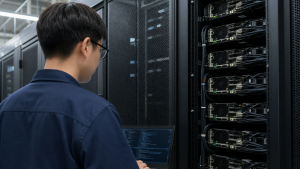
High-Performance Computing (HPC) uses aggregated computing power to solve complex problems in science, engineering, business, and AI. Modern HPC systems increasingly rely on Graphics Processing Units (GPUs), which are designed for massive parallel processing and are now central to AI training, scientific simulations, and advanced data analysis.
Comparison Between CPUs and GPUs
CPUs and GPUs serve different roles in a computing system. The table below highlights their key differences:
| Feature | Central Processing Unit (CPU) | Graphics Processing Unit (GPU) |
| Core Architecture | Few, powerful cores designed for sequential processing | Thousands of smaller, efficient cores designed for parallel processing |
| Optimized For | Low-latency sequential execution of tasks | High-throughput parallel processing of massive datasets |
| Task Handling | Executes one complex task at a time | Executes thousands of simple mathematical tasks simultaneously |
| Memory Bandwidth | Lower bandwidth, optimized for fast cache access | Extremely high bandwidth to feed thousands of active cores |
| Primary Use Cases | General system management, operating systems, databases | AI training, deep learning, 3D rendering, scientific simulations |
Prominent GPU Architectures and Hardware Solutions
Major chip manufacturers have developed specialized hardware architectures for supercomputers and AI data centres.
NVIDIA Architectures
- Blackwell (B200): Incorporates a second-generation transformer engine and custom liquid cooling systems. It is tailored for large-scale AI training and inference.
- Hopper (H100/H200): Built on a 4-nanometre process, this series introduced dedicated Transformer Engines. It provides high-speed double-precision tensor core operations for scientific simulations.
- Grace Hopper (GH200): A coherent CPU-GPU superchip that links an ARM-based Grace CPU with a Hopper GPU using high-bandwidth interconnects to minimize memory transfer latency.
AMD Instinct Series
- CDNA Architecture: Designed specifically for compute-focused workloads, avoiding consumer graphics features.
- Instinct MI300A: An Accelerated Processing Unit (APU) that combines CPU cores, GPU cores, and High Bandwidth Memory (HBM3) on a single physical package.
- Instinct MI250X: Uses a multi-die design to run highly parallel scientific workloads in top-tier global supercomputers.
Intel Xe-HPC
- Ponte Vecchio: Intel’s flagship data centre GPU features over 100 billion transistors. It powers exascale supercomputing tasks by combining multiple computational tiles via advanced packaging.
Alternative Specialized Accelerators in HPC
While GPUs remain dominant, other application-specific integrated circuits (ASICs) and processors are also used in specialized workloads.
- Tensor Processing Units (TPUs): Developed by Google, these ASICs accelerate machine learning workloads and focus on matrix operations common in neural networks.
- Data Processing Units (DPUs): These processors offload networking, storage, and security workloads from the host CPU, improving overall system efficiency in multi-tenant data centres.
- Language Processing Units (LPUs): These specialized chips focus on low-latency inference for large language models and bypass traditional memory access bottlenecks found in standard GPUs.
The Global Supercomputing Landscape
Supercomputers are ranked twice a year by the TOP500 project based on their performance on the High-Performance LINPACK (HPL) benchmark. Computing speed is measured in FLOPS (Floating-Point Operations Per Second). Systems capable of delivering more than one quintillion (1018) calculations per second are called exascale supercomputers.
The top systems in the June 2026 ranking include:
- LineShine (China): Located at the National Supercomputing Centre in Shenzhen. It achieves 2.198 Exaflops using a custom CPU-only platform called LingKun. It is the first Chinese system to lead the list since 2017.
- El Capitan (USA): Installed at the Lawrence Livermore National Laboratory. It registers 1.809 Exaflops and runs on AMD EPYC processors and AMD Instinct MI300A accelerators.
- Frontier (USA): Housed at the Oak Ridge National Laboratory. It delivers 1.353 Exaflops using AMD EPYC CPUs and Instinct MI250X GPUs.
- Aurora (USA): Stationed at the Argonne National Laboratory. It delivers 1.012 Exaflops using Intel Xeon CPU Max and Intel Data Center GPU Max processors.
- JUPITER Booster (Germany): Installed at the Forschungszentrum Jülich. It is Europe’s premier exascale system, achieving 1.000 Exaflops using NVIDIA GH200 Grace Hopper Superchips.
India’s High-Performance Computing Initiatives
India has built a structured framework to develop and deploy indigenous supercomputing systems, with the aim of reducing dependence on imported components.
National Supercomputing Mission (NSM)
Launched in April 2015 with an outlay of ₹4,500 crore, the NSM is jointly steered by the Department of Science and Technology (DST) and the Ministry of Electronics and Information Technology (MeitY). It is implemented by the Centre for Development of Advanced Computing (C-DAC), Pune, and the Indian Institute of Science (IISc), Bengaluru.
The mission follows a phased roadmap:
- Phase I: Focused on assembling imported parts to establish basic infrastructure across various academic institutions.
- Phase II: Advanced toward domestic manufacturing and developed a local software stack. It achieved about 40% local value addition.
- Phase III: Focuses on total indigenization, covering design, system architecture, and manufacturing.
- NSM 2.0: Focuses on converging supercomputing, AI, and quantum architectures. This phase introduces sovereign computing stacks and indigenously designed processors.
Indigenous Technology Development
- Rudra Server: India’s first indigenously designed secure server. It serves as the building block for new PARAM series supercomputers.
- Trinetra Interconnect: A high-speed, low-latency network technology designed in India to link multiple processing nodes within a supercomputer.
Major Indian Supercomputing Systems
India’s domestic supercomputing capability includes several high-performance installations across premier institutes.
- AIRAWAT – PSAI: Installed at C-DAC Pune. This is India’s fastest AI supercomputer, optimized for large-scale deep learning tasks.
- PARAM Rudra: Built using indigenous Rudra servers and a local software stack. Multiple units are deployed at research centres in Pune, New Delhi, and Kolkata.
- PARAM Pravega: Located at IISc Bengaluru. This system has a processing capacity of 3.3 Petaflops and supports academic research.
- PARAM Ganga: Installed at IIT Roorkee to assist in computational materials science and biological modeling.
- PARAM Shivay: Deployed at IIT (BHU) Varanasi. It was the first supercomputer assembled indigenously under the NSM.
- Pratyush and Mihir: Operated by the Indian Institute of Tropical Meteorology (IITM), Pune, and the National Centre for Medium Range Weather Forecasting (NCMRWF), Noida. These systems execute high-resolution weather forecasting and monsoon modeling tasks.
Key Applications of HPC and GPUs
Supercomputing systems process massive datasets to solve complex real-world problems. Major application areas include:
- Climate and Weather Prediction: Simulating global ocean-atmosphere interactions, predicting monsoons, and modeling natural disasters like cyclones.
- Genomics and Drug Discovery: Accelerating DNA sequencing, predicting protein structures, and modeling molecular interactions to design target therapeutics.
- Defense and Space Simulations: Testing structural aerodynamics for aircraft, simulating missile paths, and analyzing telemetry data for satellite launches.
- Nuclear and Material Science: Modeling nuclear reactions safely and discovering new materials for semiconductor manufacturing and battery storage.
- Artificial Intelligence Training: Processing large language models, neural networks, and computer vision systems that require heavy parallel processing.
Rare Facts for Prelims
- FLOPS: The term stands for Floating-Point Operations Per Second and is the standard measure of supercomputer performance.
- Exascale threshold: One exaflop equals 1018 floating-point operations per second.
- HBM3: High Bandwidth Memory is used in advanced accelerators to feed data quickly to many compute cores.
- Multi-die packaging: Some modern chips combine several smaller dies into one package to improve performance and manufacturing efficiency.
- Transformer Engine: This is especially important for AI workloads because it speeds up transformer-based model training and inference.
- TOP500 ranking: The list is updated twice a year and is widely used to compare the world’s fastest supercomputers.
| Related | |
|---|---|