Themes and Concepts in Gender Studies
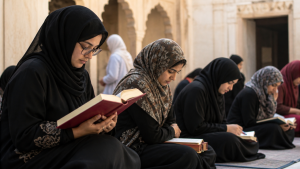
Gender studies in the Muslim world examines how faith, law, history, and culture shape ideas of gender, authority, and rights. It moves beyond one-size-fits-all views of Muslim women and instead focuses on local contexts, women’s agency, and reformist debates within Islamic traditions.
The field draws on scripture, jurisprudence, social history, and state law to study how patriarchal structures developed and how they are challenged today. It is especially important for Prelims because it links key Islamic legal concepts with contemporary family law reforms.
Theoretical Foundations
- Islamic feminism: Uses internal religious texts to argue for gender equality and social justice within an Islamic framework.
- Core argument: Reformist scholars maintain that the Qur’an’s basic message is egalitarian, while later male-dominated interpretations created patriarchal bias in fiqh.
- Tafsir: Scriptural exegesis is re-read through a gender-sensitive lens to recover egalitarian meanings.
- Ijtihad: Independent legal reasoning is used to revisit religious sources for modern gender issues instead of relying only on medieval precedent.
- Contextual analysis: The socio-historical setting of revelations is examined to separate universal moral principles from time-bound social rulings.
Critique of Orientalism and Colonial Narratives
- Orientalist critique: Gender studies in Muslim contexts rejects Western portrayals of Muslim women as passive victims of an inherently oppressive religion.
- Imperial feminism: Scholars challenge the use of women’s rights as a justification for political or military domination.
- Agency and piety: Agency is not limited to secular resistance; it can also operate within religious and traditional frameworks.
- Local context: The field emphasizes indigenous intellectual movements and lived realities rather than treating all Muslim societies as identical.
Key Jurisprudential Concepts
- Qiwamah: Traditionally understood as guardianship or financial responsibility of men over women.
- Reformist reading of qiwamah: Interpreted as a conditional obligation linked to maintenance, not absolute control.
- Wilayah: Refers to custodianship or legal representation; traditionally associated with male relatives’ decision-making power over women.
- Modern interpretation of wilayah: Activists argue for equal legal capacity for women.
- Talaq: Means unilateral divorce by the husband.
- Reformist view of talaq: Reinterpreted to require judicial oversight and more equitable divorce rights.
- Khul’: Divorce initiated by the wife, often involving return of the dower (mahr).
- Mahr: A mandatory gift or payment from groom to bride at marriage, remaining her exclusive property.
State Codification and Family Law Reforms
- 19th and 20th centuries: Post-colonial states transformed classical jurisprudence into codified national legal systems, often limiting family law to personal status codes.
- Moroccan Moudawana (2004): Raised the legal marriage age to 18.
- Moroccan reform: Established joint family responsibility between spouses and placed divorce under judicial supervision.
- Tunisian Personal Status Code (1956): Abolished polygamy.
- Tunisian reform: Also introduced judicial divorce and became an early benchmark for legal gender equality in the Arab world.
- Hybrid legal systems: Modern personal status laws in many Muslim-majority states combine classical jurisprudence with Western legal codification models.
Major Thinkers and Transnational Networks
- Fatima Mernissi: Moroccan sociologist who examined early Islamic history and hadith literature to show how political interests shaped patriarchal interpretations.
- The Veil and the Male Elite: Mernissi’s work analyzed the historical context behind gender-related traditions.
- Amina Wadud: Known for a text-focused reading of the Qur’an that argues the divine message supports full gender equity.
- Qur’an and Woman (1992): Amina Wadud’s foundational text, “Rereading the Sacred Text from a Woman’s Perspective.”
- Asma Barlas: Analyzed scriptural language to argue that the Qur’an does not support patriarchal hierarchy or male superiority.
- Leila Ahmed: Traced the historical shift from early Islamic egalitarianism to institutionalized patriarchy in the Middle East.
- Musawah: A global movement for equality and justice in the Muslim family, officially launched in 2009 in Kuala Lumpur, Malaysia.
- Sisters in Islam (SIS): Malaysian civil society group that uses Islamic frameworks to campaign for women’s legal rights and democratic freedoms.
Exam-Relevant Core Points
Important: Islamic feminism argues from within the religious tradition, not outside it.
- Ijtihad: Independent reasoning used to re-examine religious sources for legal reform.
- Qiwamah: A central jurisprudential term traditionally linked to male maintenance and authority.
- Morocco 2004: Reformed its family code to grant equal legal status to both spouses in family matters.
- Tunisia 1956: Banned polygamy through the Personal Status Code.
- Musawah: Means “equality” in Arabic.
- Mahr: Always remains the bride’s exclusive property.
- Reform agenda: Modern family law debates often revolve around how classical concepts are reinterpreted under contemporary legal systems.
Key Prelims Takeaways
- Scope: Gender studies in the Muslim world links religion, law, history, and culture.
- Method: It uses tafsir, ijtihad, and contextual analysis to revisit scriptural and legal texts.
- Critique: The field challenges Orientalist and colonial portrayals of Muslim women.
- Qiwamah: Traditionally read as male authority, but reformists see it as a conditional financial responsibility.
- Talaq and khul’: These are central to debates on divorce rights and judicial oversight.
- Legal reforms: Morocco’s Moudawana (2004) and Tunisia’s Personal Status Code (1956) are major milestones.
- Thinkers and movements: Fatima Mernissi, Amina Wadud, Asma Barlas, Leila Ahmed, Musawah, and Sisters in Islam are key names.
Current General Studies comprises current-affairs-based, General Studies-rich study material on policies, laws, institutions, economy, science, environment, governance, international relations, and other varied but important topics for UPSC and State PSC Prelims examinations.
Fortnightly PDF compilations: Available here
Originally written on
May 4, 2026
and last modified on
September 6, 2026.
| Related | |
|---|---|