Natural Hazard Early Warning and Forecasting Systems
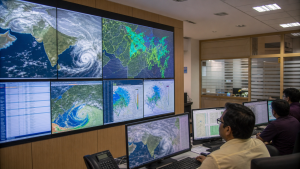
Natural hazard early warning and forecasting systems are essential disaster management tools. They help detect threats early, improve preparedness, and communicate timely alerts to reduce loss of life and economic damage.
Modern systems combine meteorological science, satellite-based observation, modeling, and communication networks. In India, these capabilities are being strengthened through Mission Mausam, IMD’s forecasting systems, and nationwide alert dissemination platforms.
Global Frameworks and Initiatives
International cooperation has become central to improving disaster warnings and reducing gaps in preparedness across countries.
- Early Warnings for All (EW4All): Launched by the United Nations in 2022, it aims to ensure that every person on Earth is protected by multi-hazard early warning systems by the end of 2027.
- Investment support: The initiative is backed by a planned investment of USD 3.1 billion for 2023–2027.
- Global Status Report 2025: The report, released at the COP30 Belém Climate Summit in November 2025, stated that 119 countries, or 60% globally, had a Multi-Hazard Early Warning System.
- Growth in coverage: The report noted a 113% increase in the number of countries with such systems over the last ten years.
- Future cooperation: Stakeholder feedback for early warning cooperation beyond 2027 is being collected through the EW4All Global Consultation Survey, open until December 2026.
Mission Mausam and Meteorological Infrastructure
Mission Mausam is India’s major meteorological modernisation programme. It aims to improve observation, forecasting, and weather-related research through upgraded infrastructure and computing systems.
- Approval and launch: Mission Mausam was approved on September 11, 2024, and officially launched on January 14, 2025.
- First phase budget: The mission had a budget of ₹2,000 crore for the first phase covering 2024–25 and 2025–26.
- Second phase proposal: For 2026–31, the mission is proposed through six verticals: OBSERVE_ALL, DEVELOP, Weather_MOD, ATCOMP, FRONTIER, and NEAT.
- Budget Estimate: A Budget Estimate of ₹1,342.29 crore has been allocated for 2026–27.
- Doppler radar expansion: India is expanding its Doppler weather radar network from 37 sites to 73 sites by the end of 2025–26, with a target of 126 sites by the end of 2026.
IMD’s Multi-Hazard Early Warning Decision Support System
The India Meteorological Department has developed centralized forecasting tools to improve lead time and support regional advisories. These systems are important for severe weather and cyclone preparedness.
- MHEW-DSS: The indigenously developed Multi-Hazard Early Warning Decision Support System has been operational in real time since January 2024.
- Improved lead time: The system extended forecast lead times from 5 days to 7 days.
- Faster preparation: It reduced preparation time by about 3 hours.
- Recognition: The system received the National Award for e-Governance 2025 and the Digital Transformation Summit Award of Excellence 2026.
- UNDRR award: The impact of the system was also recognised through the UNDRR Sasakawa Award for Disaster Risk Reduction 2025 awarded to IMD Director General Mrutyunjay Mohapatra.
- Regional role: As a Regional Specialized Meteorological Centre (RSMC), IMD provides severe weather and tropical cyclone advisories to Bangladesh, Maldives, Myanmar, Oman, Pakistan, Qatar, Sri Lanka, Thailand, UAE, and Yemen.
SACHET Portal and Disaster Communication
Warning systems are effective only when alerts reach people quickly and clearly. India’s disaster communication infrastructure has therefore focused on integrated, mobile-based dissemination.
- Nationwide launch: On May 2, 2026, the Government of India launched a nationwide mobile-based disaster communication system integrating Cell Broadcast technology with SMS.
- Developer: The SACHET portal was developed by the Centre for Development of Telematics (C-DOT) under the Ministry of Communications.
- CAP-based system: It uses the ITU-recommended Common Alerting Protocol (CAP).
- Coverage: The portal is operational across all 36 States and Union Territories.
- Scale of alerts: Before Cell Broadcast integration, SACHET had disseminated over 134 billion geo-targeted SMS disaster alerts in more than 19 Indian languages.
- Unified hub: It consolidates alerts from IMD, CWC, INCOIS, DGRE, and FSI.
Flood Monitoring and Mapping Platforms
Hydrological hazards are monitored through dedicated digital platforms that provide local-level forecasts, inundation maps, and water-level estimates.
- FloodWatch India 2.0: The Central Water Commission’s bilingual mobile app offers real-time flood monitoring and 7-day advisory flood forecasts using satellite data and mathematical modelling.
- C-FLOOD: The CWC’s web-based platform provides 2-day-advance village-level flood inundation maps and water-level predictions.
Key Prelims Takeaways
- EW4All: UN initiative launched in 2022 with the target of universal multi-hazard early warning coverage by 2027.
- Funding: EW4All is backed by a planned investment of USD 3.1 billion for 2023–2027.
- Mission Mausam: Approved on September 11, 2024, and launched on January 14, 2025; it focuses on modern meteorology infrastructure.
- Radar network: India aims to expand Doppler weather radars to 126 sites by the end of 2026.
- MHEW-DSS: IMD’s real-time decision support system provides 7-day lead forecasts and supports advisories for 10 countries.
- SACHET: Developed by C-DOT, it uses CAP and integrates Cell Broadcast and SMS for disaster alerts.
- Flood tools: FloodWatch India 2.0 provides 7-day advisory forecasts, while C-FLOOD provides 2-day village-level inundation mapping.
| Related | |
|---|---|