India–Bangladesh Bilateral Treaties and Agreements
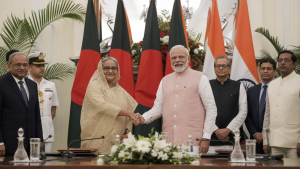
India and Bangladesh share one of South Asia’s most important bilateral relationships, shaped by a long land border, shared rivers, trade links, and deep security cooperation. The framework rests on landmark treaties on land boundaries, water sharing, border management, and extradition.
Land Boundary Agreement and Border Management
- India-Bangladesh border: The two countries share a 4,096-kilometer land boundary, the longest India has with any neighbouring country.
- 1974 Land Boundary Agreement (LBA): It was operationalised on 1 August 2015 after the Indian Parliament passed the 100th Constitutional Amendment Act.
- Enclave exchange: The agreement enabled the exchange of 111 Indian enclaves in Bangladesh and 51 Bangladeshi enclaves in India.
- Border demarcation issues: Some boundary stretches remain difficult to demarcate because of riverine, marshy, and densely forested terrain, especially in the Sundarbans delta.
- Coordinated Border Management Plan (CBMP), 2011: This bilateral mechanism coordinates border-related law enforcement and regular administration.
- Joint patrolling: The CBMP supports synchronized patrols by the Border Security Force (BSF) and the Border Guard Bangladesh (BGB).
- Security concerns: The arrangement is intended to curb trans-border crime, cattle smuggling, human trafficking, and movement of fake currency.
Transboundary Water Resources and Treaties
- Ganges Water Sharing Treaty, 1996: A landmark 30-year agreement regulating the sharing of Ganges waters at the Farakka Barrage.
- Dry-season period: The treaty governs water distribution from 1 January to 31 May each year.
- Expiry: The treaty is due to expire in December 2026.
- Negotiation status: Formal bilateral renewal talks have not yet officially begun.
- Indian consultations: India has carried out inter-ministerial and state-level consultations, including inputs from West Bengal and Bihar.
- Teesta River issue: The proposed Teesta water-sharing agreement remains unresolved and has been stalled since 2011 due to water-scarcity and irrigation concerns raised by the West Bengal government.
- Bangladesh’s project: Bangladesh is pursuing the Teesta River Comprehensive Management and Restoration Project to address dry-season shortages and riverbank erosion, with technical and feasibility assistance from China.
Trade, Economic Cooperation and Energy Connectivity
- CEPA talks: Negotiations for a Comprehensive Economic Partnership Agreement (CEPA) were formally revived in March 2026.
- Objectives of CEPA: The proposed agreement seeks to address trade imbalances, reduce non-tariff barriers, and create a modern investment framework.
- Bilateral trade: In FY2024-25, total trade between the two countries stood at USD 11.39 billion.
- Bangladesh’s exports to India: These were valued at USD 1.76 billion in FY2024-25.
- Trilateral power cooperation: In October 2024, India, Nepal, and Bangladesh signed a trilateral agreement to support sub-regional electricity integration.
- Power flow: Under this arrangement, 40 MW of Nepali hydroelectricity began transmission to Bangladesh through the Indian grid on 15 June 2025.
- Friendship Pipeline: India supplied 57 thousand metric tonnes of high-speed diesel to Bangladesh through the 131.5-kilometer India-Bangladesh Friendship Pipeline (IBFP) during the calendar year up to April 2026.
Extradition Treaty and Legal Frameworks
- 2013 Extradition Treaty: Legal cooperation and transfer of fugitives are governed by the India-Bangladesh Extradition Treaty signed in 2013.
- 2016 amendment: The treaty was amended in 2016 to simplify the extradition process by removing the requirement for courts to produce detailed evidence of the offence.
- Article 6: This article allows refusal of extradition requests under specified conditions, including when the offence is considered political in nature.
- Political sensitivity: The treaty has remained relevant in high-profile extradition requests involving political figures.
- Humanitarian consideration: India’s handling of such requests has also reflected treaty exemptions and broader legal-political sensitivities.
Key Prelims Takeaways
- 100th Constitutional Amendment Act: Enabled the operationalisation of the 1974 Land Boundary Agreement and the enclave exchange in 2015.
- 4,096-km border: India’s longest land boundary with any neighbouring country.
- CBMP, 2011: The border management mechanism coordinating BSF-BGB patrols and anti-smuggling operations.
- Ganges Water Sharing Treaty, 1996: A 30-year dry-season water-sharing agreement at Farakka, expiring in December 2026.
- Teesta issue: Still unresolved since 2011 because of state-level irrigation and water-scarcity concerns.
- CEPA revival: Negotiations restarted in March 2026 to deepen trade and investment cooperation.
- 2013 Extradition Treaty, Article 6: The key legal provision allowing refusal of extradition in specified cases, including political offences.
Current General Studies comprises current-affairs-based, General Studies-rich study material on policies, laws, institutions, economy, science, environment, governance, international relations, and other varied but important topics for UPSC and State PSC Prelims examinations.
Fortnightly PDF compilations: Available here
Originally written on
April 6, 2026
and last modified on
September 5, 2026.
| Related | |
|---|---|