Major International Humanitarian Organizations and Their Roles
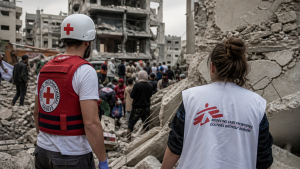
International humanitarian organizations provide relief, protection, food assistance, health support, and coordination during wars, disasters, and displacement crises. Many of them work under specific treaties, UN resolutions, or institutional charters that define their mandates and methods.
International Committee of the Red Cross and Médecins Sans Frontières
The International Committee of the Red Cross (ICRC) and Médecins Sans Frontières (MSF) are independent humanitarian actors with globally recognized roles in conflict and emergency settings. Both focus on saving lives and protecting human dignity, but they do so through different mandates and operating models.
- ICRC: Founded in 1863 in Geneva, Switzerland, it has a unique legal mandate under the Geneva Conventions of 1949 and their Additional Protocols to protect victims of international and non-international armed conflicts.
- ICRC leadership: Mirjana Spoljaric Egger serves as President of the ICRC, after being re-elected to a second four-year term on February 4, 2026.
- MSF: Founded in 1971 in Paris, France, and headquartered in Geneva, Switzerland, it works on the principles of medical ethics and témoignage (bearing witness to the plight of affected populations).
- MSF leadership: Dr. Javid Abdelmoneim serves as the International President of MSF, elected to a three-year term beginning in 2025.
UN Refugee Agency and the World Food Programme
The United Nations High Commissioner for Refugees (UNHCR) and the World Food Programme (WFP) are frontline UN bodies dealing with displacement and hunger. Their work is central to large-scale humanitarian response in crises involving refugees, internally displaced persons, and food insecurity.
- UNHCR: Established in 1950, it works under the legal framework of the 1951 Convention Relating to the Status of Refugees and the 1967 Protocol.
- UNHCR leadership: Barham Salih serves as the United Nations High Commissioner for Refugees, having assumed office on January 1, 2026, for a five-year term.
- WFP: Established in 1961 by the UN General Assembly and the Food and Agriculture Organization (FAO), it functions as the UN’s food-assistance branch.
- WFP leadership: Carl Skau serves as the Acting Executive Director of the WFP, taking over on June 1, 2026, after Cindy McCain stepped down due to health issues.
UN Office for the Coordination of Humanitarian Affairs and UNICEF
Within the UN system, OCHA and UNICEF handle coordination and child-focused assistance during emergencies. OCHA brings agencies and partners together in complex crises, while UNICEF prioritizes children’s welfare in conflict and disaster settings.
- OCHA: Established in 1991 under UN General Assembly Resolution 46/182, it coordinates international responses to complex emergencies and natural disasters.
- OCHA leadership: Tom Fletcher serves as the Under-Secretary-General for Humanitarian Affairs and Emergency Relief Coordinator, leading OCHA since October 2024.
- UNICEF: Created by the UN General Assembly on December 11, 1946, it was originally established to provide emergency food and healthcare to children in war-affected countries after World War II.
- UNICEF leadership: Catherine Russell has served as Executive Director since February 1, 2022.
World Health Organization and Emergency Response
The World Health Organization (WHO) is the UN’s directing and coordinating authority on international health work. It plays a critical role during pandemics, disease outbreaks, and disaster-related health emergencies.
- WHO: Established on April 7, 1948, it is headquartered in Geneva, Switzerland, and this date is observed annually as World Health Day.
- WHO leadership: Dr. Tedros Adhanom Ghebreyesus serves as Director-General, with his second term scheduled to conclude on August 15, 2027.
- Director-General election candidates: The candidates officially put forward by their Member States include Dr. Hanan Mohammed Al-Kuwari (Qatar), Dr. Hanan Balkhy (Saudi Arabia), Dr. Hans Henri P. Kluge (Belgium), and Budi Gunadi Sadikin (Indonesia).
Major Institutions at a Glance
| Organization | Headquarters | Primary Legal Mandate / Framework | Current Head |
| ICRC | Geneva, Switzerland | Geneva Conventions of 1949 | Mirjana Spoljaric Egger |
| UNHCR | Geneva, Switzerland | 1951 Refugee Convention and 1967 Protocol | Barham Salih |
| WFP | Rome, Italy | UN General Assembly and FAO Resolutions | Carl Skau (Acting) |
| OCHA | New York and Geneva | UN General Assembly Resolution 46/182 | Tom Fletcher |
| UNICEF | New York, USA | UN GA Mandate and Child Rights Convention | Catherine Russell |
| MSF | Geneva, Switzerland | MSF Charter (1971) | Dr. Javid Abdelmoneim |
| WHO | Geneva, Switzerland | WHO Constitution (1948) | Dr. Tedros Adhanom Ghebreyesus |
Key Prelims Takeaways
- Humanitarian principles: These organizations are guided by humanity, neutrality, impartiality, and operational independence.
- ICRC’s special status: The ICRC is the key guardian and promoter of International Humanitarian Law (IHL), also called the law of armed conflict.
- Refugees vs IDPs: Internally Displaced Persons (IDPs) have not crossed an international border, so they fall outside the strict legal protection of the 1951 Refugee Convention, though UNHCR and OCHA still help coordinate assistance.
- Nobel Peace Prizes: ICRC won in 1917, 1944, and 1963; UNHCR in 1954 and 1981; MSF in 1999; and WFP in 2020.
- CERF: The Central Emergency Response Fund is a UN humanitarian fund managed by the OCHA chief to provide rapid financing for immediate life-saving actions.
- WHO role: WHO is the main global health authority during outbreaks, pandemics, and disaster-related health emergencies.
- UN system coordination: OCHA is the main coordination body for large-scale humanitarian response, while UNICEF and WFP focus on children, nutrition, and food assistance.
| Related | |
|---|---|