Major Ministry of Culture Schemes and Programmes
The Ministry of Culture runs several central sector schemes and missions to preserve, document, and promote India’s cultural heritage. These cover manuscripts, traditional arts, free community feeding, village-level cultural mapping, and public-private participation in monument maintenance.
Gyan Bharatam Mission and National Manuscript Survey
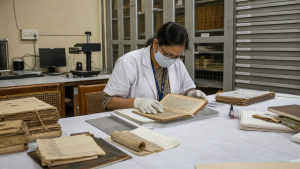
- Flagship mission: Gyan Bharatam Mission was announced in the Union Budget for FY 2025–26 to map, digitize, and preserve India’s manuscript heritage.
- Funding: The Standing Finance Committee sanctioned ₹491.66 crore for the mission for the six-year period from 2025 to 2031.
- National Manuscript Survey: Launched on March 16, 2026, it aims to create a geo-tagged national repository and a comprehensive “Manuscript Presence Map”.
- Scale of coverage: As of August 2026, over 1.19 crore manuscripts had been reported under the survey.
- Digitization: More than 4.40 lakh digitized manuscripts were available for public access on the Gyan Bharatam portal.
Kala Sanskriti Vikas Yojana
- Umbrella scheme: Kala Sanskriti Vikas Yojana (KSVY) is a Central Sector Scheme for direct financial support to artists and cultural organisations.
- Guru-Shishya Parampara: Under the Repertory Grant component, approved Gurus receive ₹15,000 per month and Shishyas receive ₹2,000 to ₹10,000 per month.
- Cultural Function and Production Grant Scheme: The CFPGS provides up to ₹5 lakh per project and up to ₹20 lakh in exceptional cases.
- Eligible activities: Support is given for seminars, research, workshops, festivals, exhibitions, and music productions.
- Himalayan cultural heritage: Annual grants go up to ₹10 lakh, and up to ₹30 lakh in exceptional cases, for preservation of Himalayan cultural heritage.
- Buddhist/Tibetan heritage: Annual grants go up to ₹30 lakh, and up to ₹1 crore in exceptional cases, for preservation of Buddhist/Tibetan heritage.
- Artists Pension Scheme: This component gives a monthly pension of ₹4,000 to indigent artists and scholars aged 60 and above with annual income below ₹48,000.
Seva Bhoj Yojana
- Launch: Seva Bhoj Yojana was launched in August 2018 as a Central Sector Scheme.
- Purpose: It reimburses the CGST and the Central Government’s share of IGST on raw food items used by eligible institutions serving free meals.
- Eligible items: Reimbursement applies only to ghee, edible oil, sugar/burra/jaggery, rice, atta/maida/rava/flour, and pulses.
- Eligible institutions: Charitable and religious institutions such as temples, gurudwaras, mosques, churches, dargahs, and monasteries are covered.
- Conditions: The institution must have existed for at least five years and serve free food to at least 5,000 people in a month.
- Tax coverage limit: The scheme does not reimburse SGST or the state’s share of IGST.
National Mission on Cultural Mapping and Mera Gaon Meri Dharohar
- NMCM: The National Mission on Cultural Mapping is meant to document India’s cultural resources at the village level.
- MGMD portal: “Mera Gaon Meri Dharohar” was launched on July 27, 2023, to culturally map approximately 6.5 lakh villages.
- Seven categories: Village cultural profiles are classified under Arts and Crafts, Ecologically Oriented, Scholastic, Epic, Historical, Architectural Heritage, and other prominent features.
- Nature of portal: It is a cultural database and not a registry for individual artists or a platform for direct financial assistance.
- No social security role: NMCM and MGMD do not provide insurance, pensions, or social security benefits.
- No operational integration: The initiative is not linked with tourism or education delivery mechanisms.
Adopt a Heritage 2.0 Programme
- Launch: The revamped Adopt a Heritage 2.0 programme was launched by the Archaeological Survey of India in September 2023.
- Objective: It invites corporate stakeholders, NGOs, and public or private companies to partner in monument upkeep.
- CSR funding: Sponsors use Corporate Social Responsibility funds under Section 135 of the Companies Act, 2013.
- Scope: Funds are used to develop, upgrade, and maintain visitor amenities at centrally protected monuments.
- No ownership transfer: Private or public entities do not get ownership or operational control of the monuments.
- MoUs: As of March 2026, 30 Memorandums of Understanding had been signed under the framework.
Key Prelims Takeaways
- Central Sector nature: Schemes like KSVY and Seva Bhoj Yojana are fully funded by the Central Government.
- Difference from CSS: Centrally Sponsored Schemes involve cost-sharing with state governments, unlike Central Sector Schemes.
- Seva Bhoj reimbursement: The scheme covers only CGST and the Central share of IGST, not SGST.
- Limited food basket: Seva Bhoj Yojana applies only to six notified raw food items.
- Gyan Bharatam focus: The mission aims at mapping, digitizing, and preserving manuscript heritage through a geo-tagged repository.
- MGMD limitation: Mera Gaon Meri Dharohar is a village cultural mapping portal, not an employment or social welfare platform.
- Adopt a Heritage 2.0: Corporate or NGO participation is limited to visitor amenities and monument upkeep, not monument ownership.
Current General Studies comprises current-affairs-based, General Studies-rich study material on policies, laws, institutions, economy, science, environment, governance, international relations, and other varied but important topics for UPSC and State PSC Prelims examinations.
Fortnightly PDF compilations: Available here
Originally written on
March 1, 2026
and last modified on
September 5, 2026.
| Related | |
|---|---|