India’s Nuclear Triad and Strategic Forces
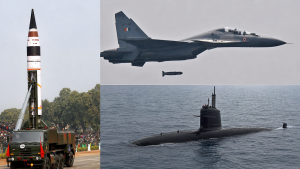
India’s nuclear triad gives it a survivable second-strike capability through land-based missiles, air-delivered weapons, and sea-based ballistic missile submarines. The system is designed to deter nuclear attack by ensuring retaliation under a civilian-controlled command structure.
Nuclear Doctrine and Command Structure
India’s nuclear posture is guided by the 2003 official doctrine, which rests on No First Use (NFU) and Credible Minimum Deterrence (CMD). Under this policy, nuclear weapons are intended only for retaliation in response to a nuclear attack on Indian territory or Indian forces anywhere.
- Political control: The Nuclear Command Authority (NCA) is fully civilian-led and governs all nuclear assets.
- Launch authority: The Political Council, chaired by the Prime Minister, has the sole authority to authorise nuclear use.
- Executive support: The Executive Council, chaired by the National Security Advisor, provides inputs and advice.
- Operational execution: The tri-service Strategic Forces Command (SFC) carries out directives related to nuclear forces.
- Readiness posture: India historically kept warheads stored separately from delivery systems in a recessed posture; recent assessments point to a shift toward higher readiness, including deployed sea-based warheads.
The Sea-Based Leg: Arihant-Class SSBNs
The sea leg is the most survivable part of the triad because submarines are harder to detect and can remain at sea for long periods. India’s indigenous nuclear-powered ballistic missile submarines (SSBNs) provide this crucial second-strike capability.
- INS Arihant: Commissioned in 2016, it was India’s first SSBN.
- INS Arighaat: Commissioned on August 29, 2024.
- INS Aridhaman (S4): Commissioned on April 3, 2026.
- S4″: Launched in October 2024 and undergoing advanced sea trials, with commissioning expected in 2027.
- Vessel design: INS Arihant and INS Arighaat are about 6,000 tonnes and have four vertical launch tubes.
- Expanded capability: The stretched 7,000-tonne INS Aridhaman and the upcoming S4″ are fitted with eight vertical launch tubes, increasing missile capacity.
- SLBMs: The submarines deploy the K-15 Sagarika and K-4 solid-fuel submarine-launched ballistic missiles.
- Range: K-15 has a range of about 750 km, while K-4 has a range of about 3,500 km.
- K-series naming: The K-series missiles are named after former President Dr. APJ Abdul Kalam.
The Land-Based Leg: Agni and Prithvi Missiles
The land leg provides long-range strike capability and fast response through road-mobile ballistic missiles. Many of these missiles are solid-fuelled, which improves readiness and mobility.
- Agni-V: A three-stage, road-mobile missile officially classified as an Intermediate-Range Ballistic Missile (IRBM).
- Range estimate: Defence experts assess Agni-V’s range to be around 5,500 km to 8,000 km, placing it in the intercontinental category.
- Canisterisation: Modern missiles such as Agni-V are canisterised, which protects them from environmental degradation and enables rapid transport and launch.
- Warhead integration: Canisterisation also allows warheads to be mated with the missile for quicker deployment.
- Other missiles: The land-based arsenal includes Prithvi-II, Agni-I, Agni-II, Agni-III, and Agni-IV to cover different strategic ranges.
The Air-Based Leg: Aerial Platforms
The air leg is the oldest and most flexible part of the triad. Aircraft can be recalled after launch, making them a useful and controllable nuclear delivery option.
- Delivery role: The Indian Air Force maintains specially configured fighter-bomber platforms for nuclear delivery.
- Aircraft platforms: These include the Dassault Mirage 2000H, SEPECAT Jaguar, Su-30MKI, and Rafale.
- Command chain: Although these aircraft belong to the Air Force, nuclear delivery missions are planned and commanded by the Strategic Forces Command.
Key Prelims Takeaways
- Nuclear triad: India has land-based missiles, air-delivered weapons, and sea-based SSBNs for a survivable deterrent.
- Doctrine: The nuclear posture is based on No First Use and Credible Minimum Deterrence.
- Authority: Only the Political Council of the Nuclear Command Authority can authorise nuclear use.
- SFC: The Strategic Forces Command is a tri-service command established in 2003 under the Ministry of Defence.
- Sea leg: INS Arihant, INS Arighaat, and INS Aridhaman are commissioned SSBNs; S4* is under trial.
- Missile family: The K-15 and K-4 missiles provide the sea-based second-strike capability.
- Recent estimates: SIPRI Yearbook 2026 estimated India’s nuclear warhead stockpile at 190, up from 180 in 2025.
| Related | |
|---|---|