ICAO: Functions, Conventions and Protocols
The International Civil Aviation Organization (ICAO) is the UN’s specialized agency for setting global rules for civil aviation. Created under the 1944 Chicago Convention, it works with member states to promote safe, secure and environmentally sustainable international air transport.
Structure and Governance
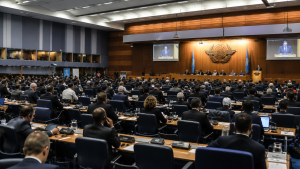
ICAO functions through three main bodies: the Assembly, the Council and the Air Navigation Commission (ANC).
- The Assembly: The sovereign body of ICAO, with representatives from all 193 member states. It meets once every three years to review work, adopt resolutions and approve the triennial budget.
- The Council: The permanent governing body responsible to the Assembly. It oversees ICAO’s work and is central to the adoption and implementation of international aviation standards.
- The Air Navigation Commission (ANC): The technical body responsible for developing Standards and Recommended Practices (SARPs) and advising on air navigation matters.
- Key leadership: Juan Carlos Salazar of Colombia serves as Secretary General. Toshiyuki Onuma of Japan serves as President of the ICAO Council. Frédéric Fachinan serves as President of the ANC.
Exam fact: ICAO has 193 member states and is headquartered in Montreal, Canada.
Chicago Convention and Legal Framework
The Chicago Convention remains the core treaty governing international civil aviation. It establishes the basic legal framework for global air transport and is supported by Annexes containing detailed SARPs.
- Standards and Recommended Practices (SARPs): These are global technical norms adopted by ICAO. Member states are expected to implement them or formally notify a difference.
- Article 3 bis: This important provision prohibits the use of weapons against civil aircraft in flight and requires states to refrain from endangering the lives of persons on board.
- Annex system: ICAO Annexes cover areas such as safety, accident investigation, environment and security, and are regularly updated through amendments.
Important Annexes and Amendments
- Annex 13: Deals with aircraft accident and incident investigation. Amendment 20, adopted in March 2026, aims to protect safety investigations from conflicts of interest and preserve objective findings.
- Annex 16: Covers environmental protection. Amendments 15, 12 and 3 to Volumes I, II and III introduce new aircraft noise standards and CO2 emissions evaluation metrics, with effect from January 1, 2027.
- Annex 19: Relates to safety management. Amendment 2, applicable from November 26, 2026, moves safety management systems from a compliance-only approach to a performance-based, intelligence-driven framework.
- Safety objective: ICAO’s standards are meant to strengthen operational safety, accident prevention and regulatory consistency across states.
CORSIA and Environmental Commitments
ICAO leads the global aviation response to greenhouse gas emissions through the Carbon Offsetting and Reduction Scheme for International Aviation (CORSIA). It is part of the wider climate framework for international air transport.
- Strategic goal: ICAO’s Strategic Plan (2026–2050) focuses on zero fatalities and net-zero carbon emissions in international civil aviation by 2050.
- CORSIA purpose: It requires airlines to offset growth in international aviation CO2 emissions beyond a fixed baseline.
- Phase 1: Runs from 2024 to 2026 and is voluntary, with 130 states participating.
- Phase 2: Begins on January 1, 2027, and becomes mandatory for all non-exempt contracting states.
- Baseline: For both phases, the baseline is 85% of the CO2 emissions reported in 2019.
- Credit rule: Phase 1 requires carbon offset credits with a corresponding adjustment under Article 6 of the Paris Agreement.
- Double counting: The corresponding adjustment mechanism prevents the same emission reduction from being counted by both the host country and the airline operator.
| CORSIA Parameter | Phase 1 (2024–2026) | Phase 2 (from January 1, 2027) |
| Participation | Voluntary; 130 states participating | Mandatory for all non-exempt contracting states |
| Baseline | 85% of 2019 CO2 emissions | 85% of 2019 CO2 emissions |
| Offset rule | Credits with corresponding adjustment under Article 6 of the Paris Agreement | Approved eligible carbon offset units |
Key Prelims Takeaways
- ICAO: UN specialized agency for international civil aviation, established by the 1944 Chicago Convention.
- Membership: ICAO has 193 member states.
- Main bodies: Assembly, Council and Air Navigation Commission (ANC).
- Assembly: Meets once every three years to review work and approve the budget.
- Article 3 bis: Prohibits the use of weapons against civil aircraft in flight.
- Annex 13, 16 and 19: Key annexes covering accident investigation, environment and safety management.
- CORSIA: ICAO’s main mechanism for controlling international aviation emissions.
| Related | |
|---|---|