Major Sports Injuries and Rehabilitation in Athletes
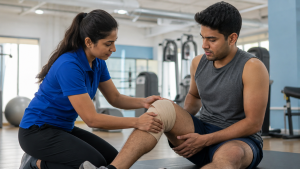
Sports injuries are common during athletic participation or exercise and mainly affect the musculoskeletal system. They may result from sudden trauma, repetitive strain, poor training methods, or equipment failure, and proper rehabilitation is essential for recovery and return to performance.
Classification of Sports Injuries
Sports injuries are generally classified into two broad categories based on their onset and duration.
Acute Injuries
- Sudden onset: These occur suddenly during physical activity due to a specific traumatic event.
- Common symptoms: Sudden severe pain, immediate swelling, inability to bear weight, and visible joint dislocation.
- Examples: Fractures, sprains, strains, and concussions.
Chronic and Overuse Injuries
- Gradual development: These develop over time due to repetitive strain on muscles, joints, or bones.
- Common symptoms: Dull aching pain during rest, swelling that increases after activity, and persistent stiffness.
- Examples: Tendinitis, stress fractures, and bursitis.
Common Sports Injuries and Affected Athletes
Different sports place unique physical demands on athletes, leading to specific injury patterns.
Anterior Cruciate Ligament (ACL) Tear
- Structure affected: The ACL stabilizes the knee joint by preventing the tibia from sliding in front of the femur.
- Typical cause: Sudden deceleration, pivoting, or landing from a jump.
- High-risk sports: Football, basketball, skiing, and rugby.
Concussion
- Nature of injury: A traumatic brain injury caused by a direct blow to the head, neck, or body.
- Symptoms: Headaches, dizziness, memory loss, and balance problems.
- High-risk sports: Boxing, rugby, and American football.
Tennis Elbow (Lateral Epicondylitis)
- Structure affected: Tendons that join the forearm muscles to the outside of the elbow.
- Typical cause: Repetitive wrist extension and forearm rotation.
- Commonly affects: Racket sport players, golfers, and weightlifters.
Shin Splints (Medial Tibial Stress Syndrome)
- Structure affected: Pain along the inner edge of the shinbone (tibia).
- Typical cause: Repetitive stress on the tibia and connective tissues.
- Commonly affects: Runners, dancers, and military recruits.
Rotator Cuff Injury
- Structure affected: A group of four muscles and tendons that stabilize the shoulder joint.
- Typical cause: Repetitive overhead motions or acute trauma.
- High-risk sports: Swimming, baseball pitching, javelin throw, and tennis.
Summary of Major Sports Injuries
| Injury Name | Primary Structure Affected | Typical Causes | High-Risk Sports |
| ACL Tear | Knee ligament | Sudden twisting, rapid deceleration | Football, basketball, skiing |
| Concussion | Brain | Head impact, violent shaking | Rugby, boxing, ice hockey |
| Tennis Elbow | Elbow tendons | Repetitive forearm gripping and extension | Tennis, squash, golf |
| Shin Splints | Tibia (shinbone) | Repetitive impact on hard surfaces | Running, gymnastics |
| Rotator Cuff Tear | Shoulder tendons | Repetitive overhead arm movements | Swimming, baseball, cricket |
| Hamstring Strain | Thigh muscle | Explosive sprinting, sudden acceleration | Athletics, football |
Modern Rehabilitation Methodologies
Rehabilitation restores physical function, strength, and mobility to injured athletes. Treatment plans are tailored to the type and severity of injury.
Standard Acute Care Protocols
- PRICE protocol: Protect, Rest, Ice, Compression, and Elevation.
- POLICE protocol: Protect, Optimal Loading, Ice, Compression, and Elevation.
- Key benefit: Replacing rest with optimal loading helps maintain tissue strength and prevent joint stiffness.
Advanced Therapeutic Interventions
- Platelet-Rich Plasma (PRP) Therapy: Concentrated blood platelets from the patient are injected into the injured area to accelerate healing of damaged tendons and ligaments.
- Cryotherapy: Athletes are exposed to sub-zero temperatures in specialized chambers to reduce muscle soreness, limit inflammation, and speed recovery.
- Hyperbaric Oxygen Therapy (HBOT): Patients breathe pure oxygen in a pressurized chamber to increase oxygen delivery to tissues and promote repair.
- Hydrotherapy: Rehabilitation exercises are conducted in water, where buoyancy reduces joint loading and allows training without straining healing tissues.
Phases of Sports Rehabilitation
A structured rehabilitation program usually consists of five sequential phases.
Phase 1: Pain and Inflammation Control
- Goal: Reduce swelling, pain, and tissue inflammation.
- Methods: Active rest, ice application, and compression garments.
Phase 2: Range of Motion (ROM) Restoration
- Goal: Restore full movement to the injured joint or limb.
- Methods: Passive and active stretching exercises to prevent scar tissue restriction.
Phase 3: Strength and Endurance Rebuilding
- Goal: Rebuild lost muscle mass and improve muscular endurance.
- Methods: Progressive resistance exercises.
Phase 4: Proprioception and Coordination Training
- Proprioception: The body’s ability to sense its position in space.
- Methods: Balance boards and agility ladders help restore neuromuscular control.
- Importance: This training is vital to prevent future injury to the same structure.
Phase 5: Sport-Specific Conditioning
- Goal: Prepare the athlete physically and mentally for return to competitive play.
- Methods: Movements that mimic the athlete’s specific sport discipline.
Preventive Measures in Sports
Preventive strategies reduce the occurrence and severity of athletic injuries.
- Dynamic Warm-up: Active movements like lunges and leg swings prepare muscles and joints for physical exertion.
- Static Stretching: Stretching after training improves muscle elasticity and flexibility.
- Periodization: Coaches divide training into phases to balance high-intensity work with adequate rest and prevent overtraining.
- Biomechanics Analysis: High-speed cameras and sensors identify movement inefficiencies that could cause chronic strain.
- Nutritional Support: Proper hydration maintains joint lubrication and muscle function, while protein-rich diets support tissue repair and muscle reconstruction.
Rare Facts for Prelims
- Meniscus function: The knee menisci act as shock absorbers and also help distribute body weight across the joint.
- Concussion recovery: Return-to-play decisions after concussion are usually based on a stepwise symptom-free progression rather than immediate clearance.
- ACL anatomy: The ACL is one of the two cruciate ligaments in the knee, along with the posterior cruciate ligament (PCL).
- Shin splints terminology: Medial tibial stress syndrome is a more precise medical term than the common phrase “shin splints.”
- Hydrotherapy advantage: Water resistance allows low-impact strengthening while reducing stress on healing joints.
- Periodization use: This training method is widely used in elite sport to peak performance for major competitions while lowering injury risk.
| Related | |
|---|---|