Types of Security Restrictions in Border Regions
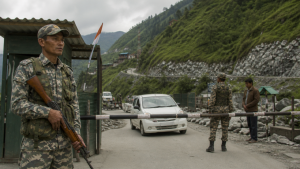
India shares about 15,106.7 km of land borders and 7,516.6 km of coastline with neighboring countries. To protect border regions from illegal migration, smuggling, and security threats, the government enforces different restrictions on movement, entry, and certain activities in sensitive areas.
Inner Line Permit (ILP)
The Inner Line Permit is required for Indian citizens from other states before entering certain protected states.
- Legal basis: Bengal Eastern Frontier Regulation Act, 1873.
- Purpose: To protect the demographic balance, culture, and land rights of indigenous tribal communities.
- States requiring ILP: Arunachal Pradesh, Mizoram, Nagaland, and Manipur.
- Issuing authority: State governments, either online or at designated entry points.
- Stay limit: The duration of stay is restricted and must be renewed if extended.
Protected Area Permit (PAP)
The Protected Area Permit regulates the entry and stay of foreign nationals in sensitive border areas.
- Legal basis: Foreigners (Protected Areas) Order, 1958, under the Foreigners Act, 1946.
- Applicability: Entire states of Arunachal Pradesh, Manipur, Mizoram, Nagaland, and Sikkim.
- Also applicable to: Certain border areas in Himachal Pradesh, Uttarakhand, Jammu & Kashmir, and Rajasthan.
- Special approval: Citizens of Pakistan, Bangladesh, China, and Afghanistan require prior approval from the Ministry of Home Affairs.
- General rule: PAPs are usually issued to foreign tourists in groups of two or more through registered travel agencies.
Reimposition of Protected Area Regime
The Ministry of Home Affairs reinstated the Protected Area Regime in Manipur, Mizoram, and Nagaland due to concerns over illegal immigration and border instability along the Myanmar border.
Foreigners visiting these states must obtain a PAP and register with the local Foreigners Registration Officer within 24 hours of arrival.
Restricted Area Permit (RAP)
The Restricted Area Permit is required for foreign nationals visiting certain designated areas.
- Legal basis: Foreigners (Restricted Areas) Order, 1963.
- Coverage: Parts of Sikkim and the Union Territory of Andaman and Nicobar Islands.
- Application: Unlike PAP, individual foreign travelers can apply for RAP.
- Issuance: It may be issued on arrival at certain international airports, such as Port Blair.
- Relaxation: In 2018, RAP requirements were relaxed for 30 inhabited islands in Andaman and Nicobar to promote tourism, though security checks continue.
BSF Operational Jurisdiction Limits
The Border Security Force is the main agency guarding India’s borders with Pakistan and Bangladesh.
- Legal basis: Section 139 of the Border Security Force Act, 1968.
- Operational limit: A 50-km belt from the international border.
- States covered: Punjab, West Bengal, Assam, Rajasthan, and Gujarat.
- Powers within the zone: Search, seizure, and arrest of suspects.
- Applicable offences: Under the Criminal Procedure Code, the Passport (Entry into India) Act, and the Passports Act.
- Handing over rule: Arrested persons must be handed to the local police within 24 hours.
Constitutional and Federalism Concerns
The expansion of the BSF’s operational belt to 50 km was challenged by states such as Punjab and West Bengal, which argued that it affected state powers over law and order. These disputes are examined by the Supreme Court under its original jurisdiction.
BSF jurisdiction in border states is a recurring federalism issue.
Restrictions on Border Infrastructure and Projects
The Ministry of Home Affairs has issued strict rules for projects near international borders.
- Current guidelines: Issued on August 8, 2026.
- Blanket ban: New solar, wind, and hybrid renewable energy projects are banned within 1 km of the International Border (IB), Line of Control (LoC), and Line of Actual Control (LAC).
- Sensitive zone: Projects within 50 km of these borders require security clearance from the Ministry of Home Affairs.
- Additional requirement: Projects between 1 km and 20 km of the border need a No Objection Certificate (NOC) from the Ministry of Defence.
- Labour restriction: Developers cannot employ labour or engineers from land-border countries such as Pakistan, China, and Bangladesh without central government permission.
- Application route: New proposals must be submitted to the Ministry of New and Renewable Energy (MNRE).
- Security cost: Developers must bear the cost of mandatory security measures, including anti-drone systems operated by CISF or state police.
- Land transfer: Transfer of project land to any foreign company requires prior clearance from the Ministry of Home Affairs and the Central government.
- Existing projects: Projects already cleared by MHA or the Ministry of Defence before these guidelines do not need to reapply.
IB is the recognized India-Pakistan boundary in most sectors, LoC separates Indian-administered and Pakistan-administered Jammu & Kashmir, and LAC is the de facto India-China boundary.
Disturbed Areas and AFSPA Restrictions
The Armed Forces (Special Powers) Act, 1958 gives special powers to the armed forces in disturbed border regions.
- Legal basis: Section 3 of AFSPA, 1958.
- Declaration: The Central government or a state governor can declare an entire state or specific districts as a disturbed area.
- Powers: Arrest without warrant, search premises, and prohibit assembly of five or more persons.
- Current areas: Parts of Nagaland, Assam, Manipur, Jammu & Kashmir, and some border districts of Arunachal Pradesh.
- Review: Notifications are reviewed every six months.
Defensive Buffer Zones and Fencing Rules
Border infrastructure is also regulated by bilateral and domestic rules.
- India-Bangladesh rule: Under the 1975 Joint India-Bangladesh Guidelines, permanent defensive structures cannot be built within 150 yards of the zero line.
- Effect: This buffer restricts civil construction, farming, and infrastructure near the border.
- Trade and movement: The Land Ports Authority of India regulates cross-border trade and passenger movement through Integrated Check Posts (ICPs) and Land Customs Stations.
Comparison of Travel-Related Security Permits
| Feature | Inner Line Permit (ILP) | Protected Area Permit (PAP) | Restricted Area Permit (RAP) |
| Applicability | Indian citizens (non-residents) | Foreign nationals | Foreign nationals |
| Primary law | Bengal Eastern Frontier Regulation Act, 1873 | Foreigners (Protected Areas) Order, 1958 | Foreigners (Restricted Areas) Order, 1963 |
| Key states/areas | Arunachal Pradesh, Mizoram, Nagaland, Manipur | Arunachal Pradesh, Sikkim, Manipur, Mizoram, Nagaland, parts of Himachal Pradesh, Uttarakhand, Jammu & Kashmir, Rajasthan | Parts of Sikkim, Andaman and Nicobar Islands |
| Issuing authority | Respective state governments | Ministry of Home Affairs or delegated state authorities | Ministry of Home Affairs or delegated authorities |
Rare Facts for Prelims
- ILP origin: The Inner Line system was originally introduced by the British to control movement into tribal frontier areas.
- PAP and tourism: PAP rules are often relaxed for organized foreign tourist groups, but not for all individual travelers.
- RAP in Andaman: Port Blair is one of the few places where RAP can sometimes be issued on arrival.
- BSF powers: The BSF’s arrest powers are limited and it must transfer the accused to state police quickly.
- AFSPA review cycle: Disturbed-area notifications under AFSPA are reviewed every six months, not indefinitely.
- Border project vetting: Renewable energy projects near borders now fall under a security-linked clearance process involving both MHA and MNRE.
| Related | |
|---|---|