Important Rocket Engine Types and Propulsion Systems
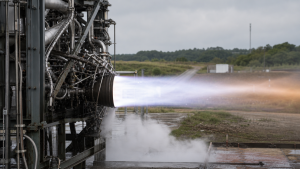
Rocket propulsion works on Newton’s Third Law: a rocket produces thrust by expelling mass at high speed in the opposite direction. Modern propulsion systems range from solid and liquid engines to electric, nuclear, and advanced reusable cycles, with efficiency commonly measured by specific impulse.
Fundamentals of Rocket Propulsion
- Newton’s Third Law: Every action has an equal and opposite reaction.
- How thrust is produced: A rocket engine burns fuel and oxidizer to create high-pressure gas that exits through a nozzle and generates forward thrust.
- Unlike jet engines: Rocket engines carry their own oxidizer and can operate in the vacuum of space.
- Specific impulse (Isp): A key measure of engine efficiency, representing thrust produced per unit of propellant consumed per second.
- Thrust-to-weight ratio: A rocket must generate thrust greater than its total weight to lift off.
Classification by Propellant State
Solid Propulsion Systems
- Construction: Solid rocket motors store fuel and oxidizer pre-mixed as a solid chemical compound called the grain.
- Operation: Once ignited, they burn continuously until all propellant is exhausted and cannot be easily throttled or shut down.
- Use: They provide massive thrust at liftoff but have lower specific impulse than liquid engines.
- Example: The S139 rocket motor used as the first stage of the Polar Satellite Launch Vehicle (PSLV) is a solid motor.
- Typical composition: Ammonium perchlorate as oxidizer, atomized aluminum powder as fuel, and hydroxyl-terminated polybutadiene (HTPB) as binder.
Liquid Propulsion Systems
- Construction: Liquid engines store liquid fuel and liquid oxidizer in separate tanks and pump them into a combustion chamber.
- Flexibility: These engines can be throttled, shut down, and restarted mid-flight, allowing precise trajectory control.
- Complexity: Liquid systems require turbopumps, valves, and injectors.
- Example: The Vikas engine used in the second stage of the PSLV and the LVM3 is a liquid propellant engine.
- Common propellant pairs: Kerosene (RP-1) and liquid oxygen, or unsymmetrical dimethylhydrazine (UDMH) and nitrogen tetroxide.
Hybrid Propulsion Systems
- Construction: Hybrid rocket engines use propellants in two different states of matter, usually a solid fuel and a liquid or gaseous oxidizer.
- Advantage: They combine the safety of solid rockets with the throttle control of liquid systems.
- Shutdown: The engine stops immediately when the flow of liquid or gaseous oxidizer is cut off.
- Example: SpaceShipTwo, developed by Virgin Galactic, uses a hybrid rocket motor with solid polyamide fuel and liquid nitrous oxide oxidizer.
Thermodynamics of Liquid Rocket Cycles
Gas-Generator Cycle
- Type: An open cycle where a small portion of propellants burns in a separate burner to power the turbopumps.
- Feature: The turbopump exhaust is dumped overboard, making the cycle mechanically simpler but less efficient.
- Examples: The Merlin 1D engine used in Falcon 9 and the Vikas engine operate on this cycle.
Staged Combustion Cycle
- Type: A closed cycle where turbopump exhaust is routed directly into the main combustion chamber.
- Feature: All propellants are burned completely, resulting in high chamber pressures and superior efficiency.
- Examples: The Raptor engine and the Russian RD-180 engine use this thermodynamic cycle.
Expander Cycle
- Working: The liquid fuel passes through cooling jackets around the nozzle, absorbs heat, and turns gaseous.
- Function: The heated fuel drives the turbopumps before entering the combustion chamber to burn.
- Limitation: It is highly efficient but generally restricted to smaller engines because of heat-transfer limits.
- Example: The RL10 is an upper-stage engine that uses this cycle.
Full-Flow Staged Combustion (FFSC)
- Type: A high-performance liquid rocket engine cycle in which both propellants pass through separate preburners to drive their turbopumps before entering the main combustion chamber.
- Advantage: It offers higher efficiency and lower thermal stress than simpler cycles.
- Current-status fact: On August 7, 2026, Bengaluru-based Astrobase Space Technologies unveiled EVEREST, India’s first privately built 80-tonne-class FFSC rocket engine.
- Current-status fact: EVEREST uses liquid oxygen (LOX) and liquid methane, generates 800 kilonewtons of thrust, and is designed for reusable medium-lift launch vehicles.
- Current-status fact: The engine has a specific impulse of about 340 seconds and a throttle range of 50% to 110%.
Cryogenic Propulsion Systems
- Propellants: Cryogenic engines use supercooled liquid gases, typically liquid hydrogen (LH2) at -253°C as fuel and liquid oxygen (LOX) at -183°C as oxidizer.
- Efficiency: This combination yields the highest specific impulse among chemical propellants, making it suitable for upper stages.
- Engineering needs: The extreme temperatures require specialized metallurgy, vacuum-jacketed insulation, and high-speed turbopumps.
- Indian examples: The CE-7.5 and CE-20 engines are cryogenic engines developed for the upper stages of the GSLV and LVM3 launch vehicles.
Electric and Ion Propulsion
- Working principle: Electric propulsion systems use electrical power to ionize and accelerate propellant particles to very high velocities.
- Thrust and efficiency: They produce low thrust but extremely high specific impulse, making them highly efficient for long-duration space flight.
- Applications: Used for satellite orbit raising, station-keeping, and deep-space science missions.
- Gridded ion thrusters: Use high-voltage electrostatic grids to accelerate ions; the Deep Space 1 mission used this technology.
- Hall effect thrusters: Trap electrons in a magnetic field to ionize propellant atoms, which are then accelerated by an electric field.
- Preferred propellants: Xenon and krypton are commonly used because of their high molecular weight and low ionization energy.
Advanced and Sustainable Propulsion Technologies
Nuclear Thermal Propulsion (NTP)
- Working: A small nuclear fission reactor heats liquid hydrogen propellant into a high-temperature gas.
- Result: The gas expands rapidly and exits through a nozzle to produce thrust.
- Importance: It offers about double the efficiency of cryogenic chemical rockets and is a candidate for future human missions to Mars.
Rotating Detonation Rocket Engine (RDRE)
- Working: An RDRE generates thrust using continuous supersonic detonation waves that travel around a circular channel.
- Advantage: It consumes less fuel and generates higher pressure than conventional constant-pressure combustion engines.
- Status: Space agencies are testing experimental RDRE prototypes to improve deep-space propulsion efficiency.
Green Propellants
- Need: Conventional storable propellants like hydrazine are toxic and require hazardous handling procedures.
- Alternatives: Green propellants include non-toxic blends based on hydroxylammonium nitrate (HAN) or hydrogen peroxide.
- Research: Eco-friendly solid propellants based on Glycidyl Azide Polymer (GAP) as fuel and Ammonium Dinitramide (ADN) as oxidizer are being developed to reduce toxic emissions.
Comparison of Propulsion Technologies
| Propulsion Category | Propellant Types | Specific Impulse (Seconds) | Thrust Range | Main Applications |
| Solid | Ammonium Perchlorate + HTPB | 250 – 300 | Very High | First-stage liftoff, missile systems |
| Liquid (Storable) | UDMH + Nitrogen Tetroxide | 290 – 340 | Medium to High | Core stages, spacecraft maneuver thrusters |
| Cryogenic | Liquid Hydrogen + Liquid Oxygen | 440 – 460 | Medium to High | Upper-stage launch vehicles |
| Electric / Ion | Xenon, Krypton | 1,500 – 8,000 | Very Low | Satellite station-keeping, deep space |
Space Flight Terminology and Concepts
- Ullage motors: Small solid-propellant rocket motors fired briefly to settle liquid propellants at the bottom of tanks before main engine ignition in microgravity.
- Gimballing: The mechanical rotation of a rocket engine nozzle to change the thrust vector, enabling steering and stability control.
- Hypergolic propellants: Propellants that ignite spontaneously on contact, eliminating the need for an external ignition system.
- Pogo oscillation: A dangerous vibration caused by unstable combustion coupled with propellant feedline pressures, which can damage the rocket structure.
Rare Facts for Prelims
- LOX-methane advantage: Liquid methane is increasingly preferred in reusable launch vehicles because it burns cleaner than kerosene and can reduce engine refurbishment time.
- IN-SPACe role: IN-SPACe functions as the regulatory and promotional body for private space activities in India under the Department of Space.
- Astrobase funding: Astrobase Space Technologies was selected under IN-SPACe’s Technology Adoption Fund on June 10, 2026, for indigenous development of the 800 kN LOX-methane engine.
- Testing timeline: The company completed sub-scale hot-fire tests in September 2025 and turbopump trials in January 2026.
- Manufacturing scale: Astrobase’s Bengaluru facility covers 46,000 square feet and uses India’s largest industrial metal 3D printer for core engine components.
- Test site size: Its dedicated propulsion test facility in Anantapur, Andhra Pradesh, spans 21.5 acres.
Current General Studies comprises current-affairs-based, General Studies-rich study material on policies, laws, institutions, economy, science, environment, governance, international relations, and other varied but important topics for UPSC and State PSC Prelims examinations.
Fortnightly PDF compilations: Available here
Originally written on
August 6, 2026
and last modified on
August 10, 2026.
| Related | |
|---|---|