Major Government Schemes for Women Farmers in India
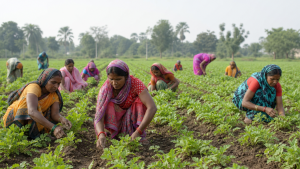
Women are central to Indian agriculture, from sowing and input management to post-harvest work and allied activities. To strengthen their incomes, access to technology, and decision-making power, the government has launched several targeted schemes, subsidies, and institutional support measures.
DAY-NRLM and Women’s Livelihood Support
- Mahila Kisan Sashaktikaran Pariyojana (MKSP): A sub-scheme of the Deendayal Antyodaya Yojana-National Rural Livelihoods Mission (DAY-NRLM), MKSP aims to empower women in agriculture through systematic investments in skills, practices, and productivity. By June 2025, 4.62 crore women farmers had adopted agro-ecological practices through this intervention.
- Lakhpati Didi Initiative: This DAY-NRLM initiative seeks to enable women Self-Help Group (SHG) members to achieve a sustainable annual household income of ₹1 lakh or more. The original target of 3 crore Lakhpati Didis was achieved ahead of the March 2027 timeline, and the target was later doubled to 6 crore by March 2029.
- Lakhpati Didi 2.0: Introduced in the Union Budget 2026–27, this provision allows women linked to SHGs to access interest-free loans of up to ₹5 lakh. Transactions and beneficiary tracking are managed through the LokOS mobile application.
Namo Drone Didi Scheme
- Scheme nature and outlay: The Namo Drone Didi Scheme is a Central Sector Scheme with a budgetary allocation of ₹1,261 crore for 2023–24 to 2025–26.
- Coverage target: The scheme aims to equip 15,000 women-led SHGs with agricultural drones so that they can provide rental services to farmers.
- Financial support: The central government provides 80% of the drone package cost, subject to a maximum subsidy of ₹8 lakh per SHG.
- Additional credit support: For the remaining cost, SHGs can access credit with a 3% interest subvention loan under the Agriculture Infrastructure Fund (AIF).
- Training package: Selected SHG members receive 15 days of drone pilot training, while drone assistants are given 5 days of training. The training covers safe operation, maintenance, and application of pesticides or fertilizers.
Krishi Sakhi Convergence Programme
- Institutional framework: The Krishi Sakhi Convergence Programme (KSCP) is a joint initiative of the Ministry of Agriculture & Farmers Welfare and the Ministry of Rural Development.
- Role of Krishi Sakhis: Rural women SHG members are trained and certified as “Krishi Sakhis” to work as para-extension workers and provide training and technical assistance to local farmers.
- Phase-1 coverage: The first phase covers 12 states: Gujarat, Tamil Nadu, Uttar Pradesh, Madhya Pradesh, Chhattisgarh, Karnataka, Maharashtra, Rajasthan, Odisha, Jharkhand, Andhra Pradesh and Meghalaya.
- Crop insurance outreach: In March 2026, the Agriculture Insurance Company of India (AIC) launched the Krishi Sakhi Initiative to use trained Krishi Sakhis for spreading awareness about crop insurance among rural women farmers.
Farm Mechanization and Marketing Support
- Sub-Mission on Agricultural Mechanization (SMAM): To promote gender parity in farm mechanization, SMAM earmarks 30% of its allocation for women farmers.
- Higher subsidy for women: Women farmers receive a 50% subsidy on agricultural machinery, compared to 40% for general category farmers.
- Implementation record: From 2014–15 to 2025–26, central assistance of ₹9,404.47 crore under SMAM supported the distribution of 21.61 lakh machines to individual farmers and the establishment of 27,554 Custom Hiring Centres (CHCs).
- Agricultural Marketing Infrastructure (AMI): Under this sub-scheme of the Integrated Scheme for Agricultural Marketing (ISAM), women beneficiaries receive a 33.33% capital subsidy for infrastructure creation in plain areas, compared to 25% for general beneficiaries.
PM-KISAN and Direct Income Support
- PM-KISAN: The Pradhan Mantri Kisan Samman Nidhi provides ₹6,000 annually to landholding farmer families in three equal installments.
- Women beneficiaries: Women farmers account for about 25% of the total beneficiaries under this direct benefit transfer (DBT) scheme.
- Recent disbursements: The 22nd installment, released on March 13, 2026, benefited over 2.15 crore women farmers out of 9.32 crore recipients. The 23rd installment was released on June 20, 2026.
Key Prelims Takeaways
- MKSP: A sub-scheme of DAY-NRLM focused on empowering women in agriculture and promoting agro-ecological practices.
- Lakhpati Didi: Aims for sustainable annual household income of ₹1 lakh or more for SHG women members.
- Lakhpati Didi 2.0: Provides interest-free loans of up to ₹5 lakh through SHG-linked access and LokOS tracking.
- Namo Drone Didi: Central Sector Scheme with 80% subsidy up to ₹8 lakh per SHG and credit support under AIF.
- KSCP: Jointly run by the Ministry of Agriculture & Farmers Welfare and the Ministry of Rural Development.
- SMAM: Earmarks 30% of allocation for women and gives them a 50% subsidy on farm machinery.
- AMI subsidy: Women get 33.33% capital subsidy in plain areas under ISAM’s marketing infrastructure component.
Current General Studies comprises current-affairs-based, General Studies-rich study material on policies, laws, institutions, economy, science, environment, governance, international relations, and other varied but important topics for UPSC and State PSC Prelims examinations.
Fortnightly PDF compilations: Available here
Originally written on
April 3, 2026
and last modified on
September 5, 2026.
| Related | |
|---|---|