India’s Integrated Defence Commands and Jointness
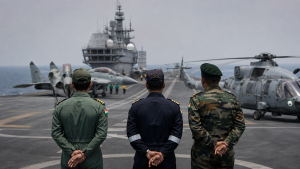
India is moving from a service-wise military setup toward a more integrated command structure. The aim is to improve coordination among the Army, Navy and Air Force, reduce duplication, and strengthen joint war-fighting capability.
Current Command Structure of the Indian Armed Forces
At present, India’s defence architecture is still largely organised around single-service commands, with a limited number of tri-service commands. This structure works, but it requires extensive coordination whenever joint operations are needed.
- 17 single-service commands: Seven each for the Army and the Air Force, and three for the Navy.
- Two tri-service commands: The Andaman and Nicobar Command (ANC) and the Strategic Forces Command (SFC).
- Andaman and Nicobar Command: Established in 2001 at Port Blair as a geographical tri-service command.
- Strategic Forces Command: Created in 2003 as a functional tri-service command to manage nuclear assets.
- Service-wise control: Each single-service command functions under its own service headquarters.
- Operational drawback: This can lead to duplication in logistics, administration and planning.
Inter-Services Organisations Act, 2023
To address jurisdictional and disciplinary issues in joint institutions, the government introduced a statutory framework for Inter-Services Organisations (ISOs) and joint commands.
- The Inter-Services Organisations (Command, Control and Discipline) Act, 2023: Enforced on May 10, 2024.
- Purpose: Empowers the central government to set up ISOs and Joint Services Commands.
- Inter-Services Organisations Rules, 2025: Notified on May 27, 2025 to operationalise the Act.
- Unified authority: Commanders-in-Chief and Officers-in-Command of notified ISOs can exercise administrative and disciplinary control over all attached personnel.
- Earlier limitation: A commander from one service could not take disciplinary action against personnel of another service, even in a joint setup.
- Parent service laws remain applicable: Personnel continue to be governed by the Army Act, 1950, the Air Force Act, 1950, or the Navy Act, 1957.
- Current notified ISOs: Andaman and Nicobar Command, Defence Space Agency, and National Defence Academy.
Proposed Integrated Theatre Commands
The Ministry of Defence has considered restructuring the existing command structure into theatre commands. The broad idea is to consolidate multiple service commands into unified geographical commands for faster decision-making and better use of resources.
| Proposed Theatre Command | Primary Focus Area | Proposed Headquarters | Expected Leadership |
| Northern Theatre Command | Borders with China | Lucknow | Indian Army Officer |
| Western Theatre Command | Borders with Pakistan | Jaipur | Indian Air Force Officer |
| Maritime Theatre Command | Indian Ocean Region | Thiruvananthapuram | Indian Navy Officer |
- Unified operational control: A single theatre commander would direct land, air and maritime assets in the assigned zone.
- Inter-service balance: The proposed commands are expected to be led by officers from the Army, Air Force and Navy respectively.
- Better resource use: Theatre commands are intended to replace compartmentalised planning with integrated deployment.
- Reduced duplication: The model aims to avoid repeated use of scarce operational and logistical assets.
Joint Support Initiatives and Operational Jointness
Alongside structural reforms, the armed forces are also building practical jointness through shared logistics and coordinated operations.
- Joint Logistics Nodes (JLNs): Operationalised in Mumbai, Guwahati and Port Blair.
- Purpose of JLNs: To support common handling of fuel, ammunition and supplies.
- Lead Service Concept: The Navy leads in Mumbai, the Army in Guwahati, and the Andaman and Nicobar Command in Port Blair.
- Operational significance: These nodes reduce duplication and improve supply efficiency.
- Joint exercises and planning: Such measures help standardise procedures across the services.
- Integrated response: Joint planning is intended to improve speed and coordination in crisis situations.
Why Jointness Matters
- Faster decision-making: A common command structure can reduce delays in execution.
- Better coordination: Army, Navy and Air Force assets can be used together more effectively.
- Resource optimisation: Shared logistics and unified planning help avoid duplication.
- Operational flexibility: Joint commands can adapt more quickly to different threat environments.
- Strategic effectiveness: Integrated structures are better suited to modern multi-domain warfare.
Key Prelims Takeaways
- Current structure: India has 17 single-service commands and 2 tri-service commands.
- Tri-service commands: Andaman and Nicobar Command and Strategic Forces Command.
- Andaman and Nicobar Command: Set up in 2001 at Port Blair as a geographical tri-service command.
- Strategic Forces Command: Created in 2003 to manage nuclear assets.
- ISO Act, 2023: Enforced on May 10, 2024, to enable unified command, control and discipline in ISOs.
- ISO Rules, 2025: Notified on May 27, 2025, to make the Act operational.
- Notified ISOs: Andaman and Nicobar Command, Defence Space Agency and National Defence Academy.
- Proposed theatre commands: Northern, Western and Maritime Theatre Commands.
- Joint Logistics Nodes: Function at Mumbai, Guwahati and Port Blair.
| Related | |
|---|---|