Chronology and Important Rulers of the Vijayanagara Empire
The Vijayanagara Empire was one of the most influential powers in South India from the fourteenth to the seventeenth century. It emerged as a strong political and cultural force, with its rulers shaping the history of the Deccan through expansion, administration, trade and patronage of literature and temples.
Foundation and Early Growth
The empire was founded in 1336 CE by Harihara I and Bukka Raya I of the Sangama dynasty. They established the capital at Vijayanagara on the southern bank of the Tungabhadra River, under the spiritual guidance of the sage Vidyaranya.
- Strategic role: The empire acted as a bulwark against northern Islamic sultanates.
- Regional control: It consolidated power over most of peninsular India south of the Krishna River.
- Early administration: The initial rulers laid the administrative base of a powerful state centered on military strength and expansion.
Sangama Dynasty Rulers
- Harihara I (1336-1356 CE): He established the early administrative foundations of the empire.
- Bukka Raya I (1356-1377 CE): He expanded control into the Madurai region and assumed the title Purvapaschima Samudradhipati.
- Devaraya I: The Sangama period saw continued consolidation, but the source text highlights Devaraya II as the peak ruler of this dynasty.
- Devaraya II (1424-1446 CE): He represented the height of Sangama power, employed Muslim cavalrymen in the army and patronized Kannada and Sanskrit literature.
Saluva and Tuluva Dynasties
Later, internal instability and provincial revolts weakened the Sangama house and led to the rise of the Saluva dynasty, followed by the more powerful Tuluva dynasty.
- Saluva Narasimha Deva Raya (1485-1491 CE): He restored internal order and strengthened coastal trade ports.
- Tuluva Narasa Nayaka: He founded the Tuluva line after the brief Saluva phase.
- Krishna Deva Raya (1509-1529 CE): He brought the empire to its golden age, defeated the Sultan of Golconda and the Gajapatis of Odisha, and maintained friendly trade relations with the Portuguese.
- Achyuta Deva Raya (1529-1542 CE): He tried to preserve territorial integrity amid growing internal rebellions.
- Sadaiva Raya (1543-1565 CE): He was the nominal ruler, while real administrative power was exercised by Aliya Rama Raya.
Golden Age under Krishna Deva Raya
The reign of Krishna Deva Raya marked the peak of Vijayanagara power in politics, warfare and culture. His court became a major centre of Telugu and Sanskrit learning, and the empire enjoyed strong commercial and diplomatic links with overseas traders.
- Military success: He defeated the Sultan of Golconda and the Gajapatis of Odisha.
- Trade: He maintained cordial relations with the Portuguese.
- Literature: He authored Amuktamalyada in Telugu and the Sanskrit drama Jambavati Kalyanam.
- Poets at court: His court included the Ashtadiggajas, the celebrated group of eight Telugu poets.
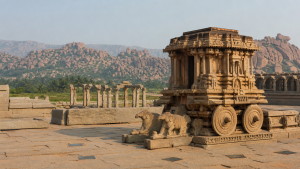
- Temple architecture: The empire left important monuments such as the Vitthala Temple complex with musical pillars and the Hazara Rama Temple, known for Ramayana reliefs and its role as a royal chapel.
Decline, Talikota and Aravidu Dynasty
The empire suffered a decisive setback in 1565 CE at the Battle of Talikota, when a coalition of the northern Deccan sultanates defeated the Vijayanagara forces. This battle shattered central military authority and marked the beginning of the empire’s decline.
- After Talikota: The victorious confederacy sacked, looted and depopulated the capital city over several months.
- Aliya Rama Raya: He was executed on the battlefield, ending effective central command.
- Tirumala Deva Raya: He shifted the capital to Penukonda and later Chandragiri in an effort to restore administration.
- Sri Ranga III: He ruled in the seventeenth century as the final ruler of the fragmented empire.
- Final phase: The empire gradually disintegrated into autonomous nayakaship states.
Dynasties at a Glance
| Dynasty | Period | Founder/Key Figure | Main Contribution |
| Sangama | 1336-1485 CE | Harihara I and Bukka Raya I | Foundation of the empire, capital at Vijayanagara and early expansion |
| Saluva | 1485-1505 CE | Saluva Narasimha | Restoration of central authority after internal turmoil |
| Tuluva | 1505-1570 CE | Tuluva Narasa Nayaka | Golden age of art, literature and military supremacy |
| Aravidu | 1570-1646 CE | Tirumala Deva Raya | Post-Talikota decentralization and limited territorial defence |
Key Prelims Takeaways
- Founded in: 1336 CE by Harihara I and Bukka Raya I.
- Capital: Vijayanagara, on the southern bank of the Tungabhadra River.
- Guidance: The founders acted under the spiritual guidance of Vidyaranya.
- Peak ruler: Krishna Deva Raya is associated with the empire’s golden age.
- Important battle: The Battle of Talikota in 1565 CE caused a major political collapse.
- Final phase: The Aravidu dynasty presided over the empire’s fragmentation.
- Cultural legacy: Kannada, Telugu and Sanskrit were important administrative and literary languages.
Important Historical and Cultural Facts
- Imperial title: The rulers were known as Rayas.
- Administration: Kannada, Telugu and Sanskrit were used in official and literary contexts.
- Foreign visitors: Ibn Battuta, Niccolo de Conti, Abdur Razzak and Domingo Paes visited and described the empire.
- Economy: Foreign accounts highlight its wealth and advanced irrigation systems.
- Vitthala Temple: Famous for musical pillars that produce distinct acoustic tones when struck gently.
- Hazara Rama Temple: Served as the private royal chapel and contains Ramayana relief carvings.
| Related | |
|---|---|