Livestock Development and Market Infrastructure Schemes
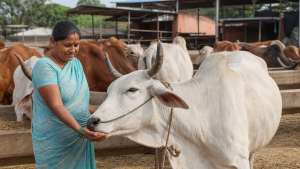
India’s livestock and agricultural market infrastructure are supported by a set of central schemes, research institutes and digital trading platforms. These programmes aim to improve animal productivity, conserve indigenous breeds, strengthen disease control, and reduce post-harvest losses through better market linkages.
Flagship Livestock Development Schemes
- Rashtriya Gokul Mission: Launched in December 2014 under the National Programme for Bovine Breeding and Dairy Development, it focuses on the development and conservation of indigenous bovine breeds.
- Genetic improvement tools: The mission supports cattle and buffalo upgradation through sex-sorted semen, embryo transfer technology and automated artificial insemination.
- Gokul Grams: It funds integrated indigenous cattle centres in native breeding tracts to conserve and develop local breeds.
- National Gopal Ratna Awards: The scheme annually recognises outstanding dairy farmers, artificial insemination technicians and dairy cooperatives.
- National Livestock Mission: Launched in 2014-15 by the Department of Animal Husbandry and Dairying, it works through three sub-missions: Breed Development of Livestock and Poultry; Feed and Fodder Development; and Innovation and Extension.
- Entrepreneurship support: It provides a 50% capital subsidy, up to statutory ceilings, to individuals, Farmer Producer Organizations and self-help groups for rural poultry, sheep, goat and pig breeding units.
- Feed and fodder support: The mission supports fodder seed production, silage-making units and mechanised fodder harvesting equipment.
Animal Health and Disease Control
- Livestock Health and Disease Control Programme: It provides national funding to prevent, control and eradicate infectious animal diseases.
- National Animal Disease Control Programme: A core component of the programme, it aims to vaccinate 100% of cattle, buffalo, sheep and goat populations against Foot and Mouth Disease and Brucellosis.
- Mobile Veterinary Units: The programme finances mobile units for doorstep treatment in remote areas at the rate of one unit per one lakh livestock population.
- Pashu Aadhaar: Animals are registered under a 12-digit unique identification tag to improve traceability and livestock management.
Exam fact: The National Animal Disease Control Programme targets 100% vaccination of cattle, buffalo, sheep and goats against Foot and Mouth Disease and Brucellosis.
Livestock Infrastructure and Credit Support
- Animal Husbandry Infrastructure Development Fund (AHIDF): Set up under the Atmanirbhar Bharat Abhiyan, the fund has a corpus of Rs. 15,000 crore.
- Coverage: It incentivises private investment in dairy processing, meat processing, animal feed plants and breed multiplication farms.
- Interest subvention: Eligible borrowers get 3% per annum interest subvention on term loans from scheduled commercial banks.
- Credit guarantee: The Credit Guarantee Fund Trust for Animal Husbandry and Dairying provides credit guarantee cover up to 25% of the loan facility for MSME units.
- Financial objective: The fund is meant to expand modern livestock infrastructure and improve value addition in animal-based industries.
Agricultural Market Infrastructure and e-Trading
- e-NAM: The electronic National Agriculture Market was launched in April 2016 as a pan-India trading portal.
- Market integration: It connects existing Agricultural Produce Market Committee mandis across states into a unified national digital market.
- Operational agency: The Small Farmers’ Agribusiness Consortium serves as the lead operational agency for implementation.
- Trading features: The platform offers electronic auctioning, online assaying reports, digital payments and warehouse-receipt-based trading.
- Agriculture Infrastructure Fund: This medium-to-long term debt financing facility has a corpus of Rs. 1 lakh crore and runs from 2020 to 2032-33.
- Infrastructure covered: It finances cold rooms, assaying units, sorting and grading sheds, and primary processing centres.
- Concessional finance: Loans up to Rs. 2 crore receive 3% annual interest subvention for a maximum term of 7 years.
- Eligible beneficiaries: Primary Agricultural Credit Societies, Farmer Producer Organizations, startups and rural entrepreneurs can avail support.
- Gramin Agricultural Markets: This scheme upgrades rural periodic markets (haats) into aggregation platforms linked with e-NAM to help small farmers trade near the farm gate.
Institutional Framework and Research Centres
- ICAR-National Dairy Research Institute, Karnal: A premier institute for dairy production, milk processing technology and livestock genetics.
- ICAR-Indian Veterinary Research Institute, Izatnagar, Bareilly: Specialises in veterinary medicine, immunology, diagnostic kits and livestock vaccines.
- National Dairy Development Board, Anand: A statutory body promoting and financing producer-owned dairy cooperative networks.
- National Bureau of Animal Genetic Resources, Karnal: Works on characterisation, evaluation and formal registration of indigenous livestock and poultry breeds.
- Central Institute for Research on Buffaloes, Hisar: Focuses on buffalo breeding, reproductive cloning and semen cryopreservation.
- Central Institute for Research on Goats, Makhdoom, Mathura: Works on breed development, health management and value-added goat products.
- Central Sheep and Wool Research Institute, Avikanagar: Specialises in genetic improvement of indigenous sheep and wool grading technologies.
- National Research Centre on Mithun, Medziphema: Handles rearing, preservation and nutritional research for mithun (Bos frontalis).
- National Research Centre on Yak, Dirang: Focuses on research and high-altitude conservation of yaks (Bos grunniens).
- National Research Centre on Equines, Hisar: Deals with health monitoring, disease surveillance and breeding of horses, mules and donkeys.
Comparative Snapshot of Core Schemes
| Scheme | Launch Year | Nature | Primary Target | Main Benefit |
| Rashtriya Gokul Mission | 2014 | Central Sector | Indigenous cattle and buffaloes | Support for breed centres, IVF-related work and awards |
| National Livestock Mission | 2014-15 | Centrally Sponsored / Central Sector | Sheep, goat, pig, poultry and fodder | 50% capital subsidy for entrepreneurship units |
| AHIDF | 2020 | Central Sector Fund | Dairy, meat and feed processing units | 3% interest subvention on bank term loans |
| e-NAM | 2016 | Central Sector Scheme | APMC mandis and farm produce | Digital trading, assaying and payment system |
| AIF | 2020 | Central Sector Scheme | Post-harvest farm-gate assets | 3% interest subvention up to Rs. 2 crore |
Key Prelims Takeaways
- Rashtriya Gokul Mission was launched in December 2014 for indigenous bovine breed development and conservation.
- National Livestock Mission has three sub-missions: breed development, feed and fodder development, and innovation and extension.
- AHIDF has a corpus of Rs. 15,000 crore and supports private investment in livestock processing infrastructure.
- e-NAM is the pan-India electronic trading platform linking APMC mandis through digital market integration.
- Agriculture Infrastructure Fund provides medium-to-long term debt financing for post-harvest infrastructure and farm-gate assets.
- National Animal Disease Control Programme targets vaccination against Foot and Mouth Disease and Brucellosis.
- ICAR institutes and NRCs play a major role in breeding, genetics, disease research and species-specific conservation.
Current General Studies comprises current-affairs-based, General Studies-rich study material on policies, laws, institutions, economy, science, environment, governance, international relations, and other varied but important topics for UPSC and State PSC Prelims examinations.
Fortnightly PDF compilations: Available here
Originally written on
June 23, 2026
and last modified on
September 6, 2026.
| Related | |
|---|---|