Major Women’s Safety and Empowerment Schemes
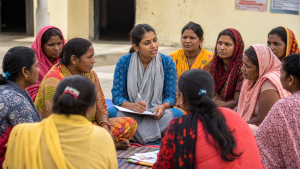
Women’s safety and empowerment schemes in India are designed to address gender-based violence, improve access to support services, and strengthen social and economic outcomes for women and girls. These initiatives combine emergency assistance, financial support, maternal health coverage, and infrastructure-backed interventions under targeted government programmes.
For Prelims revision, the most important aspect is the structure of major schemes, their implementing ministries, and the latest official indicators linked to gender welfare.
Mission Shakti: Umbrella Framework
Mission Shakti is an integrated umbrella scheme for women’s safety, security, and empowerment. It is implemented by the Ministry of Women and Child Development through two sub-schemes, designed to streamline delivery and avoid duplication of services.
- Sambal: Focuses on safety and security. It includes One Stop Centres (OSCs), the Women Helpline (WHL), Beti Bachao Beti Padhao (BBBP), and Nari Adalats.
- Samarthya: Focuses on economic and social empowerment. It includes Palna (crèches), Shakti Sadan, Sakhi Niwas, Pradhan Mantri Matru Vandana Yojana (PMMVY), and Hubs for Empowerment of Women (HEW).
The scheme is meant to ensure convergence of services at the field level and improve access to both protection and empowerment-related support.
Emergency Support Under Sambal
The Sambal components provide immediate assistance to women in distress through a single-window support system and referral mechanism.
- One Stop Centres (OSCs): Provide emergency shelter, medical aid, legal counselling, and psychological support under one roof.
- Women Helpline (WHL-181): A toll-free helpline that offers immediate assistance and referral services, including linkage with other emergency response systems.
- Nari Adalats: Promote alternative dispute resolution at the local level.
- Integrated response: The OSC-WHL network is intended to help victims of violence obtain rapid legal, medical, and psychological support.
Exam fact: OSCs and WHL were operationalized on 1 April 2015.
- OSCs coverage: As of 30 June 2026, 991 One Stop Centres were active across India, having assisted over 15.20 lakh women since inception.
- WHL reach: The 181 helpline had assisted over 1.04 crore women up to 30 June 2026.
Beti Bachao Beti Padhao and Girl Child Indicators
Beti Bachao Beti Padhao (BBBP) addresses declining child sex ratio and supports the education of the girl child. It depends on inter-sectoral coordination among the Ministry of Women and Child Development, the Ministry of Health and Family Welfare, and the Ministry of Education.
- Sex Ratio at Birth (SRB): Provisional national SRB improved from 918 in 2014–15 to 929 in 2025–26.
- Girls’ enrolment: The Gross Enrolment Ratio (GER) of girls in secondary schools rose from 75.51% in 2014–15 to 83.4% in 2025–26.
These indicators are often used in exam questions to link BBBP with broader social outcomes rather than only awareness campaigns.
Maternal Welfare: PMMVY and PMSMA
Maternal support is provided through direct benefit transfer and free antenatal care. The two most relevant schemes are Pradhan Mantri Matru Vandana Yojana (PMMVY) and Pradhan Mantri Surakshit Matritva Abhiyan (PMSMA).
- PMMVY purpose: Partly compensates for wage loss during pregnancy and lactation and supports rest and nutrition for mothers.
- PMMVY benefit: Launched in 2017, it provides a Direct Benefit Transfer of ₹5,000 in two instalments for the first child.
- Second-child provision: A ₹6,000 incentive is provided in a single instalment for the second child, if the second child is a girl.
- PMMVY progress: As of 31 August 2026, the scheme had enrolled 5.19 crore beneficiaries, paid 4.39 crore beneficiaries, and disbursed ₹20,677 crore.
- PMSMA: Provides free and quality antenatal care to pregnant women.
- PMSMA progress: As of 13 August 2026, it had conducted over 6.85 crore free antenatal check-ups and digitally tracked 1.03 crore high-risk pregnancies across 22,000 national facilities.
Nirbhaya Fund and Gender Budgeting
Infrastructure and safety-related projects are financed through the Nirbhaya Fund, a non-lapsable fund created to support women’s safety initiatives. Its non-lapsable character ensures that unspent balances do not revert to the Consolidated Fund of India at the end of the financial year.
- Fund origin: The Nirbhaya Fund was set up in 2013.
- Allocation and release: Since inception, ₹8,212.85 crore has been allocated and ₹6,581.84 crore has been released.
- Administrative issues: Delays in implementation and compliance have affected actual spending under several projects.
- FY 2025–26 RE: The Revised Estimate for the Nirbhaya Fund was reduced from ₹500 crore to ₹278 crore due to non-compliance with SNA SPARSH guidelines and delayed bill submissions by states and union territories.
- Delayed projects: Some approved projects, such as working women’s hostels in Manipur, CCTV installations at village panchayats, and an AI-based facial recognition pilot across seven railway stations, reported zero actual spending as of July 2026.
- Gender budgeting: Gender-focused allocations under the Union Budget 2026–27 increased to 9.37% of the total budget, up from 8.86% in FY 2025–26.
Key Prelims Takeaways
- Mission Shakti: The umbrella scheme has two parts—Sambal for safety and Samarthya for empowerment.
- OSCs: Provide shelter, medical, legal, and psychological support to women in distress.
- WHL-181: The national women’s helpline is linked with emergency support and referral services.
- BBBP: Focuses on improving the sex ratio and promoting girls’ education.
- SRB: Provisional national Sex Ratio at Birth improved from 918 to 929 between 2014–15 and 2025–26.
- PMMVY: Provides ₹5,000 for the first child and ₹6,000 for the second child if it is a girl.
- Nirbhaya Fund: A non-lapsable fund created in 2013 to support women’s safety infrastructure and projects.
| Related | |
|---|---|