Disaster Management Institutions and Laws in India
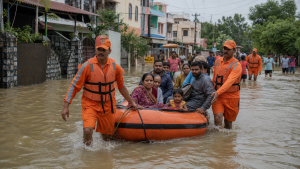
India’s disaster management framework has moved from a relief-centric model to a more proactive system focused on preparedness, mitigation and coordinated response. The Disaster Management Act, 2005 is the core law governing this structure, and the Disaster Management (Amendment) Act, 2025 has updated it to meet newer administrative and urban challenges.
The Disaster Management Act, 2005 and 2025 Amendments
The Disaster Management Act, 2005 provides the legal framework for disaster management in India and creates institutions at the national, state and district levels. The Disaster Management (Amendment) Act, 2025 (Act No. 10 of 2025) received Presidential assent on March 29, 2025 and came into force on April 9, 2025.
- Planning authority shift: The responsibility for preparing the National and State Disaster Management Plans has been shifted directly to the National Disaster Management Authority (NDMA) and State Disaster Management Authorities (SDMAs), respectively.
- Earlier system: This planning role was earlier handled by the National and State Executive Committees.
- Emergency powers: SDMA Chairpersons, usually the Chief Ministers, can now exercise authority independently during emergencies, subject to ex-post facto approval.
- Disaster databases: The amendment mandates localized National and State Disaster Databases to track disaster risk, severity, resource allocation and mitigation plans.
- Funding structure: The 2005 Act provides separate financial pools such as the National Disaster Response Fund (NDRF) and the National Disaster Mitigation Fund (NDMF), with corresponding structures at state and district levels.
Three-Tier Institutional Framework and New Statutory Bodies
The Act provides a three-tier institutional framework covering the national, state and district levels. The 2025 amendment also gives formal statutory backing to some existing coordination bodies.
- National Disaster Management Authority (NDMA): Headed ex-officio by the Prime Minister, with a maximum of nine other members. It is the apex policy-making body for disaster management.
- State Disaster Management Authority (SDMA): Headed ex-officio by the Chief Minister of the state, or by the Lieutenant Governor in Union Territories, with a maximum of nine members.
- District Disaster Management Authority (DDMA): Headed by the District Magistrate, District Collector or Deputy Commissioner as ex-officio Chairperson, and co-chaired by the elected representative of the local authority.
- National Crisis Management Committee (NCMC): Section 8A of the 2025 Amendment Act gives it statutory backing. It is chaired by the Cabinet Secretary and handles top-level coordination during major crises.
- High-Level Committee (HLC): Section 8B gives it statutory status. Chaired by the Union Minister of Home Affairs, it oversees financial relief approvals from the NDRF.
Urban Disaster Management and Field Forces
The 2025 amendment adds a sharper focus on urban hazards and strengthens the statutory basis for response forces.
- Urban Disaster Management Authorities (UDMAs): Section 41A empowers State Governments to set up UDMAs in state capitals and cities with Municipal Corporations, excluding the NCT of Delhi and Chandigarh.
- First use of the provision: Karnataka became the first state to establish a UDMA under the amended law, creating one for the Bruhat Bengaluru Mahanagara Palike (BBMP).
- National Disaster Response Force (NDRF): Constituted under Section 44 of the DM Act, 2005 for specialised response to natural and man-made disasters.
- NDRF leadership: Senior IPS officer Piyush Anand serves as Director General of the NDRF, with his tenure extended by the Appointments Committee of the Cabinet up to March 30, 2027.
- State Disaster Response Forces (SDRFs): The 2025 Act enables state governments to formally constitute their own SDRFs and define their operational functions.
National Schemes and Meteorological Initiatives
Alongside the legal framework, the government has introduced schemes and forecasting initiatives to improve preparedness and early warning.
- Yuva Aapda Mitra Scheme: Launched in May 2025 and implemented by NDMA, this community-based preparedness programme trains youth volunteers as immediate first responders.
- Participating organisations: The scheme draws volunteers from the National Cadet Corps (NCC), National Service Scheme (NSS), Nehru Yuva Kendra Sangathan (NYKS) and Bharat Scouts & Guides.
- Mission Mausam: Implemented by the Ministry of Earth Sciences and launched on January 14, 2025.
- Funding: It has an initial outlay of ₹2,000 crore for Phase-I during 2024–2026.
- Objective: To make India weather-ready and climate-smart through improved forecasting and early warnings.
- Technology focus: It uses AI/ML models for seven-day advance forecasting of extreme weather events such as floods and cyclones.
Key Prelims Takeaways
- Parent law: The Disaster Management Act, 2005 is the principal law on disaster risk reduction and response in India.
- Amendment date: The Disaster Management (Amendment) Act, 2025 received assent on March 29, 2025 and came into force on April 9, 2025.
- Planning powers: NDMA and SDMAs now prepare disaster management plans directly.
- Statutory committees: Section 8A gives legal backing to the NCMC, and Section 8B to the HLC.
- Urban focus: Section 41A enables UDMAs in state capitals and municipal corporation cities, excluding the NCT of Delhi and Chandigarh.
- Response forces: The NDRF handles specialised disaster response, while the Act enables states to create SDRFs.
- Key initiative: Mission Mausam is a ₹2,000 crore programme using AI/ML for improved weather forecasting.
| Related | |
|---|---|