Government–Industry Consultation Mechanisms in India
Introduction
Government-industry consultation mechanisms provide structured channels for dialogue between the State and the private sector. They help align policy design, trade rules, regulatory compliance, and industrial development with ground realities.
For Prelims, the important part is the institutional framework: who chairs the body, what it advises on, and which recent reforms changed consultation, compliance, or recognition thresholds.
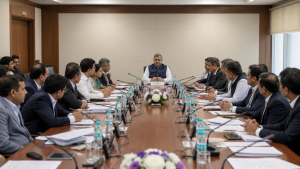
The Board of Trade (BOT)
- Advisory role: The Board of Trade is an advisory body that assists the government on foreign trade policy and export promotion.
- Chairmanship: It is chaired by the Union Minister of Commerce and Industry.
- Reconstitution: The Directorate General of Foreign Trade (DGFT) reconstituted the BOT on June 2, 2026, through Notification No. 18/2026-27.
- Expanded membership: The number of non-official members was increased from 29 to 40 to widen trade consultation.
- Policy focus: The reconstituted BOT was used to strengthen consultation on export strategy and centre-state coordination.
- Meeting theme: Its fifth meeting focused on achieving a USD 1 trillion export target for the current fiscal year and a USD 2 trillion export target overall.
Pre-Legislative Consultation Policies
- PLCP, 2014: The Pre-Legislative Consultation Policy requires a 30-day public feedback period for draft bills.
- Coverage: It is meant to improve transparency by inviting public and stakeholder comments before legislation is finalised.
- Evaluation gap: In December 2025, the Ministry of Law and Justice stated that no formal evaluation of the policy had been conducted.
- Compliance records: The same statement noted that no central compliance records are maintained.
- MCA-PLCP: The Ministry of Corporate Affairs’ pre-legislative policy became effective on January 1, 2024.
- Regulatory review: Under the MCA-PLCP, all regulatory bodies under the ministry were required to complete a comprehensive review of existing rules and regulations by March 31, 2025.
Quality Control and Compliance Facilitation
- Transition Facilitation Order, 2026: The DPIIT notified the Transition Facilitation (Quality Control) Order, 2026, on June 25, 2026, under the BIS Act, 2016.
- Purpose: The order introduced a risk-based sourcing framework to help domestic manufacturers transition to full BIS standards.
- Covered sectors: It applies to products such as toys, footwear, furniture, electrical appliances, and hinges.
- Industry linkage: The measure reflects consultation-based compliance support rather than only punitive enforcement.
- Parliamentary recommendation: On August 7, 2026, the Department-Related Parliamentary Standing Committee on Commerce presented its 201st Report.
- Committee suggestion: It recommended that the DPIIT work with industry to prepare sector-specific compliance roadmaps.
- D-BRAP: The Committee also recommended expanding the District Business Reform Action Plan (D-BRAP).
Infrastructure Schemes and Startup Thresholds
- BHAVYA Scheme: The Union Cabinet approved the Bharat Audyogik Vikas Yojana (BHAVYA) on March 18, 2026.
- Nature of scheme: It is a Central Sector Scheme under the DPIIT.
- Financial outlay: The scheme has a total outlay of ₹33,660 crore.
- Objective: It aims to develop 100 plug-and-play industrial parks over six years, from FY 2026-27 to FY 2031-32.
- Portal: The BHAVYA Portal was launched on June 8, 2026, to receive proposals from states and Union Territories.
- Phase-I: Phase-I closed on July 31, 2026, and the DPIIT received 87 proposals from state and UT governments.
- Startup recognition: DPIIT Gazette Notification 108(E), dated February 4, 2026, increased the official turnover threshold for Startup recognition from ₹100 crore to ₹200 crore.
Supply Chain and Digital Regulation Consultations
- EXIM consultation: On March 2, 2026, the Department of Commerce held a multi-stakeholder consultation on geopolitical developments affecting India’s EXIM cargo flows.
- Participants: The meeting involved logistics operators and shipping lines to discuss supply chain resilience.
- Chairing officials: It was chaired by Special Secretary Suchindra Misra and DGFT Lav Agarwal.
- Digital rules: On February 10, 2026, MeitY released the Information Technology (Intermediary Guidelines and Digital Media Ethics Code) Amendment Rules, 2026.
- Enforcement date: The amendments came into force on February 20, 2026.
- Significance: Such rules show how consultation and regulatory updates are used to manage fast-changing digital and economic sectors.
Key Prelims Takeaways
- BOT: Advisory body on foreign trade and export promotion, chaired by the Union Minister of Commerce and Industry.
- BOT reconstitution: Reconstituted by DGFT on June 2, 2026, with non-official members increased from 29 to 40.
- PLCP: The 2014 policy provides a 30-day public feedback window for draft bills.
- MCA-PLCP: Effective from January 1, 2024; required a review of existing rules by March 31, 2025.
- BHAVYA: Central Sector Scheme under DPIIT with an outlay of ₹33,660 crore for 100 plug-and-play industrial parks.
- Startup threshold: Turnover limit for recognition increased from ₹100 crore to ₹200 crore under Notification 108(E).
- D-BRAP: The Parliamentary Standing Committee on Commerce recommended expanding it for better business reform implementation.
Current General Studies comprises current-affairs-based, General Studies-rich study material on policies, laws, institutions, economy, science, environment, governance, international relations, and other varied but important topics for UPSC and State PSC Prelims examinations.
Fortnightly PDF compilations: Available here
Originally written on
April 12, 2026
and last modified on
September 5, 2026.
| Related | |
|---|---|