Major Space Recovery and Booster Landing Technologies
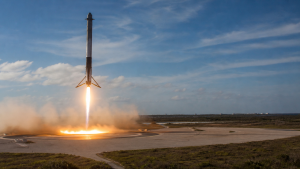
The modern space sector is moving from expendable rockets to reusable recovery systems. Booster reuse lowers launch cost, improves sustainability, and shapes the design of today’s orbital launch vehicles.
The Shift Toward Reusable Spaceflight
Traditionally, rocket boosters burned their propellant, separated from the upper stage, and fell into the ocean as debris. Today, space agencies and private companies focus on recovering and reusing boosters to preserve expensive hardware such as engines and avionics.
Vertical Takeoff, Vertical Landing (VTVL)
Vertical Takeoff, Vertical Landing (VTVL) is a widely used method for recovering orbital-class liquid rocket boosters. In this system, the first-stage booster guides itself back to Earth and lands upright.
Key Flight Phases
- Boostback Burn: After separating from the upper stage, the booster flips 180 degrees using cold gas thrusters and fires its engines to reverse its trajectory toward the landing site.
- Reentry Burn: As the booster enters denser layers of the atmosphere, it fires its engines to decelerate and protect engine components from extreme thermal damage.
- Landing Burn: Moments before touchdown, a single engine or a cluster of engines fires to reduce the booster’s velocity to near zero.
Crucial Control Hardware
- Grid Fins: Aerodynamic control surfaces arranged in a lattice pattern. Located near the top of the booster, they fold out during descent and rotate independently to adjust the trajectory.
- Cold Gas Thrusters: Small thrusters that use pressurized nitrogen gas to orient the booster in the vacuum of space before atmospheric reentry.
- Landing Legs: Shock-absorbing legs that deploy seconds before touchdown to support the booster’s dry weight.
Autonomous Recovery Platforms: Droneships and Landing Zones
Booster landing options depend on payload weight, orbit path, and remaining fuel reserves.
Return-to-Launch-Site (RTLS)
If a rocket carries a lighter payload, the booster retains enough propellant to fly back to the launch pad and land on concrete landing pads near the launch site.
Downrange Landing
Heavy payloads require more fuel, leaving less propellant for the booster’s return flight. In such cases, the booster lands downrange on a floating barge in the ocean.
Autonomous Spaceport Drone Ships (ASDS)
Drone ships are modified ocean barges equipped with thrusters for station-keeping. They remain stable in rough seas. Once a booster lands on an ASDS, robotic systems such as the Octagrabber crawl under the rocket’s engine section and secure it to the deck to prevent tipping during the return journey to port.
Mechanical Catch Systems
A newer alternative to traditional landing gear is the mechanical catch system. This technique removes the need for landing legs entirely.
Tower-Based Catch (Mechazilla)
This system uses a massive launch tower equipped with two movable mechanical arms, often called “chopsticks.”
- The Process: The booster descends toward the pad, guides itself precisely between the mechanical arms, and is caught by the tower arms at structural hardpoints.
- Historical Validation: SpaceX completed the first tower catch of its Super Heavy booster during the Starship Flight 5 test on October 13, 2024.
- Key Advantages: Eliminating landing legs reduces booster mass, allowing heavier payloads and faster refurbishment because the booster can be placed directly back on the launch mount.
Horizontal Autonomous Landing
Horizontal landing involves winged spaceplanes that glide through the atmosphere and land on a runway, similar to commercial aircraft.
India’s Pushpak Reusable Launch Vehicle (RLV)
The Indian Space Research Organisation (ISRO) is testing horizontal landing technologies. Its experimental vehicle, Pushpak, is a winged technology demonstrator.
- Autonomous Landing Experiments (LEX): ISRO completed the RLV-LEX series at the Aeronautical Test Range in Chitradurga, Karnataka. The final test, RLV-LEX-03, was conducted on June 23, 2024.
- Flight Profile: A military helicopter lifts Pushpak to an altitude of 4.5 kilometers and releases it. The vehicle autonomously corrects its course and aligns with the runway.
- Landing Dynamics: Pushpak touches down at speeds exceeding 320 kmph. It deploys a drag brake parachute and uses landing gear brakes to slow down.
- Navigation Suite: The vehicle uses multi-sensor fusion, including inertial sensors, radar altimeters, NavIC satellite navigation, and pseudolite ground systems.
Parachute Recovery and Mid-Air Retrieval
For smaller launch vehicles, propulsive landings are not fuel-efficient. Instead, these systems rely on aerodynamic drag.
Parachute Splashdowns
This traditional method uses a series of parachutes to decelerate a spent booster before it splashes down in the ocean. Saltwater exposure corrodes metal components and damages electrical systems, increasing refurbishment costs.
Mid-Air Retrieval (MAR)
Mid-air retrieval prevents saltwater damage by catching the booster before it touches the ocean.
- The Process: The booster deploys a drogue parachute to stabilize itself, then a larger main parafoil. A specialized helicopter flies into the recovery zone with a long cable and capture hook, and the pilot hooks the parachute lines to secure the booster.
- Operational Attempts: Rocket Lab developed this technique for its Electron booster. It completed a partial mid-air capture in 2022 but later opted for marine recovery because helicopter catch operations are highly complex.
Summary of Recovery and Landing Technologies
| Recovery Technology | Primary Deceleration | Terminal Landing Surface | Key Control Systems | Prominent Examples |
| VTVL (Return-to-Site) | Rocket engines (retroburns) | Ground concrete pad | Grid fins, cold gas thrusters, landing legs | Falcon 9 (LZ-1), New Shepard |
| VTVL (Downrange) | Rocket engines (retroburns) | Ocean drone ship | Grid fins, RCS, landing legs, Octagrabber | Falcon 9 (ASDS), Falcon Heavy |
| Mechanical Tower Catch | Rocket engines (hover/slide) | Tower arms (chopsticks) | Grid fins, cold gas thrusters, catch hardpoints | Starship Super Heavy (Mechazilla) |
| Horizontal Landing | Aerodynamic wings, chutes | Airport runway | Nose-wheel steering, rudder, brake parachute | Space Shuttle, ISRO Pushpak (RLV) |
| Mid-Air Retrieval | Parachutes, parafoil | Helicopter catch cable | Flight computers, drogue chutes, snag hook | Rocket Lab Electron (historic tests) |
Recent Context
SpaceX continues to expand reusable launch operations. On August 15, 2026, it flew two Falcon 9 missions from Florida and California within 38.5 minutes, with both boosters recovered successfully.
Rare Facts for Prelims
- Falcon 9 booster landings: SpaceX’s booster recovery milestones are often counted separately from orbital launches, since a single booster can fly multiple times.
- Octagrabber: This recovery robot is used only after drone-ship landings to secure the booster against ocean motion during transit.
- Grid fins: They are especially effective at high supersonic speeds because their lattice structure provides strong control authority.
- NavIC use: ISRO’s Pushpak tests show that India’s regional navigation system can support precision landing experiments.
- Parafoil recovery: A parafoil is different from a round parachute because it can be steered like a wing.
- Reusable design trade-off: Reusability reduces cost, but it also requires extra propellant, guidance hardware, and landing infrastructure.
| Related | |
|---|---|