Indian Navy Organisation, Commands, and Strategic Bases
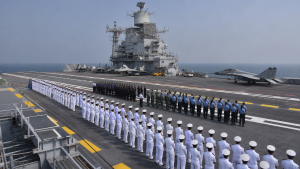
The Indian Navy is organized through a centralized headquarters, three major geographic commands, and a set of strategic bases that support operations across the Indian Ocean Region. Its structure balances day-to-day administration, maritime security, training, and long-range deterrence.
For UPSC and other prelims exams, the key focus areas are the command hierarchy, the role of tri-services command, and the strategic significance of naval bases such as INS Kadamba, INS Jatayu, INS Varsha, and INS Aravali.
Organizational Structure and Command Hierarchy
- Integrated Headquarters, Ministry of Defence (Navy): Located in New Delhi, it serves as the operational and administrative nerve center and coordinates with the Ministry of Defence and other services.
- Chief of the Naval Staff (CNS): A four-star Admiral who heads the Indian Navy.
- Vice Chief of the Naval Staff (VCNS): Handles day-to-day administration and procurement matters.
- Operational control: Exercised through major commands led by a Flag Officer Commanding-in-Chief (FOC-in-C) of Vice Admiral rank.
- Three geographic commands: Western Naval Command, Eastern Naval Command, and Southern Naval Command manage regional maritime responsibilities.
- Training role: The Southern Naval Command at Kochi functions primarily as the training command for officers and sailors.
| Command or Base | Headquarters / Location | Primary Role or Status |
| Western Naval Command | Mumbai, Maharashtra | Primary operational command for the Arabian Sea |
| Eastern Naval Command | Visakhapatnam, Andhra Pradesh | Primary operational command for the Bay of Bengal |
| Southern Naval Command | Kochi, Kerala | Training command for officers and sailors |
| Andaman and Nicobar Command | Port Blair, Andaman and Nicobar Islands | Unified tri-services command guarding key maritime choke points |
| INS Kadamba | Karwar, Karnataka | Deep-water base expanding under Project Seabird |
| INS Varsha | Rambilli, Andhra Pradesh | Classified nuclear submarine homeport |
| INS Aravali | Gurugram, Haryana | Landlocked stone frigate and information warfare hub |
| INS Jatayu | Minicoy Island, Lakshadweep | Island base monitoring SLOCs and supporting anti-piracy operations |
Tri-Services Command and Strategic Geography
- Andaman and Nicobar Command (ANC): Headquartered at Port Blair, it is India’s only unified tri-services command, integrating the Navy, Army, Air Force, and Coast Guard under a Commander-in-Chief.
- Rotational leadership: The post of CINCAN rotates among the three services.
- Strategic location: ANC is positioned near the Malacca Strait and acts as a forward-deployed theater command.
- Key sea lanes: It helps secure the Six Degree Channel and the Ten Degree Channel, both vital for Indian maritime security.
- Operational importance: The command strengthens surveillance over important trade corridors and maritime threats in the eastern Indian Ocean.
Important Naval Bases in the Indian Ocean Region
- INS Kadamba: Located at Karwar, it was developed to de-congest Mumbai port and is being expanded under Project Seabird.
- Strategic value of Karwar: It is projected to become the largest naval base east of the Suez Canal after completion of the expansion phases.
- INS Jatayu: Commissioned on March 6, 2024, at Minicoy Island, it is India’s second strategic naval base in the Lakshadweep archipelago.
- INS Dweeprakshak: Located at Kavaratti, it is the other strategic base in Lakshadweep.
- Minicoy significance: The island lies just north of the Eight Degree Channel, giving the base a key monitoring role.
- SLOC monitoring: INS Jatayu supports surveillance of Sea Lines of Communication in the western Indian Ocean.
- Additional tasks: The base also helps coordinate anti-piracy and anti-narcotics missions.
Classified Submarine Base and Information Warfare
- INS Varsha: A classified high-security base at Rambilli near Visakhapatnam, expected to be commissioned in late 2026.
- Role of the base: It is designed to homeport Arihant-class nuclear ballistic missile submarines (SSBNs) and future nuclear attack submarines (SSNs).
- Strategic significance: INS Varsha supports India’s sea-based nuclear second-strike capability.
- Concealed infrastructure: The base reportedly includes underground submarine pens and deep-water tunnels carved into the Eastern Ghats.
- Operational benefit: This layout helps submarines move covertly into the Bay of Bengal and reduces exposure to satellite and aerial surveillance.
- Stone frigates: The Navy also uses landlocked shore establishments commissioned for specialized administrative and operational duties.
- INS Aravali: Commissioned in Gurugram, Haryana, on September 12, 2025, it is a stone frigate focused on information warfare.
- Maritime Domain Awareness: INS Aravali supports MDA and the Information Fusion Centre – Indian Ocean Region (IFC-IOR), which tracks merchant shipping in real time.
Key Prelims Takeaways
- Three major geographic commands: Western, Eastern, and Southern Naval Commands are the core operational and training structure.
- Southern Naval Command: Based at Kochi, it functions mainly as the Navy’s training command.
- Only tri-services naval command: The Andaman and Nicobar Command at Port Blair integrates all three services and the Coast Guard.
- Strategic chokepoints: ANC is important for guarding the Six Degree Channel, Ten Degree Channel, and approaches to the Malacca Strait.
- Project Seabird: INS Kadamba at Karwar is being expanded as a major deep-water naval base.
- Nuclear submarine support: INS Varsha at Rambilli is meant to provide a secure homeport for SSBNs and SSNs.
- Information warfare hub: INS Aravali at Gurugram supports MDA and the IFC-IOR for maritime tracking.
Current General Studies comprises current-affairs-based, General Studies-rich study material on policies, laws, institutions, economy, science, environment, governance, international relations, and other varied but important topics for UPSC and State PSC Prelims examinations.
Fortnightly PDF compilations: Available here
Originally written on
April 21, 2026
and last modified on
September 5, 2026.
| Related | |
|---|---|