Unesco Intangible Cultural Heritage: India’s Entries and Criteria
The UNESCO Intangible Cultural Heritage framework protects living traditions such as oral expressions, performing arts, rituals, craftsmanship, and community practices. India, a party to the 2003 UNESCO Convention, has built a strong record of inscriptions and national safeguarding mechanisms for such heritage.
The 2003 UNESCO Convention and India’s Nodal Agency
- Convention purpose: The 2003 Convention for the Safeguarding of the Intangible Cultural Heritage aims to safeguard oral traditions, performing arts, social practices, rituals, festive events, and traditional skills.
- India’s ratification: India ratified the Convention on September 9, 2005, formally committing itself to the protection of living heritage.
- Nodal agency: Sangeet Natak Akademi, an autonomous body under the Ministry of Culture, serves as the national nodal agency for UNESCO ICH nominations.
- Core functions: It coordinates nominations, updates the National Inventory of Intangible Cultural Heritage, and prepares nomination dossiers.
- International role: India served as a member of the 24-member Intergovernmental Committee for the Safeguarding of the Intangible Cultural Heritage for the 2022–2026 term.
- National inventory: The government maintains a digital repository of regional documentation to build state-level lists of living traditions and craftsmanship.
UNESCO Operational Criteria for Inscription
- Five domains: A nominated element must fall within one or more of the five UNESCO domains: oral traditions and expressions; performing arts; social practices, rituals and festive events; knowledge and practices concerning nature and the universe; and traditional craftsmanship.
- Domestic inventory: The element must already be included in the country’s National Inventory of Intangible Cultural Heritage.
- Community participation: The nomination must show the widest possible participation of the community, group, or individuals concerned.
- Free consent: UNESCO requires free, prior, and informed consent from the communities linked to the element.
- Safeguarding plan: The dossier must provide concrete and feasible measures to keep the element viable and ensure its transmission.
- Intergenerational continuity: The element should demonstrate active transmission across generations and continuity of identity within the community.
India’s Inscribed Elements on UNESCO’s Representative List
| Year | Element | Key identity |
| 2008 | Kutiyattam | Sanskrit theatre from Kerala with stylized hand gestures and eye movements. |
| 2008 | Tradition of Vedic Chanting | Oral recitation of sacred Vedic texts with precise pitch and pronunciation. |
| 2008 | Ramlila | Folk theatre re-enacting the Ramayana during Dussehra. |
| 2009 | Ramman | Religious festival and ritual theatre of the Garhwal Himalayas in Uttarakhand. |
| 2010 | Chhau Dance | Masked martial and folk dance tradition of Jharkhand, West Bengal, and Odisha. |
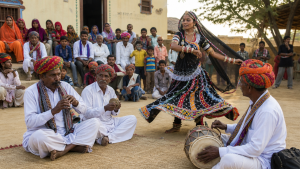
| 2010 | Kalbelia | Folk songs and dances of the nomadic Kalbelia community of Rajasthan. |
| 2010 | Mudiyettu | Ritual dance-drama from Kerala depicting the battle between Goddess Kali and Darika. |
| 2012 | Buddhist Chanting of Ladakh | Recitation of sacred texts by Buddhist lamas in Ladakh monasteries. |
| 2013 | Sankirtana | Ritual singing, drumming, and dancing of Manipur linked to life-cycle events. |
| 2014 | Traditional Brass and Copper Craft | Utensil-making craft practiced by the Thatheras of Jandiala Guru in Punjab. |
| 2016 | Yoga | Ancient Indian system of physical, mental, and spiritual practices. |
| 2016 | Nawrouz | Spring festival celebrating the Persian New Year across several communities. |
| 2017 | Kumbh Mela | Mass congregation of pilgrims who bathe in sacred rivers at four rotation sites. |
| 2021 | Durga Puja in Kolkata | Festival of public artistic installations and celebration of Goddess Durga. |
| 2023 | Garba of Gujarat | Devotional circle dance performed during the nine-day Navratri festival. |
| 2025 | Deepavali | Annual festival of lights symbolising the victory of light over darkness. |
Institutional Schemes and Zonal Cultural Centres
- Safeguarding scheme: The Ministry of Culture runs the Scheme for Safeguarding the Intangible Heritage and Diverse Cultural Traditions of India.
- Financial assistance: The scheme supports practitioners, research institutions, and community organisations working in the field of intangible heritage.
- Guru-Shishya Parampara: This scheme helps preserve rare and vanishing art forms through direct transmission from master practitioners to disciples.
- Zonal Cultural Centres: The government operates seven ZCCs to document, promote, and preserve regional folk arts and traditions.
- ZCC headquarters: The centres are based in Patiala, Nagpur, Udaipur, Prayagraj, Kolkata, Dimapur, and Thanjavur.
- Role of ZCCs: They also support documentation that can feed into future inventory updates and nominations.
Key Prelims Takeaways
- Total Indian inscriptions: India has 16 elements on UNESCO’s Representative List of the Intangible Cultural Heritage of Humanity.
- Most recent inscription: Deepavali was added on December 10, 2025.
- Nodal body: Sangeet Natak Akademi under the Ministry of Culture coordinates UNESCO ICH nominations in India.
- Legal basis: India ratified the 2003 UNESCO Convention on September 9, 2005.
- Core UNESCO test: A proposed element must be in the National Inventory and must have community consent and a safeguarding plan.
- Important domains: Oral traditions, performing arts, social practices, knowledge concerning nature, and traditional craftsmanship are the five UNESCO domains.
- ZCC network: Seven Zonal Cultural Centres support regional documentation and preservation of traditions.
Current General Studies comprises current-affairs-based, General Studies-rich study material on policies, laws, institutions, economy, science, environment, governance, international relations, and other varied but important topics for UPSC and State PSC Prelims examinations.
Fortnightly PDF compilations: Available here
Originally written on
April 21, 2026
and last modified on
September 5, 2026.
| Related | |
|---|---|