Major Areas of India-France Defence Cooperation
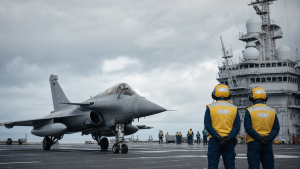
India-France defence cooperation rests on a strategic partnership established in 1998. It combines defence procurement and technology collaboration with military exercises, maritime engagement and space cooperation, strengthening defence diplomacy and supporting shared security interests.
Defence Procurement and Technology Transfer
India’s defence partnership with France includes major acquisitions as well as provisions for domestic production, maintenance and technology transfer. On April 28, 2025, the two countries signed an Inter-Governmental Agreement for 26 Rafale Marine aircraft for the Indian Navy: 22 single-seat fighters and four twin-seat trainers. The contract is valued at approximately ₹63,000 crore. Deliveries are scheduled to begin in late 2028 or early 2029 and are expected to be completed by 2030. The agreement covers weapons, simulators, personnel training in France and India, and logistics support. It also provides for additional equipment for the Indian Air Force’s existing Rafale fleet. Technology transfer is intended to support integration of indigenous Indian weapons. The agreement includes an Indian production facility for Rafale fuselage sections and domestic maintenance, repair and overhaul (MRO) facilities for engines, sensors and weapons. The Rafale M is adapted for carrier operations. Its reinforced landing gear, arrestor hook and launch-bar-equipped nose gear distinguish it from land-based Rafale variants. India will be the first operator of the naval Rafale outside France. The Indian Air Force operates 36 Rafale fighter jets, acquired under a 2016 agreement. Project 75 is another major outcome of defence-industrial cooperation. Under the programme, six Kalvari-class (Scorpene) submarines were built or are being built at Mazagon Dock Shipbuilders Limited (MDL), Mumbai, in collaboration with French Naval Group. The submarines are INS Kalvari, INS Khanderi, INS Karanj, INS Vela, INS Vagir and INS Vagsheer. The project combines foreign collaboration with construction in India, supporting domestic shipbuilding capability.
Joint Military Exercises
Regular exercises build interoperability, enable professional exchanges and improve mutual understanding among the armed forces.
- Exercise Varuna: A bilateral naval exercise conducted annually since 1993. It involves platforms and personnel from the two navies, including warships, submarines, maritime patrol aircraft and carrier-borne fighters.
- Exercise Garuda: A bilateral air exercise involving fighter jets, transport aircraft and Airborne Warning and Control Systems (AWACS). It enables air forces to practise coordinated operations.
- Exercise Shakti: A bilateral army exercise focused on counter-terrorism operations, combat drills and tactical exchanges across varied terrain.
Maritime Security and Naval Engagement
India and France share an interest in a free, open, inclusive and rules-based Indo-Pacific. Maritime cooperation supports this objective through information exchange, naval engagement and coordination on common security concerns. Maritime Domain Awareness (MDA) is advanced through information-sharing channels, including the Information Fusion Centre for Indian Ocean Region (IFC-IOR), hosted by India and engaging partners such as France. India has also participated in the French-led La Pérouse naval exercise with other friendly navies. Port calls, training exchanges and joint patrols further strengthen operational links between the navies. The countries coordinate efforts against piracy, illegal fishing and maritime terrorism. These activities combine practical cooperation at sea with defence diplomacy and contribute to a wider regional security relationship.
Space Cooperation
India’s space agency, ISRO, and France’s CNES work together in areas including satellite launch services, navigation and Earth observation. The joint TRISHNA mission—Thermal infraRed Imaging Satellite for High resolution Natural resource Assessment—is a key collaborative project. Cooperation also includes Space Situational Awareness (SSA), particularly tracking space debris and supporting safe space operations. France provides ground station support for Indian satellites, while the partnership also encompasses joint research and development in advanced space technologies. Space collaboration thus complements defence and strategic cooperation beyond conventional military domains.
Defence Research and Strategic Partnership
The Defence Research and Development Organisation (DRDO) and France’s Direction Générale de l’Armement (DGA) lead defence research collaboration. Joint working groups identify potential areas for co-development and co-production of defence equipment. Priority areas include critical and emerging technologies such as artificial intelligence, cybersecurity and propulsion systems. Collaboration in these fields can support indigenous defence capabilities and reduce reliance on external sources. It also aligns with India’s Make in India initiative in defence, linking strategic partnership with technology collaboration and domestic industrial capacity. The partnership is supported by regular high-level engagement, including an annual Defence Ministerial Dialogue. Procurement, joint exercises and research cooperation together make defence a central pillar of India-France relations.
Key Prelims Takeaways
- Strategic partnership: Established in 1998.
- Rafale Marine agreement: Signed on April 28, 2025, for 26 aircraft—22 single-seat fighters and four twin-seat trainers—at approximately ₹63,000 crore.
- Rafale Marine deliveries: Scheduled to begin in late 2028 or early 2029 and expected to conclude by 2030.
- Project 75: Scorpene submarines built at MDL, Mumbai, with French Naval Group collaboration.
- Military exercises: Varuna is naval, Garuda is air force and Shakti is army; Varuna has been held annually since 1993.
- Space cooperation: ISRO-CNES collaboration includes TRISHNA and Space Situational Awareness.
- High-level engagement: Annual Defence Ministerial Dialogue.
Recent Context
On October 29, 2026, a Rafale Marine fighter completed its maiden landing and first take-off on INS Vikrant. The trials assess compatibility with the carrier’s Short Take-Off But Arrested Recovery (STOBAR) system; earlier shore-based testing took place at the Shore Based Test Facility at INS Hansa, Goa.
| Related | |
|---|---|