Important Rock Art and Petroglyph Heritage Sites in India
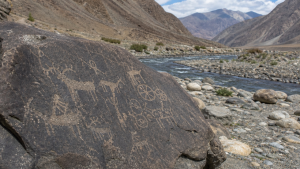
India’s rock art ranges from engravings on river stones and open rock surfaces to paintings in natural shelters. These sites preserve evidence of artistic expression, human activity and changing environments across different periods, making their documentation and conservation important for archaeological research and heritage management.
Rock Art in Ladakh
Ladakh has extensive prehistoric engravings, particularly along the Indus and its tributaries. Petroglyphs are images or designs carved, pecked or engraved into rock surfaces.
- Indus River sites: Khaltse, Domkhar, Achina and Biamah are among the locations with rock carvings. Scholars date them to the 3rd and 2nd millennia BCE and later.
- Motifs and materials: Common depictions include ibexes, mounted archers and geometric patterns, carved into basalt or granite river stones.
- Wider distribution: Other important sites include Dras, Kargil, Mulbekh, Nurla and Leh. Engravings also occur along the upper Indus and its tributaries in the Karakoram hills and Zanskar Valley.
The spread of carvings across river valleys and mountain regions makes systematic documentation important for archaeological study. Conservation efforts must also protect vulnerable carvings while ensuring that access and visitor activity do not damage the rock surfaces.
Bhimbetka Rock Shelters, Madhya Pradesh
Located in the foothills of the Vindhyan Mountains, the Bhimbetka Rock Shelters are a UNESCO World Heritage Site. The complex comprises five clusters of natural shelters and has more than 700 shelters, of which over 400 contain paintings.
- Period and habitation: The shelters display paintings from the Mesolithic Period through the historical period. The wider site preserves evidence of human presence from the Stone Age, including the earliest traces of human life in India.
- Artistic themes: Paintings depict hunting, dancing, animals and community life, offering visual evidence of human activity across different periods.
- Research value: The range of shelters and paintings allows archaeological research into artistic practices and changing forms of community life.
Bhimbetka’s significance lies in both its long human history and the variety of its paintings. Protecting the shelters and managing tourism sustainably are important to preserve this record for future research and public understanding.
Konkan Petroglyphs, Maharashtra
The Konkan region is known for its petroglyphs, locally called katal shilpa. More than 1,500 carvings have been recorded across over 70 sites, mainly in the southern districts of Ratnagiri and Sindhudurg.
- Dating and form: The carvings are estimated to be around 10,000–12,000 years old. They include human and animal figures and abstract motifs, and are considered rare examples of geoglyphs on horizontal, open rock surfaces.
- Important locations: Sites include Kasheli, Rundhetali, Devachegothane, Devi Hasol, Barsu, Jambharun, Ukshi, Kudopi, Deood, Pomendi and Nivli Phata.
- Archaeological value: Their distribution and imagery provide material for studying early human expression and the region’s prehistoric heritage.
The scale and open-surface setting of the Konkan carvings make careful recording and site protection especially important. Sustainable tourism can support public awareness, provided visitor access is managed to avoid damage to the petroglyphs.
Southern India Rock Art Sites
- Usgalimal, Goa: Located along the banks of the Kushavati River, Usgalimal is known for engravings that showcase hunter-gatherer art from the Mesolithic to the Bronze Age. Its carvings include bulls, labyrinths and human forms.
- Edakkal Caves, Kerala: Situated in Wayanad district, these are natural rock shelters rather than caves in the conventional sense. They contain significant petroglyphs and are an important site for the study of South India’s prehistoric rock art.
Together, these sites illustrate the regional variety of rock art in southern India. Research and conservation help document the engravings while supporting responsible interpretation of their cultural and archaeological significance.
Central and Eastern India Rock Art
Central India has a large concentration of rock art sites across the Satpura, Vindhya and Kaimur hills, as well as the Chambal Valley. The sites represent a broad span of periods, including the Lower, Middle and Upper Palaeolithic, Mesolithic, Chalcolithic and Early Historical periods.
- Adamgarh Hills, Madhya Pradesh: Near Narmadapuram, formerly Hoshangabad, these hills contain rock art from the Upper Paleolithic to historic times. The paintings depict wildlife, dances and battles.
- Bhanpura region, Madhya Pradesh: Chaturbhujnath Nala, Chibbad Nala and Daraki-Chattan feature Pleistocene and Holocene art, including cupules and petroglyphs.
- Other central Indian sites: Important locations include Pahadgarh-Likhichhaj in Morena, Bhimlat, Govindpura in Bundi, and sites in Raisen and Bhopal districts.
- Unakoti, Tripura: Near Kailashahar, Unakoti is known for massive rock-cut sculptures and carvings on a hill slope. Its name means “one less than a crore” and is associated with a local legend of Shiva and celestial beings.
The variety of sites and periods makes central India important for comparative archaeological research. Conservation planning should account for the different settings of these remains, while sustainable tourism can help visitors engage with the heritage without compromising its preservation.
Key Prelims Takeaways
- Petroglyphs: Images carved, pecked or engraved into rock; pictographs are painted or drawn on rock surfaces.
- Ladakh: Indus-basin sites include Khaltse, Domkhar, Achina and Biamah; motifs include ibexes and mounted archers.
- Bhimbetka: UNESCO World Heritage Site in Madhya Pradesh, with over 700 shelters and paintings in more than 400.
- Konkan: Over 1,500 petroglyphs occur across more than 70 sites, mainly in Ratnagiri and Sindhudurg.
- Southern sites: Usgalimal is in Goa; Edakkal Caves are in Wayanad district, Kerala.
- Central and eastern sites: Adamgarh and the Bhanpura region are in Madhya Pradesh; Unakoti is in Tripura.
Recent Context
On 15 October 2026, India’s first Petroglyph Conservation Park was inaugurated at Sindhu Ghat in Leh. It is intended to preserve Ladakh’s rock-carving heritage by systematically relocating ancient carvings from vulnerable sites.
| Related | |
|---|---|