
Horticulture and Fruit Development Schemes in India
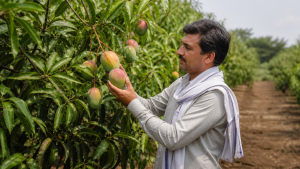
India is among the world’s largest producers of fruits and vegetables, and horticulture plays a major role in farm income, nutrition, and supply-chain development. The sector includes fruits, vegetables, roots and tubers, mushrooms, spices, aromatic and medicinal plants, flowers, and plantation crops.
To support this segment, the Ministry of Agriculture and Farmers Welfare and allied agencies run several missions and infrastructure schemes for production, planting material, irrigation, post-harvest handling, and market linkages.
Mission for Integrated Development of Horticulture (MIDH)
MIDH is the main Centrally Sponsored Scheme for holistic growth of horticulture. It was launched in 2014-15 and covers fruits, vegetables, roots, tubers, spices, bamboo, and aromatic plants.
- Funding pattern: 60:40 between the Union Government and General States.
- North-Eastern and Himalayan States: 90:10 funding pattern.
- Union Territories without legislatures and national-level agencies: 100% central funding.
- Major support areas: nurseries, tissue culture units, protected cultivation, water harvesting systems, and post-harvest infrastructure.
Sub-schemes under MIDH
- National Horticulture Mission (NHM): Implemented in all states and Union Territories except the North-Eastern and Himalayan regions.
- Horticulture Mission for North East and Himalayan States (HMNEH): Implemented in the eight North-Eastern states, Jammu and Kashmir, Ladakh, Himachal Pradesh, and Uttarakhand.
- National Bamboo Mission (NBM): Focuses on bamboo plantation in non-forest government and private lands to support rural industries.
- National Horticulture Board (NHB): Runs specialised schemes for commercial horticulture, cold storage, and technology transfer.
- Coconut Development Board (CDB): Implements integrated development programmes for coconut cultivation and processing.
- Central Institute for Horticulture (CIH): At Medziphema, Nagaland, for technical capacity building and training in the North-Eastern region.
Oil Palm and Clean Plant Initiatives
Some horticulture-linked interventions focus on specific crops and planting material. These programmes are important for improving productivity, reducing dependence on imports, and ensuring disease-free supply.
- National Mission on Edible Oils – Oil Palm (NMEO-OP): Launched in August 2021 as a Centrally Sponsored Scheme with an outlay of Rs. 11,040 crore.
- Oil palm area target: 10 lakh hectares by 2025-26 and 16.7 lakh hectares by 2029-30.
- Priority regions: North-Eastern states and the Andaman and Nicobar Islands due to suitable agro-climatic conditions.
- Price assurance: Uses a Viability Price mechanism to protect farmers from international crude palm oil price volatility.
- Clean Plant Programme (CPP): Approved under MIDH to address the shortage of disease-free, high-yielding planting material.
- Clean Plant Centres: Set up for major fruit crops such as apple, walnut, almond, citrus, mango, and guava.
- Key features of CPP: virus-indexing, quarantine testing facilities, and maintenance of clean mother stock.
Cluster Development and Market Integration
The Cluster Development Programme and related market support schemes aim to create competitive horticulture value chains by linking production with logistics, storage, processing, and marketing.
- Cluster Development Programme (CDP): A central sector sub-scheme of MIDH implemented by the National Horticulture Board.
- Objective: To make horticulture clusters globally competitive through end-to-end integration.
- Coverage: Pre-production, production, post-harvest management, logistics, and marketing.
- Examples of pilot clusters: apple in Shopian and Kinnaur, mango in Lucknow and Mahbubnagar, banana in Ananthapur, and grapes in Nashik.
- Operation Greens: Introduced by the Ministry of Food Processing Industries in 2018 on the lines of Operation Flood.
- Original scope: Tomato, Onion and Potato (TOP) crops.
- Expanded scope: 22 perishable fruit and vegetable commodities under TOTAL.
- Support provided: 50% subsidy on transportation and cold storage during seasonal gluts.
Irrigation Support for Horticulture
Water management is critical in orchards and high-value crops. Under PMKSY, the micro-irrigation component supports efficient water use in horticulture.
- Per Drop More Crop: A component of the Pradhan Mantri Krishi Sinchayee Yojana (PMKSY).
- Focus: Drip and sprinkler irrigation systems, especially in fruit orchards.
- Benefit: Drip fertigation can reduce water use by up to 60 percent.
- Additional advantage: Water-soluble fertilizers are delivered directly to the root zone.
Key Institutions and Research Centres
- ICAR-Indian Institute of Horticultural Research (IIHR): Headquarters at Hessaraghatta, Bengaluru; works on tropical and subtropical fruit crops.
- ICAR-Central Institute for Subtropical Horticulture (CISH): Located at Lucknow; focuses on mango, guava, papaya, and bael improvement.
- ICAR-Central Institute of Temperate Horticulture (CITH): Located at Srinagar; conducts research on apple, pear, peach, plum, and walnut.
- ICAR-National Research Centre on Banana (NRCB): Located at Tiruchirappalli; maintains the largest field gene bank for banana germplasm in Asia.
- ICAR-National Research Centre for Grapes: Important research centre for grape development.
Key Prelims Takeaways
- India’s horticulture basket: fruits, vegetables, roots and tubers, mushrooms, spices, aromatic plants, medicinal plants, flowers, and plantation crops.
- MIDH launch year: 2014-15.
- MIDH funding: 60:40 for General States, 90:10 for North-Eastern and Himalayan States, and 100% central funding for UTs without legislatures and national agencies.
- NHM and HMNEH: Important MIDH sub-schemes with separate regional coverage.
- NMEO-OP: Launched in August 2021 with an outlay of Rs. 11,040 crore.
- Operation Greens: Started in 2018, expanded from TOP crops to 22 TOTAL commodities.
- Drip fertigation: Can cut water use by up to 60 percent in orchards.
| Related | |
|---|---|


