Major Naval Aircraft and Their Roles in India
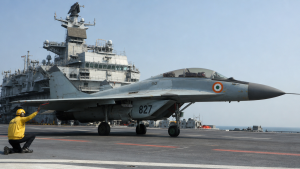
India’s naval aviation combines carrier-based fighters, maritime patrol aircraft, helicopters and unmanned platforms. Together, they support air defence, maritime surveillance, anti-submarine warfare, search and rescue, and the readiness of ships operating across the Indian Ocean Region.
Naval Fighter Aircraft
Carrier fighters protect naval formations and can conduct air-to-air combat, anti-ship strikes and ground attack missions. Carrier operations require aircraft and deck systems suited to short take-offs and arrested landings.
- MiG-29K: This Russian-origin, twin-engine, all-weather multirole fighter is the Indian Navy’s primary carrier-borne combat aircraft. It operates from INS Vikramaditya and INS Vikrant and forms the backbone of the Navy’s carrier fighter fleet.
- Roles and operating system: The MiG-29K can undertake air-to-air combat, anti-ship strikes and ground attack missions. It operates from India’s STOBAR carriers, using a ski-jump for launch and arresting wires for recovery.
- Rafale Marine (Rafale M): India has an agreement with France for 26 aircraft: 22 single-seat fighters and four twin-seat trainers. The French-origin aircraft is a twin-engine, canard-delta multirole fighter adapted for carrier operations.
- Naval adaptations: The Rafale M has reinforced landing gear, an arrestor hook and a launch-bar-equipped nose gear. These features distinguish the carrier version from land-based Rafales. Its capabilities include advanced avionics, electronic warfare systems and a range of weapon payloads.
Maritime Reconnaissance and Anti-Submarine Warfare Aircraft
Long-range patrol aircraft help monitor sea lanes, gather intelligence and track submarines over extensive maritime areas. Their sensors and weapons can support both surveillance and engagement.
- P-8I Neptune: This American-origin maritime reconnaissance and anti-submarine warfare aircraft is based on the Boeing 737 airframe. It is a key Indian Navy asset for surveillance across its areas of interest, including the Indian Ocean Region.
- Detection and engagement: The P-8I uses sensors, radars and sonobuoys to detect and track submarines. It can carry anti-ship missiles and torpedoes to engage surface and sub-surface targets.
- Dornier Do-228: These German-origin light transport aircraft support short-range maritime reconnaissance, coastal surveillance and search and rescue. They also perform communication and liaison duties.
- Equipment: Dornier aircraft can be fitted with basic surveillance radar and electro-optical/infrared (EO/IR) sensors, supporting coastal monitoring and other short-range tasks.
Naval Helicopters
Helicopters operate from shore bases and naval vessels, including frigates, destroyers and aircraft carriers. Their ability to deploy from ships makes them useful for fleet surveillance, submarine search, transport and rescue missions.
- Kamov Ka-31: This Russian-origin airborne early warning (AEW) helicopter uses radar to detect airborne and surface threats beyond the range of shipboard radars. It extends fleet surveillance and improves the situational awareness of commanders.
- Sea King Mk.42B/C: These British-origin helicopters perform anti-submarine warfare (ASW) and anti-surface vessel warfare (ASVW), as well as commando transport and search and rescue (SAR). The Mk.42B is configured for ASW and is equipped with dipping sonar and torpedoes.
- HAL Dhruv: The indigenously developed Advanced Light Helicopter (ALH) serves in maritime reconnaissance, SAR and utility roles. Its naval variant has an Automatic Flight Control System and is capable of ship-based operations.
- Chetak (Alouette III): This French-origin light utility helicopter is used for SAR, liaison and limited anti-submarine roles. It also serves as a primary helicopter trainer for Navy pilots.
- MH-60R Seahawk: The Indian Navy is acquiring these American-origin multirole helicopters for ASW, anti-surface warfare, SAR and naval gunfire support. Their induction is intended to replace the ageing Sea King fleet and upgrade rotary-wing capabilities.
Unmanned Aerial Vehicles
Unmanned aerial vehicles (UAVs) provide surveillance and reconnaissance without placing aircrew in potentially dangerous environments. Their ability to remain over an area can strengthen maritime monitoring and support target acquisition.
- Heron: These Israeli-origin medium-altitude, long-endurance UAVs are used for long-range maritime surveillance and intelligence gathering. They provide continuing situational awareness over large ocean areas.
- Future capability: The Navy is also looking at armed UAV versions for offensive capabilities; this is distinct from the surveillance and intelligence-gathering role of the Heron.
Operational Significance
Naval aviation links ships, shore facilities and airborne surveillance into a broader maritime capability. Its aircraft perform complementary tasks: fighters defend carrier groups, patrol aircraft cover large distances, helicopters extend ship-based operations, and UAVs provide persistent observation.
- Maritime surveillance: Long-range patrol aircraft and UAVs help monitor sea lanes and maritime areas of interest, while ship-based helicopters support local surveillance.
- Force readiness: Carrier fighters, airborne early warning and ASW platforms contribute to the protection and operational readiness of naval formations.
- Defence procurement: The fleet combines indigenous platforms such as HAL Dhruv with aircraft acquired from France, Russia, the United States, Germany, Israel and the United Kingdom.
- Carrier trials: The Shore Based Test Facility (SBTF) at INS Hansa, Goa, replicates a carrier ski-jump and arrested-landing deck for aviation trials. It supports testing before carrier operations.
Key Prelims Takeaways
- India operates STOBAR carriers: aircraft launch under their own power using a ski-jump and recover with deck arresting wires.
- The MiG-29K is the Indian Navy’s primary carrier-borne fighter; the Rafale M agreement covers 26 aircraft.
- The P-8I is a long-range maritime reconnaissance and ASW aircraft; the Dornier Do-228 supports short-range coastal surveillance.
- The Kamov Ka-31 provides airborne early warning, while Sea King helicopters perform ASW, ASVW and SAR roles.
- HAL Dhruv is an indigenously developed multirole helicopter; the Navy is acquiring MH-60R Seahawks.
- The SBTF at INS Hansa, Goa, replicates carrier launch and arrested-landing features for aviation trials.
Recent Context
On October 29, 2026, a Rafale Marine fighter made its first landing and take-off from INS Vikrant as part of trials for compatibility with the carrier’s STOBAR system. The Navy shared a video of the landing on October 30; shore-based testing had earlier taken place in Goa.
| Related | |
|---|---|