Important Communication Technologies Used in Defence
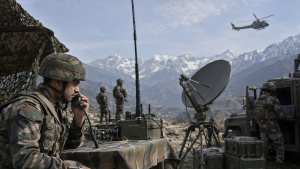
Defence communications connect personnel, platforms and command centres, enabling command and control, intelligence sharing and situational awareness. Systems range from radio and satellites to optical and acoustic links, each suited to different environments and operational needs. Secure, resilient connectivity is central to modern military operations.
Radio Frequency Communication
Radio frequency (RF) communication transmits information through electromagnetic waves and remains fundamental to tactical operations. It supports voice and data exchange among personnel, vehicles, aircraft and command elements. Performance depends on frequency, terrain, obstacles and the communication system used.
- High Frequency (HF): Can provide beyond-line-of-sight (BLOS) communication. Surface-wave propagation is useful for links over water, although data rates are generally limited.
- Very High Frequency (VHF): Covers 30–300 MHz and is used for tactical communication, including squad and convoy operations. It can provide effective range in relatively open, unobstructed terrain.
- Ultra High Frequency (UHF): Covers 300 MHz–3 GHz. Its shorter wavelengths can be useful in urban areas and among obstacles, depending on terrain and system design.
- Software-Defined Radios (SDRs): Support multiple waveforms and frequency bands, allowing forces to adapt communications to changing operational requirements.
RF links may face jamming, interference and interception. Encryption and frequency hopping help protect transmissions; RF over Fiber (RFoF) carries RF signals as light through optical fibre, reducing electromagnetic leakage and interference in suitable applications. Spectrum management is also important: military systems must use available frequencies efficiently while limiting interference and maintaining secure communications.
Satellite Communication
Satellite communication (SATCOM) provides BLOS connectivity where terrestrial networks are unavailable or geography limits direct links. It supports strategic command and control, surveillance-data transmission and remote operations across land, air and sea. Systems include satellites, ground stations, transponders and user terminals.
- Geosynchronous Earth Orbit (GEO): Satellites appear fixed relative to Earth and can provide broad, continuous coverage. Their orbital characteristics and infrastructure make them important for wide-area links, though satellites and ground systems may be vulnerable to attack.
- Medium Earth Orbit (MEO) and Low Earth Orbit (LEO): These orbits are used for different coverage and latency needs. LEO satellites operate closer to Earth and can provide lower-latency links, but their movement requires network coordination and tracking.
- High-Throughput Satellites (HTS): Increase capacity through techniques such as frequency reuse across multiple beams.
India’s dedicated military communication satellites include GSAT-7, GSAT-7A and the planned GSAT-7B. Launched in 2013, GSAT-7, also known as Project Rukmani, provides multi-band SATCOM in UHF, S, C and Ku bands for Indian Navy surface, subsurface and air assets. GSAT-7A serves the Indian Air Force. GSAT-7B is planned for the Indian Army to provide BLOS communication for troops, formations and weapon systems. Indigenous satellite capacity contributes to strategic autonomy and secure military communications.
Fiber Optic Communication
Fiber optic systems transmit data as light pulses through optical fibres. Total Internal Reflection guides the light along the fibre, making the technology suitable for high-capacity links within military networks.
- Operational advantages: High bandwidth, low signal loss over long distances and immunity to electromagnetic interference (EMI).
- Security: Fibre does not radiate electromagnetic signals in the way conventional electrical cables can, making interception more difficult.
- Uses: Terrestrial backbone networks, secure links in armoured vehicles, warship radar networks, missile guidance and transmission of high-resolution video or sensor data from unmanned aerial vehicles and ground-surveillance systems.
Fibre’s low weight and compact size are useful on aerospace and naval platforms. Physical cables, however, can be impractical for some mobile or remote links, making wireless alternatives important.
Free Space Optical Communication
Free Space Optical Communication (FSOC) transmits data as light through air, vacuum or space, rather than through a solid fibre cable. Lasers or LEDs carry signals along a line-of-sight path. A narrow optical beam is harder to intercept than a broad RF transmission and has favourable EMI characteristics compared with microwave links. FSOC systems can support full-duplex communication, allowing simultaneous two-way data transmission.
- Applications: High-speed links between platforms, drone communications and inter-satellite connections.
- Limitations: Terrestrial links may be disrupted by fog, precipitation, atmospheric absorption, beam dispersion and pointing instability caused by wind.
- Tracking: Maintaining alignment between terminals is especially demanding when one terminal is mounted on a moving platform.
FSOC can provide an alternative to vulnerable RF links or trailing fibre cables, but its effectiveness depends on maintaining a clear, stable optical path.
Emerging and Specialised Technologies
- Quantum communication: Quantum Key Distribution (QKD) uses quantum properties to establish encryption keys and can reveal attempts to intercept the key exchange. It is being explored for highly secure links, including satellite and tactical communications.
- Li-Fi: Uses visible light from LEDs or laser diodes to transmit data. Because light generally does not pass through walls, signals can be confined to a space, which can be useful in bunkers, submarines and drone-swarm coordination where RF use is restricted or vulnerable. DRDO is developing secure Li-Fi systems for defence.
- Underwater acoustic communication: Uses transducers to convert electrical signals into sound waves, since electromagnetic waves are severely limited underwater. It supports communication with submarines, Autonomous Underwater Vehicles (AUVs) and divers. Bandwidth is limited, propagation is slower, and temperature and salinity affect signal transmission.
Across these technologies, defence planners must balance security, coverage, capacity and resilience. Secure communications support effective command and control, while careful spectrum management reduces interference and competition for frequencies. Indigenous development of satellites, radios and optical systems can strengthen strategic autonomy and reduce dependence on external infrastructure.
Key Prelims Takeaways
- RF communication uses HF, VHF and UHF bands, each with distinct propagation characteristics.
- SDRs can support multiple waveforms and frequency bands.
- GEO, MEO and LEO satellites serve different coverage and latency requirements.
- GSAT-7 supports the Navy, GSAT-7A the Air Force, and the planned GSAT-7B the Army.
- Fibre optics offer high bandwidth and immunity to EMI; FSOC transmits light through air or space.
- QKD, Li-Fi and underwater acoustic links address specialised security and operational environments.
Recent Context
On November 23, 2026, DRDO awarded Pune-based olee.space an 18-month contract to develop an indigenous laser-link system for drones. It includes ground and airborne FSOC terminals with automatic Pointing, Acquisition, and Tracking (PAT), aiming to provide secure, high-speed, two-way communication without RF jamming or trailing fibre cables.
| Related | |
|---|---|