Applications of Artificial Intelligence in India’s Defence Sector
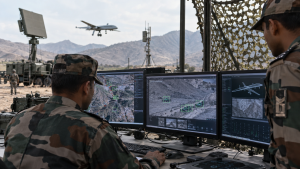
Artificial intelligence (AI) can help defence organisations process large volumes of information, monitor threats and support operational decisions. Its applications span surveillance, autonomous platforms, cybersecurity, logistics and command support, while raising questions about human oversight, accountability and responsible use.
AI Fundamentals and Surveillance
AI refers to computer systems performing tasks associated with human intelligence. In defence, its sub-fields include Machine Learning (ML), Deep Learning (DL), Natural Language Processing (NLP) and Computer Vision. They enable systems to learn from data, interpret language and analyse visual information. Their usefulness depends on the quality of data, the operational setting and appropriate human oversight.
- Image and video analytics: Computer Vision can help process satellite imagery and drone footage to identify patterns, track movement and flag anomalies for review.
- Pattern recognition: Algorithms can assist in recognising military equipment, troop formations and changes to infrastructure that may be difficult to identify across large volumes of imagery.
- Predictive intelligence: Models can analyse historical data alongside current information to help assess potential threats, adversary intentions and possible conflict hotspots. Such assessments are indicators, not certainties.
- Border surveillance: AI-assisted analysis can help personnel review information from surveillance systems and prioritise areas requiring attention.
Autonomous Systems and Counter-Drone Operations
AI can support the navigation and task execution of unmanned platforms, including in hazardous or difficult-to-access environments. Autonomy varies by system and task; it does not necessarily mean that a platform operates without human supervision.
- Unmanned Aerial Vehicles (UAVs): AI can support drone navigation, surveillance and reconnaissance, and help identify objects of interest. Some systems may perform tasks without continuous human input.
- Unmanned Ground Vehicles (UGVs) and Unmanned Underwater Vehicles (UUVs): These platforms can be used for reconnaissance, logistics support, demining and patrolling in hazardous environments.
- Swarm robotics: AI-enabled groups of drones or robots can coordinate tasks, including complex search-and-rescue operations. Their use in combat also raises questions about control and accountability.
- Counter-drone systems: AI can help detect and identify hostile drones and support their neutralisation through hard-kill or soft-kill measures.
Cybersecurity, Command and Decision Support
AI is a dual-use technology in cyberspace: it can strengthen defence against attacks, but can also be used to develop more sophisticated offensive tools. Military networks therefore require cybersecurity measures as well as clear responsibility for decisions made with AI assistance.
- Threat detection: Analysis of network traffic can help flag anomalous or malicious patterns, including those associated with malware or phishing.
- Automated response: Systems can help isolate compromised networks or address vulnerabilities more quickly. Responses need safeguards to avoid disrupting legitimate operations.
- Vulnerability assessment: AI tools can assist in scanning defence networks and identifying weaknesses that require remediation.
- Offensive cyber use: AI may enable more sophisticated or evasive cyberattack tools, increasing the need for resilient defences.
- Information fusion: AI can help combine intelligence feeds, sensor data and open-source information, giving decision-makers a more integrated operational picture.
- Decision support: Systems can compare possible courses of action, simulate outcomes and provide recommendations. Commanders retain responsibility for decisions, particularly where information is uncertain or consequences are significant.
Logistics, Maintenance and Responsible Use
AI applications extend beyond battlefield operations. They can assist with planning and equipment upkeep, helping defence organisations allocate resources and prepare for operational requirements.
- Supply chains: Forecasting demand for spare parts, ammunition and other supplies can support inventory planning and help reduce waste.
- Predictive maintenance: Analysis of sensor data from aircraft, vehicles and ships can help identify possible component failures before they occur, enabling proactive maintenance and reducing downtime.
- Resource allocation: AI can help allocate personnel, equipment and supplies in response to operational requirements and changing circumstances.
- Governance and accountability: Military modernisation using AI requires attention to human oversight, cybersecurity, data quality and responsibility for system-assisted decisions.
India’s Defence AI Initiatives
India’s defence AI framework includes bodies focused on strategic direction, project implementation and research, alongside initiatives supporting domestic innovation.
- Defence AI Council (DAIC): Established to provide strategic direction for AI adoption in defence.
- Defence AI Project Agency (DAIPA): Tasked with implementing AI projects within the Ministry of Defence.
- Centre for Artificial Intelligence and Robotics (CAIR): A DRDO laboratory focused on AI research and development for defence applications.
- Innovations for Defence Excellence (iDEX): Encourages startups and micro, small and medium enterprises (MSMEs) to develop indigenous defence solutions, including AI applications.
- Atmanirbhar Bharat Abhiyan: Promotes self-reliance in defence technology, including AI.
Key Prelims Takeaways
- Core sub-fields: Machine Learning, Deep Learning, Computer Vision and Natural Language Processing.
- Surveillance: AI can assist in imagery analysis, pattern recognition and threat assessment.
- Unmanned platforms: UAVs, UGVs and UUVs use AI for navigation and task support.
- Counter-drone role: AI can support detection, identification and neutralisation of hostile drones.
- Cybersecurity: AI can aid threat detection and vulnerability assessment, but also has offensive applications.
- Indian institutions: DAIC, DAIPA and CAIR have distinct strategic, implementation and research roles.
- Innovation: iDEX supports indigenous defence innovation, including AI solutions.
Recent Context
India test-fired the indigenous JWALA MK-1 at Pokhran, Rajasthan, on 23 November 2026. Developed by IG Defence, it is described as India’s first autonomous Counter-Unmanned Aircraft System (CUAS) micro-missile system, with a range of up to 5 kilometres. Its GRID AI platform manages threat detection through engagement; the hard-kill interceptor uses a dual-pulse solid rocket motor.
| Related | |
|---|---|