Important Diagnostic Tests and Drug-Resistance Detection Methods for Tuberculosis
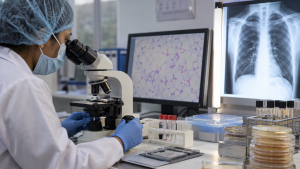
Tuberculosis (TB), caused by Mycobacterium tuberculosis, requires timely diagnosis to guide treatment and limit transmission. Tests range from microscopy and chest imaging to molecular assays and culture. Detecting drug resistance is also essential, particularly resistance to rifampicin, a key anti-TB medicine.
Understanding Tuberculosis
TB is an infectious disease that primarily affects the lungs, but it can also affect organs such as the kidneys, spine and brain. It spreads through the air when a person with TB coughs, sneezes or talks. It remains a major public health challenge, making accessible testing and appropriate treatment important for both patients and disease control.
Important Diagnostic Tests
Diagnostic methods serve different purposes: some help identify people who may have TB, while others detect the bacterium or support confirmation and treatment decisions.
- Frontline microscopy: Sputum smear microscopy examines a sample under a microscope for acid-fast bacilli (AFB), which include TB bacteria. It is a rapid, relatively low-cost test and forms part of the first tier of the diagnostic network. Its role is important where access to more advanced testing is limited.
- Chest X-rays: Imaging can reveal lung abnormalities that may indicate TB and is used in screening and proactive case finding. AI-enabled X-rays can support faster interpretation, but an abnormal image is a screening finding and should be considered alongside diagnostic testing.
- Nucleic acid amplification tests (NAATs): These molecular tests detect genetic material from TB bacteria and can provide results rapidly. More than 3 crore NAATs were conducted as part of the TB Mukt Bharat Abhiyaan.
- CBNAAT and GeneXpert MTB/RIF: The automated Cartridge-Based Nucleic Acid Amplification Test detects TB and can simultaneously identify rifampicin resistance, often within a few hours.
- TruNat: This rapid molecular test can detect TB and rifampicin resistance. CBNAAT and TruNat expand access to testing that can inform early treatment decisions.
- Culture tests: A patient sample is used to grow Mycobacterium tuberculosis in a laboratory. Culture is considered the gold standard for definitive diagnosis and can support further drug-susceptibility testing. Because bacterial growth takes time, results may take several weeks.
- Tuberculin Skin Test (TST): Also called the Mantoux test, it involves injecting tuberculin purified protein derivative (PPD) into the skin. A positive reaction indicates TB infection or exposure, but the test cannot distinguish latent infection from active disease. It may also be affected by prior BCG vaccination.
- Interferon-Gamma Release Assays (IGRAs): These blood tests measure the immune response to TB bacteria. They are more specific than the TST for detecting infection because BCG vaccination does not affect their results. Like the TST, an IGRA does not distinguish latent infection from active TB disease.
Detecting Drug Resistance
Drug-resistant TB, including multidrug-resistant TB (MDR-TB) and extensively drug-resistant TB (XDR-TB), can make treatment more difficult. Identifying resistance early helps clinicians choose an appropriate regimen and can reduce the risk of ineffective treatment and further transmission.
- Rapid molecular testing: CBNAAT and TruNat can detect rifampicin resistance alongside TB. Rifampicin resistance is an important marker of possible drug-resistant TB, including potential MDR-TB. A result can help prompt further assessment and timely treatment decisions.
- Line Probe Assays (LPAs): These molecular tests detect resistance to several first- and second-line anti-TB drugs, including rifampicin and isoniazid. They provide results faster than traditional culture-based drug-susceptibility testing.
- Phenotypic drug-susceptibility testing (DST): This method grows TB bacteria in the presence of anti-TB drugs and assesses whether the drugs inhibit their growth. Culture-based DST takes longer than rapid molecular tests but can provide a broader resistance profile.
India’s Diagnostic Network and Programme
India’s National TB Elimination Programme (NTEP), formerly the Revised National Tuberculosis Control Programme (RNTCP), operates across national, state, district and sub-district levels. Tuberculosis Units function at block level and form an important part of service delivery. The diagnostic network has three tiers, linking initial testing to advanced laboratory services and quality oversight.
- Frontline tier: Includes basic microscopy centres and rapid molecular testing facilities for initial diagnosis.
- Intermediate tier: Reference and culture laboratories conduct culture testing and more advanced drug-susceptibility testing, and serve as referral centres.
- National tier: National Reference Laboratories provide quality assurance, training and policy guidance for the diagnostic network.
Public Health Priorities
NTEP measures include proactive case finding, AI-enabled X-rays and rapid diagnostics. Nutritional and community support are also part of the response: Ni-kshay Poshan Yojana provides nutritional support to TB patients, while Ni-kshay Mitra encourages community support for them. Domestic resources meet 96% of the TB programme’s funding requirements. These measures also highlight continuing implementation issues. Diagnostic capacity depends on accessible frontline testing and effective links to intermediate and national laboratories. Rapid detection of resistance is important to address antimicrobial resistance, while access to health technology—including molecular tests and AI-enabled imaging—must extend across the diagnostic network.
Key Prelims Takeaways
- Causative agent: Mycobacterium tuberculosis; transmission is airborne.
- Microscopy: Frontline sputum testing detects AFB.
- Rapid tests: CBNAAT and TruNat detect TB and rifampicin resistance.
- Culture: The gold standard for definitive diagnosis; it also supports DST.
- Infection tests: TST and IGRA do not distinguish latent infection from active disease.
- NTEP network: Frontline, intermediate reference and culture labs, and National Reference Laboratories.
Recent Context
India did not meet its 2025 TB elimination target. The WHO Global Tuberculosis Report 2026 recorded a 38% fall in Indian TB deaths between 2015 and 2025, but India still accounted for about 25% of global cases and 23% of deaths in 2025.
| Related | |
|---|---|