Major International Sanctions and Economic Restrictions
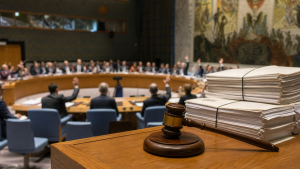
International sanctions are coercive foreign policy tools used by governments and multilateral bodies to change the behaviour of states, entities, or individuals without resorting to armed conflict.
Introduction to International Sanctions
Sanctions are broadly of two types:
- Unilateral Sanctions: Imposed by a single country to protect its national security interests. The United States and Japan frequently use this mechanism.
- Multilateral Sanctions: Coordinated by several nations or international bodies. The United Nations and the European Union use them to enforce international law.
Types of Sanctions and Economic Restriction Mechanisms
Economic restriction mechanisms target different sectors of a country’s economy.
Trade Embargoes
- These measures restrict the import or export of specific goods, services, or technologies.
- A comprehensive trade embargo bans all commercial activity with a target country.
- An arms embargo restricts the supply of weapons, military equipment, and dual-use technologies.
Financial Sanctions
- These restrictions block target entities from accessing global financial markets.
- Asset freezes prevent designated individuals or governments from accessing funds held in foreign banks.
- Capital controls limit foreign direct investment and prevent the target from raising debt or equity in global markets.
Sectoral Sanctions
- These policies target key industries that generate state revenue.
- Energy sanctions restrict the purchase of oil, natural gas, and coal from the target state.
- Mining and mineral sanctions block trade in gold, diamonds, and precious metals.
Targeted or Smart Sanctions
- These measures focus on specific individuals, elites, or military leaders rather than entire populations.
- Asset freezes lock personal bank accounts of targeted oligarchs and officials.
- Travel bans prevent listed individuals from entering or transiting through sanctioning jurisdictions.
Secondary Sanctions
- These measures penalize third-party individuals or countries that do business with a primary sanctioned target.
- They force foreign entities to choose between trading with the sanctioned country or retaining access to the sanctioning country’s market.
- The United States frequently uses this mechanism to enforce its foreign policy globally.
Legal and Institutional Frameworks
Various international laws and agencies govern sanctions regimes.
United Nations Security Council (UNSC)
- The legal basis for UN sanctions resides in Article 41 of Chapter VII of the UN Charter.
- Article 41 allows the UNSC to decide on measures not involving the use of armed force.
- These measures can include the complete or partial interruption of economic relations, communications, and the severance of diplomatic relations.
- Decisions made under Chapter VII are legally binding on all UN member states under Article 25.
US Office of Foreign Assets Control (OFAC)
- OFAC is an agency under the United States Department of the Treasury.
- It administers and enforces US economic and trade sanctions based on US foreign policy and national security goals.
- OFAC maintains the Specially Designated Nationals and Blocked Persons List (SDN List).
- Individuals and businesses on the SDN List have their assets blocked, and US citizens are prohibited from dealing with them.
Countering America’s Adversaries Through Sanctions Act (CAATSA)
- CAATSA is a United States federal law enacted in August 2017.
- It imposes sanctions on Iran, North Korea, and Russia.
- Section 231 of CAATSA targets entities engaging in transactions with the defense or intelligence sectors of the Russian Federation.
- It carries consequences for third-party nations purchasing military hardware from Russia, such as procurement of defense equipment.
Financial Exclusion Mechanisms
Global banking and payment systems are major instruments for enforcing financial restrictions.
- SWIFT Exclusion: The Society for Worldwide Interbank Financial Telecommunication (SWIFT) is a secure messaging network that facilitates global financial transactions. Disconnecting a country’s banks from SWIFT prevents them from sending or receiving money across borders.
- Central Bank Asset Freezes: Sanctioning coalitions can freeze the foreign exchange reserves of a target country’s central bank. This prevents the target nation from using its international reserves to defend its currency.
- Correspondent Banking Restrictions: Regulators can prohibit domestic banks from maintaining correspondent accounts for foreign financial institutions, cutting off access to major currencies like the USD or Euro.
Comparative Table of Key Sanctions Regimes
| Target | Imposing Authority | Key Legal Basis / Mechanism | Primary Focus |
| Iran | US (OFAC), UN, EU | CAATSA, Joint Comprehensive Plan of Action (JCPOA) fallback | Banking, oil exports, nuclear program development |
| Russia | US, EU, UK, G7 coalition | Executive Orders, EU Council Regulations | Central Bank reserves, SWIFT ban, G7 crude oil price cap |
| North Korea | United Nations Security Council | UNSC Resolutions (e.g., Resolution 1718, 2270) | Arms embargo, mineral exports, luxury goods, banking restrictions |
| Cuba | United States | Trading with the Enemy Act, Helms-Burton Act | Comprehensive trade and financial embargo |
| Venezuela | US, EU | Executive Orders targeting state agencies | Oil sector, gold trading, state-owned enterprise PDVSA |
Sanctions Circumvention and Alternative Financial Mechanisms
Target states often adopt defensive economic strategies to bypass sanctions networks.
De-dollarization
- Nations reduce their reliance on the USD in bilateral trade.
- Governments promote international trade using local currencies or alternative reserve currencies, such as the Chinese Renminbi.
Alternative Financial Messaging Networks
- SPFS (System for Transfer of Financial Messages): Developed by the Central Bank of Russia as an alternative to SWIFT.
- CIPS (Cross-Border Interbank Payment System): Developed by China to clear international transactions in Renminbi.
- SFMS (Structured Financial Messaging System): Used internally within India, and can link to international systems for secure messaging.
Barter Trade and Local Currency Swaps
- Countries engage in direct currency swaps to settle trade balances without using international clearinghouses.
- Barter arrangements, such as trading agricultural products for energy resources, bypass banking systems.
- The Rupee-Ruble mechanism is an example used for clearing trade balances between India and Russia.
Cryptocurrencies and Digital Currencies
- Decentralized blockchain technologies allow peer-to-peer value transfer without reliance on correspondent banks.
- Central Bank Digital Currencies (CBDCs), like the digital Yuan, facilitate cross-border payments outside the traditional financial system.
Historical Developments in International Sanctions
- First UN Sanctions: The UN Security Council imposed its first mandatory sanctions under Article 41 against Southern Rhodesia in 1966.
- The Trading with the Enemy Act (1917): A US federal law giving the President the power to oversee or restrict trade between the US and its enemies in times of war. This law serves as the foundation for the current US embargo on Cuba.
- Post-9/11 Shift: After the September 11 terrorist attacks, the international community shifted from comprehensive nation-wide embargoes to targeted financial sanctions to limit humanitarian impact on civilians.
Impact of Sanctions on Global Economy and Trade
- Supply Chain Disruptions: Sanctions on major commodity exporters lead to shortages and price inflation in energy, food, and industrial metals.
- Fragmentation of Global Finance: Frequent use of financial exclusions encourages parallel banking structures and non-Western currency trade.
- Compliance Burden: Global corporations must navigate overlapping regulatory regimes to avoid heavy penalties from agencies like OFAC, often leading to over-compliance.
Recent Context
OFAC granted ONGC a licence to resume full oil-field operations in Venezuela through ONGC Videsh Ltd. The move also allows recovery of frozen dividends linked to Venezuelan projects.
Rare Facts for Prelims
- Article 41: It is the UN Charter provision specifically used for non-military coercive measures.
- SDN List: A person or entity on this list is effectively cut off from most US-linked financial dealings.
- SWIFT: It is not a payment system itself, but a messaging network used by banks to communicate payment instructions.
- PDVSA: It is one of the most sanctioned state oil companies in the world due to Venezuela’s political and financial restrictions.
- Southern Rhodesia: It was the first case where the UNSC used mandatory sanctions under Chapter VII.
- CAATSA Section 231: It is widely known for enabling sanctions on major defence transactions with Russia.
Current General Studies comprises current-affairs-based, General Studies-rich study material on policies, laws, institutions, economy, science, environment, governance, international relations, and other varied but important topics for UPSC and State PSC Prelims examinations.
Fortnightly PDF compilations: Available here
Originally written on
August 18, 2026
and last modified on
August 17, 2026.
| Related | |
|---|---|