Sustainable Mining and Mine-Closure Framework in India
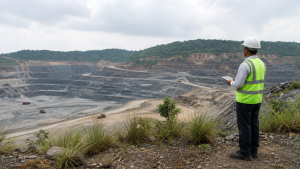
India’s sustainable mining framework seeks to balance mineral extraction with land restoration, community welfare, and long-term ecological stability. Mine closure is now treated as a planned regulatory stage, not an afterthought.
Sustainable Mining in India: Core Concepts
Mining is a critical sector for industrial development and energy security. However, resource extraction causes land degradation, biodiversity loss, and ecological imbalance. Sustainable mining aims to balance economic mineral extraction with environmental protection and social equity. This approach requires systematic planning from exploration to the final stage of land rehabilitation.
The Mines and Minerals (Development and Regulation) Act, 1957 (MMDR Act) serves as the primary statutory foundation for mining in India. Under the National Mineral Policy, miners must restore the leased area to an acceptable ecological condition. The guiding principle is that miners must leave the extraction site in a better environmental state than they found it.
The Mine Closure Regulatory Architecture
Mine closure is an active process of restoring degraded land to a productive state. In India, mine closure planning is a mandatory part of the overall mining plan. The Ministry of Coal oversees the execution of closure guidelines for coal and lignite blocks, while the Ministry of Mines regulates non-coal minerals.
Progressive and Final Mine Closure Plans
Every mine operator must submit a comprehensive Mine Closure Plan (MCP) at the inception stage of the project. The closure process is divided into two distinct parts:
- Progressive Mine Closure Plan (PMCP): This plan covers activities carried out concurrently during the active life of the mine. It includes annual land reclamation, afforestation, water management, and pollution control measures.
- Final Mine Closure Plan (FMCP): This plan is executed at the end of the operational life of the mine. It focuses on decommissioning machinery, dismantling structures, sealing mine entries, and managing the socio-economic transition of local communities.
Key Regulatory Revisions
The Ministry of Coal first issued detailed Mine Closure guidelines in August 2009. The government updated these guidelines in 2013, 2020, and most recently via an Office Memorandum dated January 31, 2025.
The Coal Controller’s Organisation (CCO) is the nodal body that certifies successful mine closures. Third-party institutions like the Central Mine Planning and Design Institute (CMPDI), CSIR-NEERI, and IIEST Shibpur perform independent verification before the release of financial security deposits.
The Modern Era: AAROH and Repurposing Frameworks
In July 2026, the Ministry of Coal released AAROH: Annual Report on Mine Closure. This publication documents the successful scientific closure of 42 coal mines across India. The report serves as a national knowledge repository to guide future rehabilitation initiatives.
To systematize the transition from active mining to post-mining land use, India utilizes several specialized frameworks:
RECLAIM Framework
The RECLAIM (Reach Out, Envision, Co-create, Localize, Act, Integrate, and Maintain) framework is a community-centric model. It provides standardized steps to engage local communities in decision-making during the closure phase.
L.I.V.E.S. Framework
The L.I.V.E.S. (Livelihood, Inclusion, Value, Environment, and Sustainability) framework guides the eco-restoration of mined-out areas. It ensures that the transition protects regional economic stability and improves environmental quality.
SUVIKALP Mine Repurposing Tool
SUVIKALP is an interactive digital decision-support tool. It assists project proponents in identifying viable post-mining land uses based on regional parameters and community priorities. The tool evaluates more than 35 repurposing options, including:
- Pumped Hydro Energy Storage
- Floating Solar PV installations
- Eco-Parks and Botanical Gardens
- Agroforestry and Aquaculture centers
Progressive versus Final Mine Closure
| Feature | Progressive Mine Closure Plan (PMCP) | Final Mine Closure Plan (FMCP) |
| Execution Timing | Carried out concurrently during active mining operations. | Carried out when mineral reserves are exhausted or operations cease. |
| Primary Focus | Concurrent reclamation, waste dump stabilization, and green belt development. | Decommissioning of machinery, safe sealing of mine openings, and land repurposing. |
| Funding Source | Funded as an operational expenditure from regular corporate revenue. | Funded through a dedicated escrow account managed by the Coal Controller. |
| Plan Submission | Submitted as part of the initial Mining Plan. | Submitted 2 to 5 years before the scheduled closure of the mine. |
| Community Impact | Continuous monitoring of air, water, and local environmental health. | Long-term livelihood transition, vocational training, and asset handovers. |
International Cooperation and Local Initiatives
India has expanded its technical capacity through bilateral partnerships to align its mining sector with global standards:
- India-Germany Technical Cooperation: In July 2026, the Ministry of Coal signed an Implementation Agreement with Germany’s GIZ. This project has a budget of EUR 10 million co-financed by the European Union. It runs until 2030 and focuses on technical cooperation for “to-be-closed” mines.
- Coal NEER Plants: This initiative focuses on converting mine discharge water into safe drinking water for surrounding communities.
- Jharia Rehabilitation Project: Tripartite Memoranda of Understanding have been signed to support vocational training and rehabilitation in Jharia coalfield areas.
Recent Context
The Ministry of Mines has also moved toward organized mineral trading through a regulated electronic exchange. The first phase covers iron ore, limestone, manganese, and bauxite, with price discovery and delivery-based contracts.
The final Mineral Exchange Rules, 2026 were notified on June 30, 2026, and the Indian Bureau of Mines will supervise the platform.
Rare Facts for Prelims
- Major minerals are regulated centrally under the MMDR Act, while minor minerals are largely administered by states.
- Minor minerals include building stones, ordinary clay, and ordinary sand used for stowing.
- IBM is a subordinate office under the Ministry of Mines, not a statutory body.
- Mine closure planning is required from the project’s inception, not only at the end of mining.
- Financial security deposits are linked to closure compliance and are released only after verification.
- Anti-cartel safeguards are a key feature of the new mineral exchange framework to improve market transparency.
| Related | |
|---|---|